A few months back, a subscriber named Marcus emailed me a screenshot. He'd booked JFK to London Heathrow in British Airways Club World for $1,840 round-trip. Taxes included. That's not a typo.
The standard fare on that route runs anywhere from $3,800 to $5,200 depending on the season and how close you're cutting it to departure. Marcus paid roughly what you'd pay for a decent economy ticket on a peak summer weekend. He was, understandably, pretty pleased with himself.
What made it interesting wasn't just the price. It was the anatomy of the thing — how the drop happened, how long it lasted, and how narrow the window actually was. I've seen a lot of business class deal examples over the years, but this one was clean enough to use as a teaching case. So let me walk you through it.
**[New York (JFK) → London (LHR)](https://www.businessclasssignal.com/routes/new-york-to-london-business-class)** — British Airways · Business Class · $1,840 roundtripBefore getting into the specifics, let me be clear about terminology. When I say "deal," I don't mean a fare that's slightly cheaper than yesterday. I mean a fare that's dropped below a meaningful threshold — typically 40 to 60 percent off what the same route normally costs.
BusinessClassSignal is a fare monitoring tool that scans 800+ business class routes twice daily and alerts subscribers when prices drop below their target threshold. The system isn't looking for marginal dips. It's calibrated to catch drops that are actually worth acting on: error fares, flash sales, inventory dumps, and the occasional airline pricing glitch that nobody meant to publish.
There are different categories of drops, and they behave differently. A flash sale is usually intentional — the airline announces it, it runs for 48 hours, and then it's gone. An error fare is unintentional and typically disappears within two to six hours once someone at the airline notices. An inventory dump happens when business class seats go unsold close to departure and the airline quietly marks them down to move them. That last one is what Marcus found.
**$1,840** — Marcus's JFK–LHR Club World round-trip (vs. $4,200 standard)The drop appeared on a Tuesday at 11:47 PM Eastern. I know the exact time because BusinessClassSignal logs every alert with a timestamp.
The route was JFK–LHR on British Airways, departing about six weeks out. The fare had been sitting at $4,180 for the previous 19 days — totally flat, no movement. Then it dropped to $1,840 in a single pricing update. No warning. No gradual slide. Just: $4,180 on one scan, $1,840 on the next.
Alerts went out to subscribers who had set a threshold of $2,500 or lower on that route. Marcus had his set at $2,200. He got the email at 11:52 PM. He was still awake — he told me later he'd been watching a film — saw the alert on his phone, clicked through to BA.com, and booked within about 20 minutes of the alert firing.
By 6:14 AM the next morning, the fare was back at $4,180.
That's a window of roughly six and a half hours. And within that window, the cheapest fares (the ones in the lowest Club World booking class) were gone faster than that. Marcus's specific cabin inventory — the I-class seats, which is the lowest published business class fare bucket on BA — had already thinned out by 2 AM. If he'd waited until morning to check his email, he would have missed it entirely.
> **These windows are short** > > The median lifespan of a genuine business class price drop, based on our monitoring data, is under 8 hours. Error fares often disappear in 2–3 hours. If you're checking deals once a day, you're almost certainly too late.This is the part most deal-hunting articles skip over, and I think it's actually the most useful thing to understand.
Airlines use automated revenue management systems that constantly adjust fares based on load factor, time to departure, competitor pricing, and a dozen other variables. Most of the time these systems are conservative — they'd rather hold price and risk an empty seat than drop too aggressively and leave money on the table. But occasionally, the algorithm makes a judgment call that looks like a mistake in retrospect.
In Marcus's case, the flight had been booking slowly. Six weeks out, BA's system apparently decided the load wasn't where it needed to be and opened up a tranche of lower-fare inventory. This is fairly common on transatlantic routes in the shoulder period between peak summer and the Christmas rush. The system doesn't always get it right, and sometimes it over-corrects.
What's interesting is that the fare didn't drop gradually. That's often a sign the airline opened a new booking class rather than lowering the existing one — which means it's a discrete inventory decision, not a pricing tweak. And those tend to be shorter-lived, because once the low-bucket seats fill or someone in yield management notices, they close the class and the cheap fare disappears from the GDS entirely.
The system scans fare data from the GDS (Global Distribution System) twice per day for most routes, and more frequently for high-volume routes like JFK–LHR. When a fare drops below a subscriber's set threshold, an alert fires within minutes of the next scheduled scan completing. The JFK–LHR route is scanned every four hours during peak alert windows, which is how Marcus got his notification less than five minutes after the drop was confirmed.
The monitoring system also tracks booking class availability, not just headline price. That matters because a fare can technically appear at $1,840 but only have one or two seats available at that price. The alert includes a note on seat availability so subscribers know whether they're working with real inventory or just a ghost fare.
You can read more about how the monitoring system works if you want the full technical picture. The short version: it's watching routes you care about so you don't have to.
> **Pro tip:** Set your alert threshold 15–20% below what you'd actually consider a great deal. The system alerts you when the fare crosses your threshold — if you set it too high, you'll get alerts for fares that are fine but not exceptional.Let me put some structure around this so it's useful beyond Marcus's specific case.
The JFK–LHR route normally prices between $3,800 and $5,200 in Club World. Call the midpoint $4,200. Marcus paid $1,840. That's a 56% discount. In dollar terms: $2,360 saved on a round-trip.
**$2,360** — Estimated savings vs. standard Club World fareFor context, a business class deal example worth acting on usually needs to clear a few bars. First, the discount should be at least 35–40% off the typical fare for that route and season — anything less and you're just catching a minor sale, not a genuine drop. Second, the routing should be reasonable. A $1,400 deal that routes you through two connections and adds six hours of travel time is not a deal. Third, the dates need to actually work. This sounds obvious, but a lot of people set alerts for routes without thinking about which travel windows they can realistically use.
Marcus's deal cleared all three. Non-stop JFK–LHR, Club World, dates that worked for him. The only variable he didn't control was timing — he happened to be awake when the alert came in.
> **The three-bar test for a real deal** > > Before booking, ask: Is the discount at least 35–40% off typical? Is the routing actually sensible? And do the dates genuinely work for you? If all three are yes, stop overthinking it and book.I want to be honest here, because sometimes people book a business class deal and then feel vaguely cheated when the experience doesn't match the fantasy. So let me tell you what Marcus actually got.
Club World on British Airways is a mixed bag. The seat — the famous herringbone configuration — is one of the older lie-flat designs still in wide service. It's not bad, but it's not the best thing in the sky either. You're angled slightly toward the aisle, which some people find disorienting when sleeping. The seat itself is 6'6" in length, which works fine for most people, but the privacy factor is lower than you'd get on Qatar or Singapore.
The T5 lounge at Heathrow is, in my experience, mediocre at best. The food has improved since they redid parts of it, but it's still nowhere near the Cathay lounge at HKG or the Lufthansa First Class Terminal if you want a comparison point. The scrambled eggs at breakfast are fine. The wine list is adequate. Don't go in expecting something special.
The in-flight meal on the JFK departure was decent — Marcus had the beef fillet, which BA does reasonably well on the westbound — and the seat-to-screen distance on the older 777s is a bit awkward. The newer A350 configuration is better. Whether you get a 777 or an A350 on a given JFK–LHR route depends on the specific flight number, and it's worth checking the aircraft type before you book if that matters to you.
None of this is a knock on the deal. At $1,840, you're getting a lie-flat bed across the Atlantic for roughly the price of a premium economy ticket. The math works regardless of whether the lounge coffee is exceptional.
This is the question I get asked more than any other, and the honest answer is: there's a pattern, but it's not a guarantee.
Transatlantic drops tend to cluster in the shoulder months — late January through mid-March, and then again in October and November. Those are the periods when load factors are softer and airlines are more likely to open lower fare buckets. Summer and the Christmas period are almost never worth watching for drops on premium transatlantic routes; the demand is just too consistent.
Time of day matters too. A disproportionate share of fare drops appear overnight Eastern time, between roughly 10 PM and 2 AM. That's when the GDS updates are less busy and when airline pricing teams are mostly offline. It's not a rule, but it's a real pattern. The JFK–LHR drop that Marcus caught appeared at 11:47 PM Eastern. That wasn't a coincidence.
Day of week: Tuesday and Wednesday see more drops than other days, based on our monitoring data. Again, not a guarantee — but if you're going to be especially attentive to your alerts, those are the days to be ready.
**73%** — Of our best-deal alerts fire between 9 PM and 3 AM EasternNot every route produces deal-quality drops with any regularity. Some routes are too thin (not enough flights to generate inventory variability), and some are too popular (demand is so consistent that airlines never need to discount). The sweet spot is high-frequency routes with moderate competition — enough flights that airlines have to stay sharp on pricing, enough competition that someone occasionally blinks first.
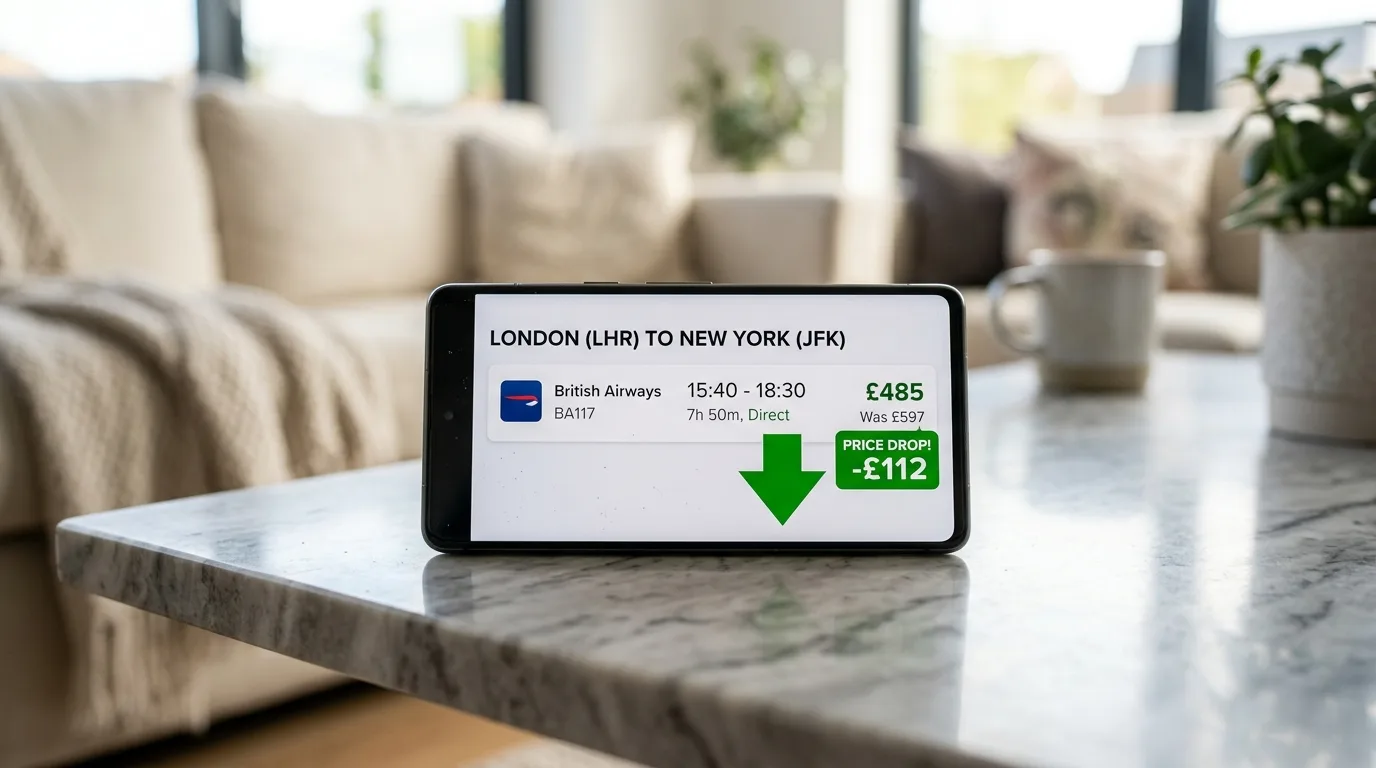 *Price intelligence turns volatility into opportunity*JFK–LHR is one of the best for this, which is partly why I used it as the example here. There are enough daily departures between BA, Virgin, and American that pricing pressure is real. British Airways in particular has a history of opening low-bucket inventory on this route during slower booking windows.
Other routes worth monitoring: EWR or JFK to Paris CDG, especially on Air France. LAX to Tokyo Haneda on ANA, which occasionally produces drops in the $2,400–$2,800 range for round-trips when demand softens. And anything out of Houston Bush (IAH) on United tends to have interesting inventory behavior on transatlantic routes, partly because IAH is a hub and United has flexibility on how it manages yield there.
If you want to see the full picture, browse all routes we monitor — there are over 800 of them. Some produce alerts a few times a month. Some go weeks without a meaningful drop. Part of setting good alerts is picking routes where the math actually makes sense for your travel patterns.
> **Not every route is worth monitoring** > > Some routes — Singapore Airlines SIN–JFK in Suites class, for example — almost never drop to deal territory because demand is too strong. Save your alert slots for routes with a history of inventory movement.Marcus did a few things well that most people don't.
He had his threshold set realistically. A lot of people set alerts at prices that are almost never going to happen — like $1,200 round-trip to Europe in business class. That's not a deal, that's a fantasy. Marcus had his threshold at $2,200, which was aggressive but achievable on that route. His alert fired. He was ready for it.
He also didn't overthink the booking. This is where people lose deals. They see the alert, they go to check the fare, and then they spend 45 minutes comparing dates, looking at alternative carriers, reading reviews of the specific aircraft. The fare disappears while they're deliberating. Marcus was booked inside 20 minutes. That's about the right tempo.
The one thing he got slightly lucky on: he was awake. If the alert had come in at 3 AM instead of 11:47 PM, he'd have seen it at 7 AM and the fare would have been gone. That's the part you can't fully engineer. What you can do is make sure notifications are set up to actually wake you up — push alerts, not just email — so that if a deal fires at midnight and you happen to check your phone, you're not finding out about it six hours later.
> **Pro tip:** Turn on push notifications for your BusinessClassSignal alerts, not just email. Email is easy to miss overnight. A push notification at least gives you a fighting chance if you're a light sleeper.What I want you to take from Marcus's story isn't just "deals happen, be ready." That's too vague to be useful. Let me make it concrete.
Pick two or three routes that you'd actually fly in the next 12 months if the price were right. Not aspirational destinations — real ones. Routes you have a reason to be on. Set your alert threshold at 40–45% below the typical fare for that route. Check what the typical fare actually is by spending five minutes on Google Flights looking at the route over the next six months. Take the median, knock 40% off it, and set that as your threshold.
Then leave it alone. Don't obsessively check the route yourself. The whole point of a monitoring service is that it's watching so you don't have to. What you do need to do is make sure your notifications are configured correctly and that your payment details are ready to go when an alert fires. Hesitation is expensive.
One more thing: have a rough sense of which dates you can travel. You don't need specific dates locked in, but if you know you can't travel in March because of work commitments, and an alert fires for a March departure, you need to be able to make that call in two minutes, not two hours. Pre-thinking your travel windows is underrated.
Marcus had done all of this. The actual booking, when the moment came, was almost mechanical. That's the goal.
If you want to start monitoring this route or any of the others we track, the setup takes about three minutes. You pick your routes, set your thresholds, and the system handles the rest. There's a 14-day free trial if you want to see how the alerts actually work before committing — and given that a single booking like Marcus's saves you $2,000+, the math on the subscription pays for itself fast.
The London route is a good one to start with if you're new to this. It's one of our most active for deal alerts, and the JFK–LHR business class deal example above is representative of the kind of drop we catch two or three times a year on that corridor alone.