# Etihad vs Qatar Airways Business Class
- Canonical URL: https://www.businessclasssignal.com/blog/etihad-vs-qatar-business-class
- Author: Steve Hamilton
- Published: 2026-10-26
- Updated: 2026-11-22
- Tags: comparison, etihad, qatar-airways
- Publisher: BusinessClassSignal (https://www.businessclasssignal.com)
> Qatar's QSuite is still the best business class product in the sky on the routes where it flies.
> **Quick summary**
>
> Qatar's QSuite is still the best business class product in the sky on the routes where it flies. Etihad's Business Studio is genuinely good — better than most people give it credit for — but it's a different experience, and the right choice depends heavily on your route, your travel dates, and what you actually value in a seat. This article breaks down where each airline wins, where each one disappoints, and how to think about pricing from the US.
The honest version of this comparison
I've seen a hundred "Etihad vs Qatar business class" posts. Most of them read like the airlines wrote them. So let me just tell you what I've found after flying both carriers multiple times across different aircraft, different routes, and different years.
Qatar is the better product on paper. QSuite deserves its reputation. But Etihad is not the consolation prize people make it out to be, and on certain routes — especially if you're connecting through Abu Dhabi — it can be the smarter call. The pricing difference alone sometimes settles the argument before you even get to seat specs.
What each product actually is
What is Qatar QSuite, exactly?
QSuite is Qatar Airways' flagship business class cabin, introduced in 2017 and still operating on the airline's Boeing 777 and most Airbus A350 fleet. The seat itself is a 1-2-1 configuration in a herringbone layout, but what makes it stand out is the double suite option — two center seats can be joined together with a shared surface and closing privacy panels. Qatar calls it the "world's first double bed in business class" and while that's marketing language, the actual execution is impressive.
The suite walls are genuinely tall. The door closes. You can have a full meal with the person next to you, or you can close everything off and feel completely alone at 38,000 feet. The bed is flat, long enough for most people up to around 6'2", and the mattress pad is good enough that I've slept better in QSuite than in some hotels.
**76 inches** — QSuite lie-flat bed length
The IFE screen is large (around 21 inches on most aircraft), the Wi-Fi is actually usable — not fast, but functional — and the food quality is consistently above average for airline food, which is a low bar but Qatar clears it by more than most.
What QSuite is not: available on every Qatar aircraft. This is the thing that trips people up. If you book Qatar business class and don't specifically verify the equipment, you might end up on an older 777 or an A320 regional configuration that has nothing to do with QSuite. Always check the aircraft type before booking.
> **Check your equipment**
>
> Qatar's older Boeing 777 variants and some A321 routes still operate non-QSuite cabins. Before you pay a premium for Qatar business class, verify on the seat map that your specific flight is running QSuite-equipped aircraft. SeatGuru and the Qatar booking flow itself will usually show you.
What is Etihad Business Studio?
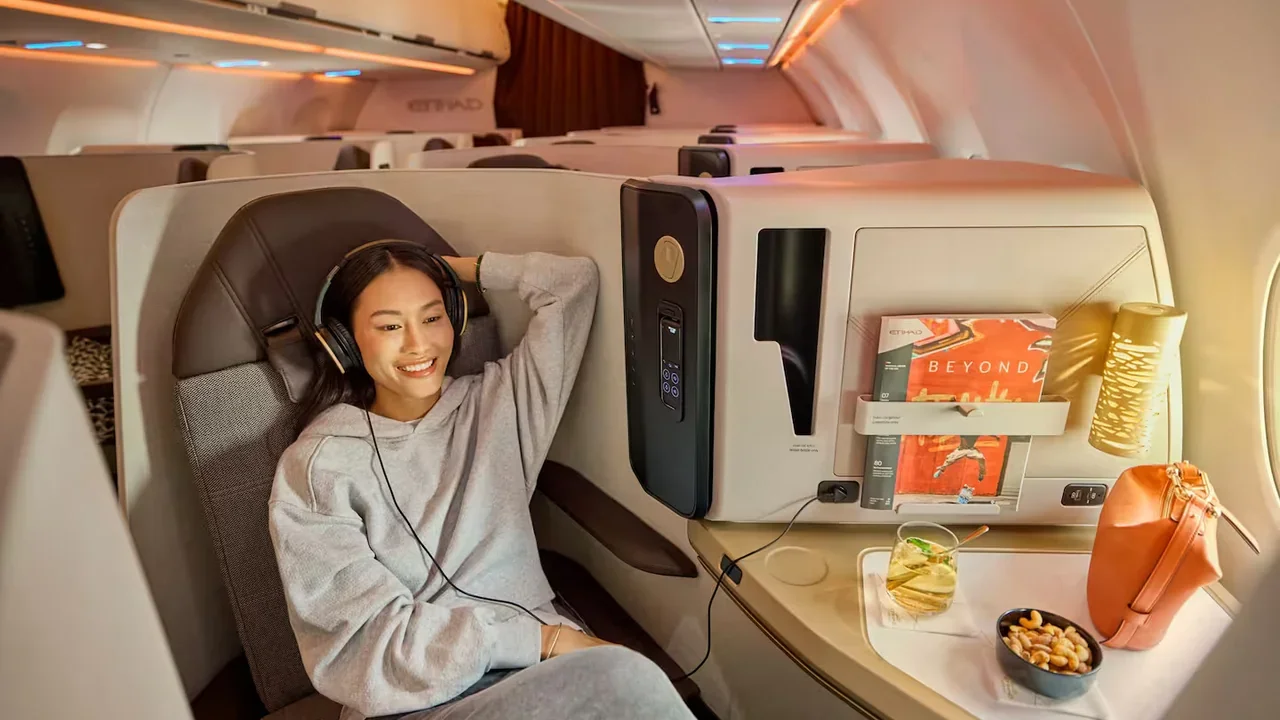
Business Studio is Etihad Airways' current business class product, flying on their A380 upper deck, Boeing 787 Dreamliner, and most A350 routes. It's a 1-2-1 layout (on the 787 and A350) with fully flat beds, a decent-sized IFE screen, and direct aisle access from every seat.
The seat shell is smaller than QSuite. There's no door. The privacy screen is shorter and doesn't give you the same cocoon feeling. But the seat itself is comfortable — the bed is genuinely flat, the padding is good, and the 787's cabin humidity and pressure make overnight flights noticeably more comfortable than older aircraft.
What Etihad does particularly well: service. The crew-to-passenger ratio in business tends to be higher than on Qatar, and in my experience the service has been more personal and less scripted. That's a subjective thing, but it's something I hear from other frequent flyers consistently.
The food on Etihad is hit or miss depending on the route. Abu Dhabi to London is solid. Some of the US routes I've tried have been less impressive. The lounge situation at AUH (Abu Dhabi) is something I'll get into separately because it deserves its own conversation.
The seat-by-seat breakdown
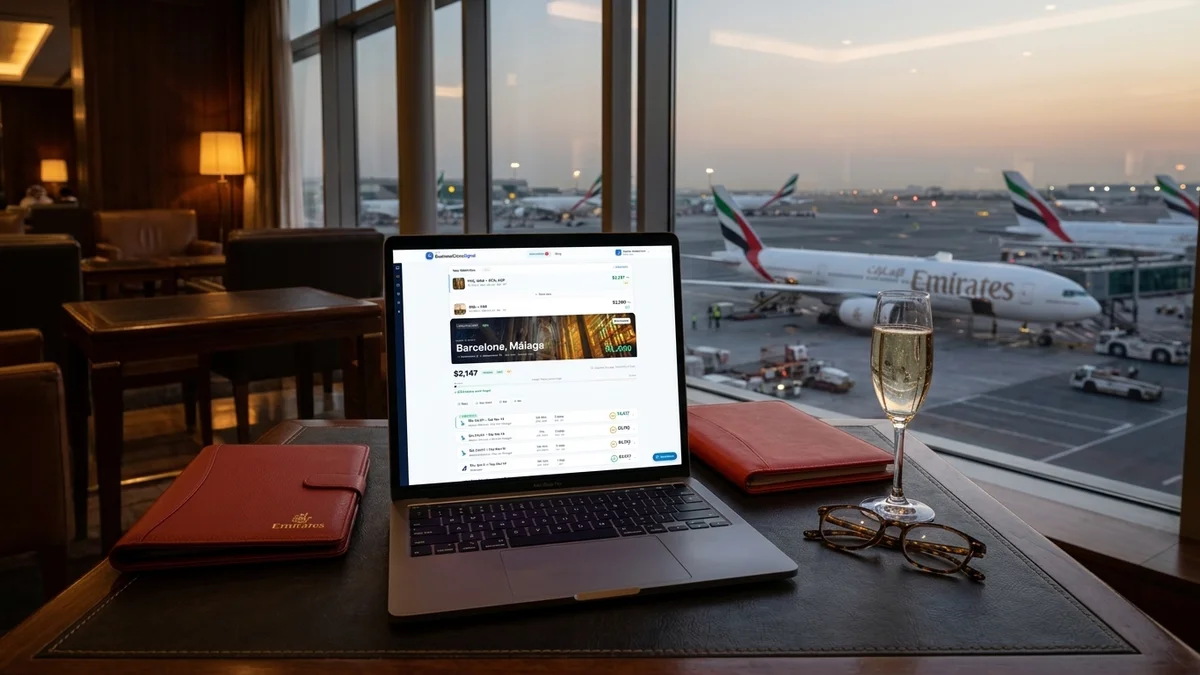
*Track fares across multiple airlines simultaneously*
Let me be direct here rather than hedging everything.
**QSuite wins on privacy.** It's not close. The door, the height of the dividers, the ability to close yourself off completely — if you're someone who values sleeping undisturbed or working without feeling exposed, QSuite is better. Full stop.
**Business Studio wins on the 787.** Etihad's 787 Dreamliner cabin is one of the more pleasant places to spend a long-haul night. The larger windows, the lower cabin altitude, the dimming glass — it adds up. Qatar doesn't fly 787s on most of its routes, so this isn't always a direct comparison, but if you're sensitive to how aircraft pressure and humidity affect how you arrive, it matters.
On the A350, it's closer. Qatar's A350 QSuite is excellent. Etihad's A350 Business Studio is comfortable but less private. If you're on an A350 and privacy is your priority, Qatar wins.
> **Pro tip:** On Etihad's 787, seat 2A or 2K gives you direct aisle access and you're far enough from the galley that you won't get the cart noise. Avoid row 11 on the same aircraft — it's right by the rear galley.
The window seats on Etihad (A and K on the 787) are the most private seats in the cabin by default, since you've only got one neighbor direction. On QSuite, even the window seats feel enclosed because of the suite design. Different solutions to the same problem.
Hub experience: Abu Dhabi vs Doha
This is where the comparison gets more interesting and where most articles gloss over the details.
Is the Hamad International lounge actually better than Abu Dhabi?
Yes. But with caveats.
Hamad International Airport in Doha (DOH) is genuinely one of the better airports to connect through. The Qatar Airways Al Mourjan Business Lounge is large, well-stocked, has decent food (the mezze spread is legitimately good), and the shower rooms are plentiful enough that you can usually get one without waiting more than 15 minutes. The airport itself is easy to navigate, the gates are close to the lounge, and connections under 90 minutes are usually manageable.
The downside: DOH gets crowded. Qatar flies a lot of metal and the lounge fills up during peak connection windows. I've been in Al Mourjan at 7am when it was standing room only near the buffet. The food quality also varies — on a good day it's excellent, on a bad day it's indifferent hotel breakfast energy.
Abu Dhabi's Etihad Lounge (the one at AUH Terminal 3) is smaller and, honestly, less impressive overall. The food is fine but not memorable. The showers are good. The bar is adequate. What AUH has going for it is the US Customs and Border Protection pre-clearance facility — if you're flying to certain US cities (including New York JFK, Washington Dulles, Chicago O'Hare, Dallas, and others), you clear US immigration in Abu Dhabi before you board. You land in the US as a domestic arrival.
That's a genuinely useful thing. Landing at JFK as a domestic arrival — skipping the immigration hall entirely — is worth something real, especially after a long overnight flight when you're tired and you just want to get out.
> **US pre-clearance at AUH**
>
> Etihad's Abu Dhabi hub offers US Customs pre-clearance, meaning you arrive in the US as a domestic passenger. On a busy JFK arrival morning, this can save you 45-90 minutes. If your final destination is one of the pre-clearance cities, this is a genuine advantage worth factoring into your routing decision.
Etihad vs Qatar business class pricing from the US
This is where things get practical. Because all the seat comparisons in the world don't matter if one airline is charging $3,800 round-trip and the other is at $2,100.
From the US East Coast, Qatar generally prices its transatlantic business class higher than Etihad, especially on peak dates. A round-trip JFK-London in business on Qatar will often run $3,200–$4,500 at normal fares. Etihad's JFK-London via Abu Dhabi route typically comes in $400–$900 cheaper on the same dates — and drops further when Etihad runs one of its periodic sales.
**$2,147** — Avg. Etihad business class round-trip, JFK to London (via AUH)
**$3,400** — Avg. Qatar business class round-trip, JFK to London (via DOH)
From the US West Coast, the picture changes a bit. LAX or SFO to Southeast Asia or Australia — routes where Qatar has strong positioning through DOH — tends to price Qatar competitively. Etihad's AUH connection adds time to a westbound routing from LA, so the convenience math shifts.
**[New York (JFK) → London (LHR)](https://www.businessclasssignal.com/routes/new-york-to-london-business-class)** — Etihad Airways · Business Class · $2,200 roundtrip
**[New York (JFK) → London (LHR)](https://www.businessclasssignal.com/routes/new-york-to-london-business-class)** — Qatar Airways · Business Class · $3,400 roundtrip
The gap closes when Qatar drops fares. Qatar does run sale fares, and when they do, QSuite at $2,400 round-trip from the East Coast is one of the better values in premium travel. These sales don't last long — often 48-72 hours — and they're not well-publicized. This is exactly the kind of thing the monitoring system at BusinessClassSignal is built to catch: a Qatar QSuite fare dropping below your target threshold on your specific route.
Which airline is better for award tickets?
Both airlines are Oneworld members, which means Qatar flies on the Oneworld alliance. Etihad is not in any alliance — it's a standalone program with its own Etihad Guest miles and transfer partnerships.
For redeeming points, Qatar is generally the more useful option for US-based travelers because of American Airlines' partnership. You can book Qatar QSuite using American AAdvantage miles — though availability is notoriously tight and the program has gotten stingier over the years. When space opens up, it's 70,000 miles one-way from the US to Europe, which is a strong redemption if you can find it.
Etihad Guest miles can be earned and transferred from Amex Membership Rewards, Chase, and Citi. Etihad's own award space is more accessible than Qatar's — they tend to release more business class seats to their own program. The rates are reasonable: around 50,000–55,000 Etihad Guest miles for a US-to-Europe business class one-way. The program doesn't get as much attention as it deserves.
> **Award space tip**
>
> Etihad tends to open last-minute award space (within 7-14 days of departure) more frequently than Qatar. If you're flexible on dates and willing to wait, monitoring Etihad award availability in the final two weeks before travel can turn up solid redemptions.
What the lounges are actually like day-to-day
*Dining quality varies significantly between carriers*
I want to spend a moment on this because lounge quality affects your overall experience more than people account for when comparing airlines.
At DOH, the Al Mourjan Lounge is Qatar's main business class space. The design is genuinely good — high ceilings, natural light in parts, a la carte dining with a proper menu (the lamb ouzi is worth ordering if it's on). There are quiet zones and livelier areas. The bar is well-stocked. But the lounge is also heavily used and can feel chaotic during peak hours. I've been there when the noise level made it genuinely hard to work.
The new Qatar Premium Terminal, which opened in 2023 and is reserved for first class and Platinum/Gold Privilege Club members, is a different story entirely — but that's not accessible to standard business class passengers on most fares.
At AUH, Etihad's business lounge is more modest. The food is decent but not distinctive. The Etihad Lounge does have a spa area with Timeless Spa treatments if you want to book ahead — a 15-minute neck and shoulder massage before a long flight is something I've done and would do again. The lounge is quieter than Al Mourjan on most days, which I've come to appreciate more than I expected.
One specific thing worth knowing about AUH Terminal 3: the walk from the lounge to some gates is long. Longer than it looks on the map. Give yourself more time than you think you need for connections.
> **Pro tip:** If you're transiting AUH with under 90 minutes and need to clear US pre-clearance, head to the CBP facility immediately after you land. Don't stop at the lounge. The queue can build quickly on busy morning departure banks and you don't want to be the person who misses the pre-clearance window.
The honest verdict on service quality
Service is subjective and variable, and I'm always a bit skeptical of sweeping claims about any airline's crew. I've had great Qatar flights and mediocre ones. Same with Etihad. Any given flight depends on the specific crew.
That said, there are patterns. Qatar's service tends to be more formal and structured. The pre-takeoff drink is offered promptly, the meal service follows a specific sequence, and the crew is attentive in a professional way. Sometimes it can feel a little regimented — like excellent service delivered by people who've been very thoroughly trained to deliver excellent service.
Etihad's crew, in my experience across maybe a dozen segments, has tended to feel slightly more relaxed and personable. The service isn't less attentive — it's just warmer in tone. I've had better conversations on Etihad than on Qatar. Whether that matters to you depends on what you want from a long-haul flight.
The food quality edge goes to Qatar on most routes, particularly the signature dishes and the Arabic mezze options. Etihad's catering is good but less consistent. The bread basket on Etihad is genuinely excellent, which is a specific thing that I mention because it sounds trivial but it isn't when you're at hour seven of a flight.
So which one should you actually book?
Here's how I'd think about it.
Book Qatar QSuite if: privacy matters most to you, you're traveling with a partner and want the double suite option, you're going eastbound through the Gulf to Southeast Asia or Australia, and the price difference is under $600 round-trip compared to Etihad.
Book Etihad Business Studio if: you're price-sensitive and Etihad is running $800+ cheaper on your dates, you're flying on the 787 and care about aircraft comfort, you value the US pre-clearance at AUH, or you're redeeming points and Etihad award space is more available on your dates.
The pricing gap is the thing that genuinely moves the needle for most people. A $1,500 difference on a round-trip is hard to argue away by pointing at seat door privacy. But a $400 difference? That's when the QSuite starts to make real sense.
Browse current business class routes on both carriers and you'll see the spread varies significantly by departure city and time of year. January and February tend to be the cheapest months for both airlines on transatlantic routes. Summer is expensive. The shoulder seasons (April-May, September-October) are where I've found the best combination of price and availability.
If you want to watch for the fare drops specifically, that's exactly what BusinessClassSignal monitors for you — it scans your target routes twice daily and alerts you when either airline drops below your price threshold. I built the monitoring system around this specific use case: catching the 48-72 hour sale windows when Qatar or Etihad briefly prices business class at levels you'd actually pay.
**48 hrs** — Average duration of Etihad / Qatar flash sale windows
A few things neither airline tells you
Qatar's QSuite middle seats (D and G in the center section) are the best seats in the cabin if you're traveling solo and want the full suite experience. The window seats are fine, but the center suites feel more enclosed. This is counterintuitive and most people don't realize it until they've flown both.
Etihad's A380 upper deck business class (which still operates on some routes, including AUH-LHR) uses a different seat than Business Studio — it's an older product that's less impressive than the 787 or A350 version. If you care about the seat, check which aircraft is operating your specific flight. An A380 Etihad business class product is not the same as what you'd get on a 787.
On both airlines, the experience degrades noticeably on shorter segments. A 3-hour DOH-BKK flight in QSuite is fine, but the full meal service gets compressed and the lie-flat time is minimal. The products are really designed for 7-14 hour flights.
And one more thing: both airlines can and do change aircraft on routes with relatively little notice. I've seen Etihad swap a 787 for an A320 on a route I was monitoring. If your seat assignment matters to you, recheck the equipment a week before departure.
Check the Qatar Airways page and the Etihad Airways page on this site for current route coverage and fare history on both carriers — it's the fastest way to see where each airline has been pricing and where the gaps are opening up.