I'll be honest: I spent years booking full business class itineraries out of habit more than logic. JFK to Singapore, connecting through Heathrow or Frankfurt, business class on every segment. It felt cleaner, more consistent. One booking, one experience.
Then I started actually thinking about what I was buying.
The transatlantic or transpacific leg — that's the one where the flat bed matters. That's the 8, 10, 12-hour stretch where the difference between a $4,500 ticket and an $800 ticket is the ability to sleep horizontally and arrive functional. But that 90-minute hop from, say, Edinburgh to London Heathrow before the long-haul departs? You're going to be in that seat for maybe 70 minutes of actual flight time. The business class cabin on a short-haul BA or Lufthansa regional flight is often just economy with a blocked middle seat and a slightly better biscuit. Paying a $600–$900 premium for that is hard to justify.
The math shifts dramatically when you start treating the legs differently. And once you've built a few mixed-cabin itineraries, the all-business-all-the-way approach starts looking like something you do when you're spending someone else's money.
**30–50%** — Typical savings vs. full business class bookingA mixed-cabin itinerary is exactly what it sounds like: you fly different classes on different legs of the same trip. The most common version is economy on a short connecting flight, business class on the long-haul segment. But it can also mean business class on the outbound (when you need to arrive rested) and economy on the return (when you have a few days to recover and the ticket back is half the price).
What it is not is a compromise. When it's planned well, you're not sacrificing anything on the legs where comfort matters. You're just not paying for a premium experience you won't notice on a 45-minute flight.
Airlines do offer mixed-cabin tickets themselves, but their versions are usually priced awkwardly — you end up paying close to full business class fare for the whole itinerary with a downgrade on one leg. The smarter play, and the one most experienced travelers use, is booking the legs separately.
Separate tickets mean separate bookings, separate confirmation numbers, and separate baggage check-ins. That last part trips people up. If you're flying economy from Manchester to Heathrow on a BA domestic ticket, then connecting to a Cathay Pacific business class flight to Hong Kong, Cathay isn't going to check your bags through from Manchester. You'll need to collect them at Heathrow and re-check.
At T3, that's manageable. At some other airports, it's a genuine pain. Factor in the time.
The bigger risk is the missed connection. When you book through a single carrier or alliance on one ticket, they're responsible for getting you on the next flight if something goes wrong. When you book separately, you're on your own. A delay on your economy leg that causes you to miss your business class departure is your problem, not theirs.
> **Buffer time matters** > > Build at least 2.5–3 hours of connection time when your legs are on separate tickets. At major hubs like Heathrow, Frankfurt, or Dubai, 90 minutes feels like plenty until it isn't. I've been burned by a 2-hour buffer at LHR T3 when a BA domestic flight came in late and the bags took forever. The Cathay flight waited for nobody.That said, the financial upside is real enough that most experienced travelers accept this tradeoff. You just need to build your itinerary with eyes open.
It varies a lot by route and timing, but the numbers I've seen consistently across five-plus years of monitoring fares are meaningful. A round-trip in business class from New York to Tokyo, booked as a single itinerary connecting through Los Angeles, might run $5,800–$7,200 depending on the carrier and timing. Book the LAX-NRT-LAX legs in business class only (skipping the JFK-LAX domestic segments or flying them in economy), and you're often looking at $3,400–$4,500 for the long-haul portion, plus $180–$300 for the domestic legs in economy.
**$1,800+** — Estimated savings on a mixed-cabin NYC–Tokyo bookingOn a Europe trip, the savings are smaller in absolute terms but often proportionally similar. Flying economy into Heathrow from a domestic US hub, then picking up a business class fare to Rome or Athens or Istanbul, can easily save $800–$1,200 compared to booking business class on the full itinerary from your home airport.
**[New York (JFK) → London (LHR)](https://www.businessclasssignal.com/routes/new-york-to-london-business-class)** — British Airways · Business Class · $2,200 roundtripThe routes where mixed-cabin itineraries make the most sense are the ones where the connection hub has genuinely good business class inventory on the long-haul leg but the domestic or short-haul feeder is expensive or thin. United's Polaris product on transpacific routes, for example, often has more accessible pricing when you're originating at the hub (IAH, ORD, EWR) than when you're booking the whole thing from a smaller US city. Same logic applies to Lufthansa ex-Frankfurt or Emirates ex-Dubai.
The framework I use is simple: if the flight is under 3 hours, economy is fine unless you're already exhausted or connecting immediately to something important. Over 5 hours, business class is worth serious consideration. Between 3 and 5 hours, it depends on the time of day, whether there's a flat bed, and what the price gap looks like.
Red-eye flights change the math. A 4-hour overnight flight in a reclined-but-not-flat seat is genuinely worse than a 4-hour daytime flight in economy. If you're flying overnight and need to function the next morning, the bed matters more than the duration suggests.
The outbound vs. return question is worth thinking through too. Arriving rested at your destination is usually more valuable than arriving rested back home. At home, you can sleep in your own bed. At your destination, you might have a meeting at 9am or a connection to a smaller city. I've started defaulting to: business class on the outbound, economy on the return if the prices are dramatically different. It's not always the right call, but it's a useful starting point.
> **Pro tip:** Check the return fare independently before committing. Sometimes the business class return is actually cheap enough that the mixed-cabin premium is minimal. Other times it's double the outbound. You won't know until you look.This is where most people get stuck. Monitoring two separate fares, on potentially different airlines, through different booking channels, is genuinely more work than booking a single itinerary. The tools you use matter.
For the business class leg, BusinessClassSignal monitors 800+ routes twice daily and sends you an alert when the price drops below whatever threshold you've set. You tell it the route, the airline if you have a preference, and your target price. It watches it for you. I've seen fares on routes like London to Singapore or New York to Tokyo drop by $1,200–$1,800 in a 24–72 hour window before bouncing back. If you're not watching daily, you miss those. The full list of monitored routes covers most of the major long-haul corridors.
For the economy leg, the monitoring problem is different — you're looking at a much higher volume of routes and carriers, and the price movements are faster and more volatile. I've been pointing readers toward FlightKitten for exactly this. It does for economy fares what BusinessClassSignal does for business class — watches 220+ airlines and alerts you when prices fall below your target. It's $4.99 a month and genuinely useful when you're building a mixed-cabin itinerary and need both sides monitored simultaneously.
The combination of the two tools means you're not sitting there refreshing Google Flights every day. You set your targets, go live your life, and get notified when either leg hits your number.
This is the question I get more than any other. The honest answer is: it's less predictable than people want it to be, but there are patterns.
The clearest pattern I've tracked over the years is the 6–10 week window before departure. Airlines have usually sold their advance-purchase premium inventory by then, and they're looking at what's left in the cabin. If it's not filling, revenue management systems start releasing lower fare buckets. Not always, and not on every route, but often enough that this window is worth watching closely.
The second pattern is mid-week releases. Tuesday and Wednesday, particularly in the afternoon US Eastern time, is when a lot of fare adjustments happen. I've seen this enough times that it feels reliable, though I'd never tell you to count on it.
January and February are historically soft months for transatlantic business class, after the holiday rush clears. September is often softer on transpacific routes once the summer travel wave is done. These are generalizations, but they've held up reasonably well across the routes I monitor.
What I'd actually recommend: set up monitoring on your target route six months out and let it run. You'll see the fare history build up, which tells you whether the current price is high, low, or middling for that route. That context is worth more than any rule of thumb.
> **Fare history is your friend** > > BusinessClassSignal shows you a price history graph for each monitored route. Before you book, look at where the current fare sits relative to the last 90 days. If it's near the bottom of the range, that's a signal. If it's near the top, it might be worth waiting — or setting a lower alert threshold.A few things I've noticed that don't show up in the standard travel advice:
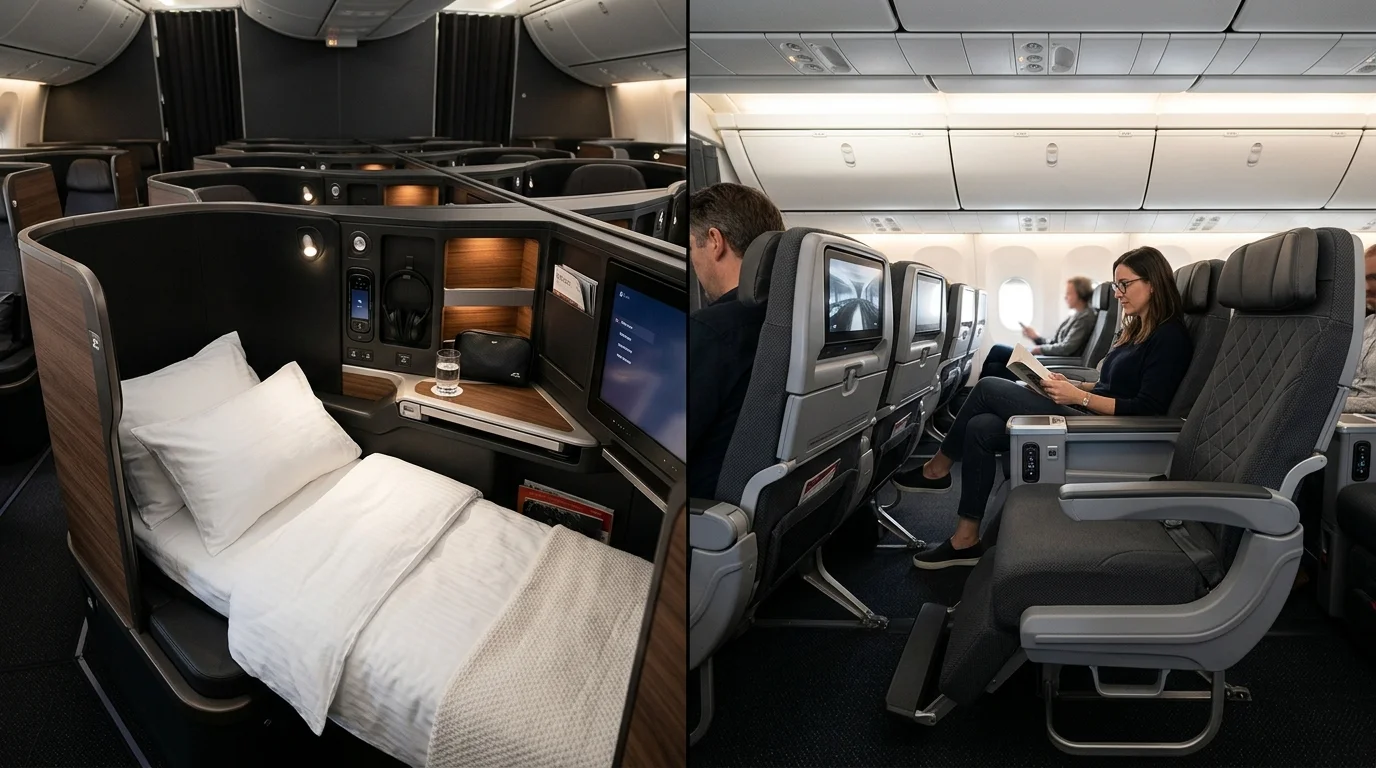 *A mixed-cabin strategy can save 40% while still getting lie-flat on the longest leg*Lufthansa is one of the better options for mixed-cabin itineraries originating in Europe. Their business class from Frankfurt to the US or Asia is a solid product — the new Allegris seat is genuinely good — and booking ex-FRA often yields better pricing than booking the full itinerary from a smaller European city. A cheap Ryanair or EasyJet flight into Frankfurt, then a Lufthansa business class long-haul, is a legitimate strategy. Just mind the terminal (Ryanair uses T2, Lufthansa uses T1 and T2 depending on the flight) and give yourself time.
Emirates is worth flagging for the Dubai hub. Their economy on short-haul regional routes (Dubai to Muscat, Dubai to Beirut, etc.) is fine. The A380 business class on the long-haul is still one of the better products in the sky, especially the upper deck. If you're flying from South Asia to Europe or the US and connecting through Dubai, flying economy on the short regional leg and picking up Emirates business ex-DXB is a well-worn approach among frequent flyers.
United's Polaris is genuinely good on the 777-300ER and the newer 787-9 configuration. But it's wildly inconsistent — the 767 seats they still fly on some transatlantic routes are narrow and not fully flat. If you're building a mixed-cabin itinerary around a United business class segment, check the equipment before you book. A 767 in "business class" at $3,200 is not the same product as the 777-300ER at the same price.
On British Airways: their Club World product is aging, the new Club Suite is only on some aircraft, and the T5 lounges at Heathrow are overcrowded most of the time. The Galleries First lounge (accessible if you're on a First ticket, or occasionally with a same-day upgrade) is meaningfully better — quieter, better food, the eggs Benedict are actually decent. The standard Club lounge coffee has been mediocre every single time I've been in there. That's not a dealbreaker, but it's worth knowing if you're arriving early and planning to eat.
A few things that make the actual execution easier:
Book the economy leg first. It's the more volatile price, and if you lock in the business class long-haul and then find the economy feeder has jumped 40%, the math changes. Get the cheap leg secured, then hunt for the business class deal.
Keep your booking references somewhere accessible. When you're checking in at Manchester for the economy leg to Heathrow, the agent doesn't see your Cathay booking. You need to have that information ready for when you re-check at T3. Obvious, maybe, but I've watched people fumble this at the check-in counter.
Status helps here. If you have elite status with an airline or alliance, your checked bag allowance on the economy leg is often elevated. On a mixed-cabin itinerary where the legs are on separate tickets, you don't automatically get the business class baggage allowance to apply to the economy leg. Check each ticket's rules independently.
> **Pro tip:** If your economy leg and business class leg are on the same airline or alliance, call the airline and ask if they can link the bookings. Not all will, and it doesn't always work, but when it does, it gives you some protection if the first flight delays.Airport lounge access is another variable. Your business class ticket typically comes with lounge access at the departure airport for that flight. But if you're landing from an economy flight and have a few hours before your business class departure, check whether your business class ticket grants you lounge access from the moment you land. Many do, if you're departing from the same terminal or airport that day. Emirates, Qatar, and Singapore Airlines are generally good about this. Some carriers are stingier. Worth a 5-minute call to confirm before you spend three hours in a terminal food court.
I want to be fair about this. There are situations where trying to split the booking actually costs you more or creates enough stress that it's not worth it.
Short trips — 3 nights or fewer — are harder to justify the complexity for. The savings are real, but the operational overhead (two check-ins, the baggage logistics, the connection anxiety) feels heavier when the total trip is brief.
If you're traveling with children or elderly family members, the risk of a missed connection on separate tickets becomes less acceptable. The buffer time you'd need to make it safe often reduces the schedule flexibility that made the cheap economy fare attractive in the first place.
And sometimes the all-in business class fare is just genuinely competitive. This happens more than people expect, especially on routes that BusinessClassSignal tracks with strong sale frequency. I've seen round-trip business class fares from the US to Europe drop to $1,800–$2,200 during sale windows — at that price, the mixed-cabin math stops looking clever and starts looking like extra work for minimal gain.
**$1,800** — Lowest round-trip business class fares we've tracked, JFK–LHRThe point of building a mixed-cabin itinerary is to spend money where it buys you something real. When the full business class fare is already reasonable, just book the full business class fare.
Here's the workflow I'd suggest if you're building a mixed-cabin itinerary from scratch:
Start with the long-haul business class leg. Go to BusinessClassSignal's route list, find your origin-destination pair, and set an alert at 15–20% below the current fare. That's usually aggressive enough to catch a genuine drop without being so low that you never get an alert. If you're flexible on dates by even a few days, set alerts across multiple date ranges — fares vary significantly by day of week and week of month.
Then set up the economy monitoring for the feeder or return leg. FlightKitten's fare wizard walks you through it in a few minutes — you enter the route, your target price, and your date range, and it starts watching. The two systems running in parallel means you're covered on both sides without checking manually.
When one leg hits your target, book it. Don't wait for the other leg to also hit your target simultaneously. That's a coordination problem that will cause you to miss both deals. Book the leg that hits first, then adjust your target on the remaining leg if needed.
This whole approach requires a bit more active management than a single booking, but the savings justify it on most long-haul trips. I've built probably 40 or 50 mixed-cabin itineraries this way over the years, and the average saving compared to a full business class itinerary has been well over $1,000 per trip.