Quick summary
Not all airports treat business class passengers equally. Some have genuinely excellent lounges, fast connections, and dedicated infrastructure that makes the premium experience feel worth the price. Others are just expensive airports with a slightly nicer carpet. This article covers eight airports where the business class experience is consistently strong — based on 12 years of actually passing through them.
Why the airport matters more than people think
You can book the best seat on the best airline and still have a miserable time if you're connecting through a chaotic hub with a mediocre lounge and a 40-minute bus transfer to your gate. The airport is half the business class experience. Maybe more than half.
I've flown through most of the world's major hubs enough times to have real opinions about them. Some airports have invested seriously in the infrastructure that premium passengers care about — fast security, dedicated lounges that are actually good, short walks to gates, real food that doesn't taste like it was made in a catering factory. Others are coasting on reputation.
The eight airports below are the ones where I'd genuinely choose to connect through if I had options, or where the departure experience alone makes the trip feel worth starting.
Hamad International, Doha (DOH)
Doha's Hamad International is the one airport I'd nominate if someone forced me to pick a single best airport for business class passengers. It's not a perfect airport — the walk to some gates is genuinely brutal, and the Al Mourjan lounge can get crowded during the late-night bank of departures — but the overall product is exceptional.The Al Mourjan Business Lounge is the showpiece. It's enormous, well-staffed, and the food is legitimately good. Hot mezze, carved lamb, fresh juices. There's a garden area with natural light which sounds gimmicky until you've spent a night there and realized how much it helps. The showers are fast to book and the rooms are clean. They also have a swimming pool, which I've never actually used but which exists.
Qatar Airways runs the show here, and they've built the entire airport around their premium passengers. The dedicated business class check-in and immigration lanes work. The buggy service to distant gates is available and actually shows up. And if you're flying QSuites — which you should be at least once — the onboard product picks up exactly where the lounge leaves off.Al Mourjan timing tip
If you're connecting through DOH on a late-night arrival, the lounge empties significantly between about 2am and 4am local time. That's the window to grab a shower room without waiting.
One honest note: the airside transit hotel is decent but not cheap, and if your connection is under three hours, you won't have time to use the pool or the hotel anyway. DOH rewards long layovers. A tight 90-minute connection here is fine operationally, but you won't get to enjoy any of it.
Changi Airport, Singapore (SIN)
Singapore Airlines' SilverKris Business Class Lounge in Terminal 3 is genuinely one of the better airline lounges in the world. The satay counter alone is worth a mention — they grill it to order, and it's not some sad approximation of Singaporean food. It's the real thing. The champagne selection is better than most, and the seating areas are actually designed for rest, not just for people-watching.
The Jewel complex is technically landside, but if you're arriving with time before your departure, it's worth the detour. The waterfall is one of those things that photographs better than it experiences, but the food hall is genuinely useful.
My one complaint about Changi for business class: the lounge situation is less strong if you're flying a non-oneworld, non-Star Alliance carrier. Priority Pass options exist, but they're not the same level. If you're on SQ or a Star Alliance partner, you're in great shape. Otherwise, manage expectations.
Hong Kong International (HKG)
Hong Kong has had a rough few years for obvious reasons, but as an airport for business class passengers, it remains one of the best-designed hubs I've ever used. The layout is logical, the transit is fast, and Cathay Pacific's The Pier Business Class lounge is among the finest I've sat in.The Pier has a noodle bar. Fresh, hot, made to order. After a red-eye, this is not a small thing. The seating is divided into zones — dining, working, rest — and it actually works as divided space rather than just being one open room with different furniture. The showers are excellent and there's a spa area for longer connections.
Cathay's been through a lot of turbulence (the real kind and the financial kind), and the product has had some inconsistencies, but at HKG specifically, the ground experience is still strong. The airport itself is fast to navigate — they've invested in automated immigration, and the train to the city is one of the cleanest and most efficient airport rail links anywhere.
If you're connecting at HKG on Cathay, ask at check-in about The Pier vs. The Wing lounges. The Pier Business lounge is generally considered the better of the two, and it's worth the slightly longer walk from the gate.
Incheon International, Seoul (ICN)
Incheon doesn't get talked about enough in discussions about the best airports for business class, and I'm not sure why. It's genuinely excellent. Korean Air and Asiana both operate premium lounges here that punch well above average, and the airport itself is a model of efficiency.The Korean Air Prestige Class lounge in Terminal 2 has a proper Korean food section — not just bibimbap and calling it a day, but jeon, japchae, doenjang jjigae. Real food. The lounge is large enough that it rarely feels crowded, and the shower suites are among the cleanest I've encountered anywhere.
Transit through ICN is also notable because the airport runs a free city tour for passengers with long layovers. I've done the Gyeongbokgung Palace tour. It's three hours, leaves from the transit hotel area, and it's free. That's remarkable. No other airport in this list offers anything close to that.
ICN transit tours
Free transit tours of Seoul run multiple times daily for passengers connecting through Incheon. You need a minimum of about 5 hours to do it comfortably. Worth it if you haven't been to Seoul.
The one caveat: if you're not on Korean Air or Asiana, the lounge options are thinner. The airport is excellent; the lounge situation depends heavily on your carrier.
Istanbul Airport (IST)
Istanbul's new airport is one of the most ambitious airport builds of the last decade, and for business class passengers, IST delivers in ways that surprised me the first time I connected there.
Turkish Airlines operates what they call the Turkish Airlines Lounge, and it is, without exaggeration, the largest airline lounge in the world. Around 53,000 square feet. It has a cinema, a golf simulator, a sleep room, a library, and a live cooking station that serves genuine Turkish food — gözleme, kebabs, baklava, proper Turkish breakfast at the right time of day. It can feel overwhelming the first time you walk in.
The airport itself is large and can feel slightly disorienting on a first visit. Wayfinding is decent but not perfect, and the distances between some gates are significant. I'd allow extra time if you're connecting here for the first time.
But for a long layover? IST is the best airport on this list for sheer entertainment and food value. The lounge almost makes you want a longer connection.
Amsterdam Schiphol (AMS)
Schiphol is the most European airport on this list, and I mean that as a specific observation rather than a vague compliment. It's compact, logical, and doesn't try to be a theme park. For business class passengers, that clarity is a real asset — you can get from landside to gate in under 20 minutes if you need to.KLM's Crown Lounge is solid without being spectacular. The Dutch food touches are nice — stroopwafels, decent bitterballen, good coffee (this matters, because airport coffee is almost universally terrible). The lounge is well-lit and doesn't feel like a cave, which more lounges than you'd expect manage to get wrong.
Where Schiphol really earns its place on this list is as a connection airport. It's one of the few hubs in Europe where a 60-minute connection is genuinely achievable without running. The layout, the passport control efficiency for non-Schengen transfers, and the gate proximity all work in your favor. Compare that to a connection at CDG or FCO, and you'll understand why AMS gets a loyal following among frequent business class flyers.
The Rijksmuseum satellite gallery inside the airport is a small but genuinely good detail. Real Rembrandt prints, free to visit. It's between gates E and F. Worth five minutes.
Zurich Airport (ZRH)

Swiss International Air Lines' SWISS Business Lounge in Airside Center is quiet, well-maintained, and has the kind of restrained quality that you'd expect from something Swiss. The cheese and cold cuts selection is better than almost any other airline lounge in Europe. Good coffee. Fast wifi. The lounge doesn't try to impress you with a golf simulator or a cinema, and sometimes that's exactly right.
ZRH security note
If you're connecting at Zurich on a non-Schengen to non-Schengen itinerary, the transfer process can involve a passport control step that catches people off guard. Budget at least 90 minutes for connections here.
The airport's location means you can be in the city in under 15 minutes by train, which matters for early morning departures — you can stay downtown the night before and still make a 7am flight without much drama. That's not true of most airports on this list.
Swiss's business class check-in at ZRH is also one of the better-run premium check-in experiences I've had. Fast, staffed by people who seem to know what they're doing, and the bag drop is actually quick.
Tokyo Narita and Haneda (NRT / HND)
Narita and Haneda are different airports serving Tokyo, and I've included both because they serve different routes and different purposes. Narita handles most long-haul international traffic; Haneda has been expanding its international slots and is increasingly the better option for certain routes given its proximity to central Tokyo.Japan Airlines' Sakura Lounge at both airports is excellent. The ramen at Narita's JAL lounge is the specific thing I'd tell any first-timer to seek out — it's made fresh, it's a full bowl, and it's far better than what most airlines are serving in their lounges. The soba is also good. JAL takes the food seriously in a way that not all carriers do.
ANA's Suite Lounge at Haneda is slightly more exclusive (first class only for some sections), but the business class lounge is still strong. Quieter than Narita, faster to get to from central Tokyo.
Both airports are safe, orderly, and efficient in a way that's distinctly Japanese. Buses run on time. Signage is clear in English. You won't lose your bags. These sound like low bars, but they're not — plenty of supposedly premium airports fail on all three.
How to actually find business class fares worth paying at these airports
The airports above are good because they've been built or refined to support a strong premium experience. But the experience only materializes if you can get there in business class at a price that makes sense.
Business class fares are volatile. The same route can swing by $1,000 or more depending on when you look, which day you depart, and whether the airline is running a sale. A JFK-DOH round-trip in Qatar business can be $2,200 one week and $4,800 the next. That's not an exaggeration — I've watched it happen.
How do business class fare drops actually work?
Airlines reprice business class seats dynamically based on load factors, competitive pressure, and occasionally what seems like pure randomness. A fare drop can last hours, sometimes less. They tend to happen on specific routes at predictable times — late Tuesday nights for transatlantic routes, for instance — but there's no universal rule. The carriers serving the airports above (Qatar, Singapore Airlines, Cathay, Korean Air, Turkish, KLM, Swiss, JAL, ANA) all run periodic flash sales and seat sales that can cut prices by 30-50%.
The problem is that most people don't find these drops because they're not watching. They check once, see a high price, and either book it or give up.
Is it worth using a fare monitoring tool for business class?
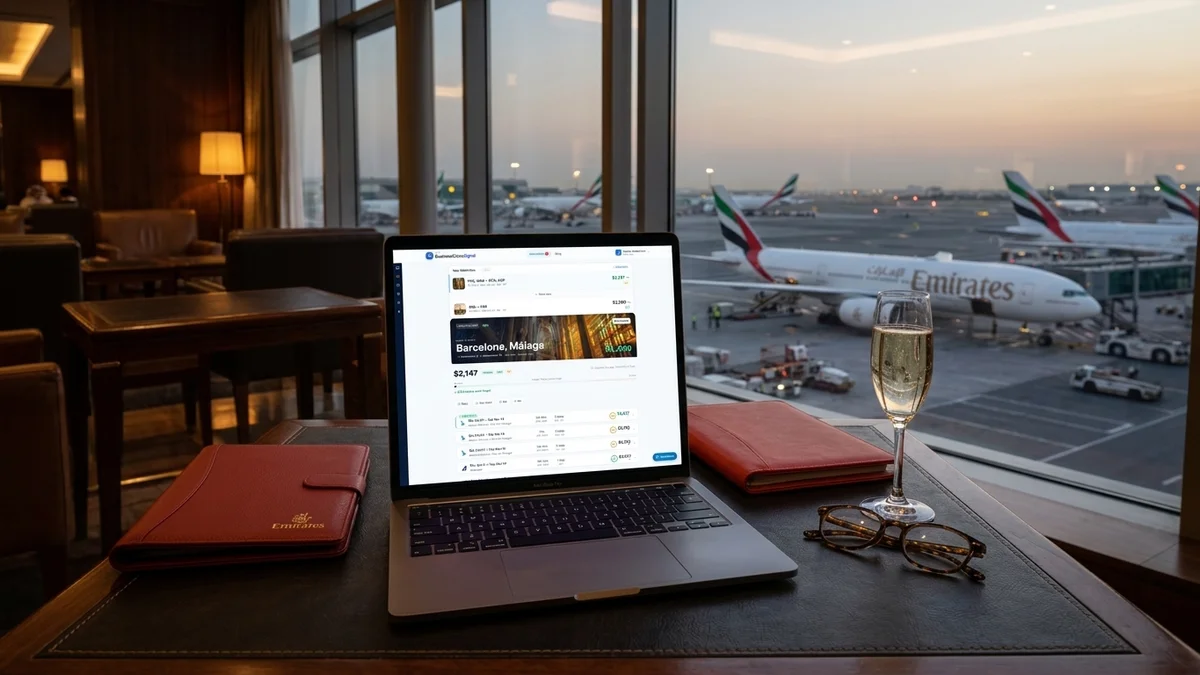
For routes you actually care about, yes. I built BusinessClassSignal specifically because I got tired of missing drops on routes I fly regularly. It monitors 800+ business class routes twice daily and sends an alert when the price falls below whatever threshold you set. You pick the route, set your target price, and it does the watching.
For a route like LHR-SIN or JFK-HKG, a single alert can save you $800-$1,500 on a round-trip. It's not a points program or an aggregator — it just watches prices and tells you when to book.
Set your target price slightly above the lowest fare you've ever seen on a route, not at the absolute floor. That way you catch real deals without waiting forever for a fare that may never return.
The airports above are where business class is worth paying for. The lounges are good, the connections work, and the overall experience justifies the premium. The trick is not paying more than you have to for the seat that gets you there.
If you're planning to fly through any of these hubs in the next few months, it's worth monitoring the route for a few weeks before you book. Prices move more than most people realize, and the airports above will reward you properly once you arrive — as long as you didn't overpay to get there.
Monitor business class fares on 800+ routes — 14-day free trial, no card required
Try Free