The QSuite reputation, and whether it holds up
I've sat in a lot of business class seats. Some were genuinely great. Some were expensive disappointments dressed up in nice brochure photography. And a few — a very small number — actually delivered something that made me understand why people get obsessive about premium cabin travel.
Qatar Airways' QSuite is in that last category. But it's complicated.
The first time I flew QSuite was Doha to London in 2019, and I remember thinking: okay, this is the one everyone's been talking about. The door actually closes. The bed is genuinely flat and genuinely wide. The storage makes sense. When it launched, it was a legitimate step ahead of what British Airways, Lufthansa, and even Singapore Airlines were offering at the time. But that was then. The question I get asked constantly now — especially from readers booking 2025 and 2026 travel — is whether it still deserves its reputation, or whether the competition has caught up enough that it's just another good business class product.
Short answer: it's still excellent. But the gap has narrowed, and there are specific things about QSuite that I think get oversold.
Let me tell you what I actually found the last time I flew it — JFK to Doha, then Doha to Singapore — and what you should realistically expect if you're booking it in 2026.
QSuite seat configuration: what you're actually getting
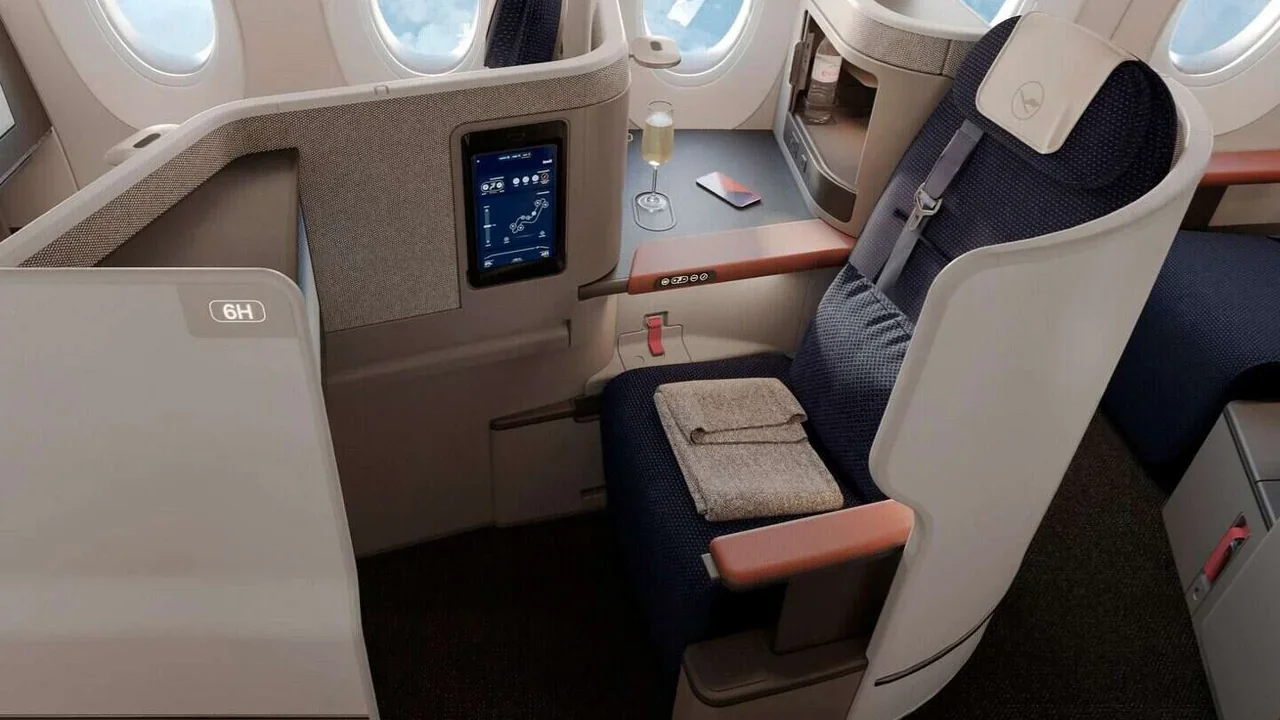
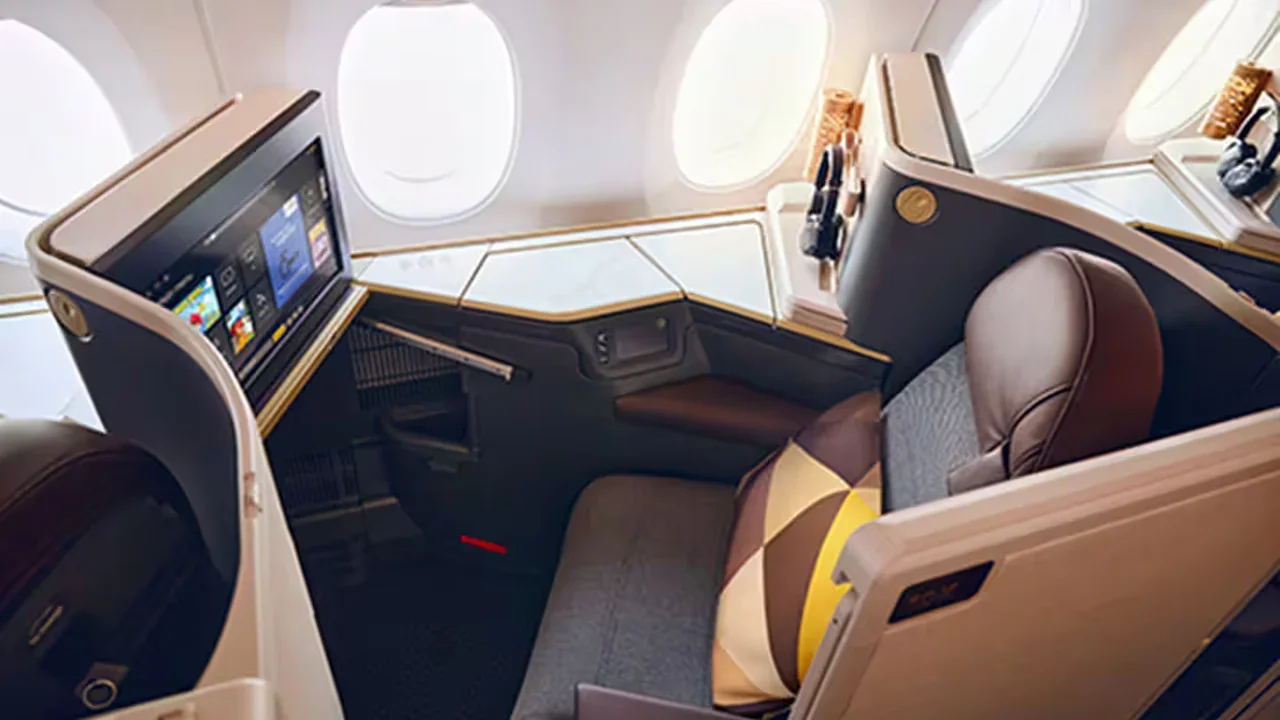
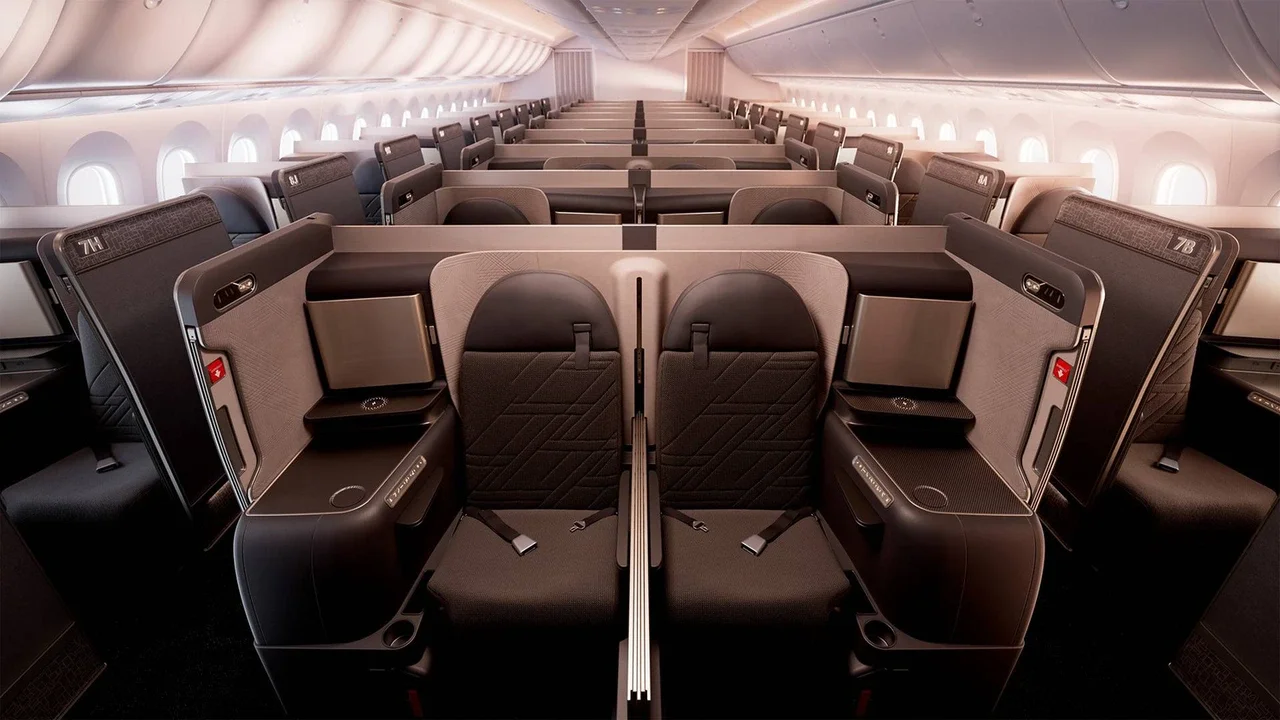
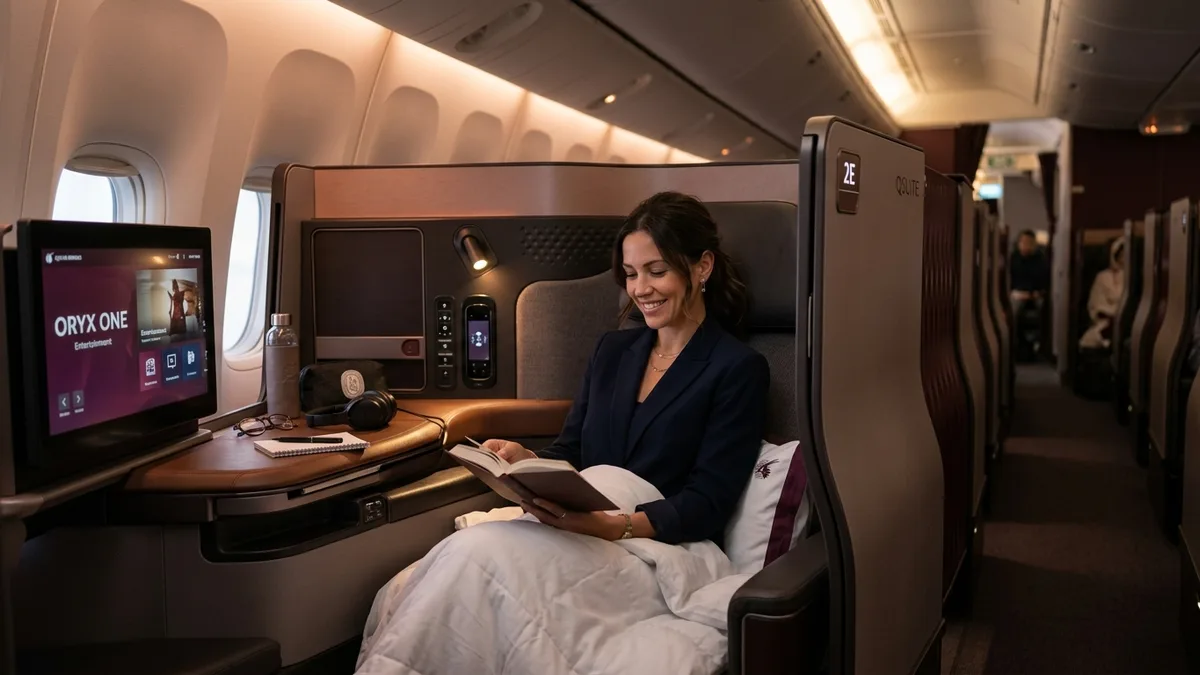
The cabin runs in a 1-2-1 configuration, which means every seat has direct aisle access — no climbing over your neighbor. That's table stakes for premium business class at this point, but Qatar does it better than most because of how the center pairs work.
The seats in the middle section are designed to convert into a shared space. The divider between the two center seats lowers, the footrests fold out, and you end up with what Qatar calls a "double bed" — which is genuinely useful if you're traveling with a partner or a colleague you don't mind sleeping next to at 37,000 feet. I've used this exactly once, with my wife on a Doha-Melbourne positioning flight, and it worked better than I expected. The mattress topper they lay across it isn't quite as thick as you'd want, but you're not going to complain.
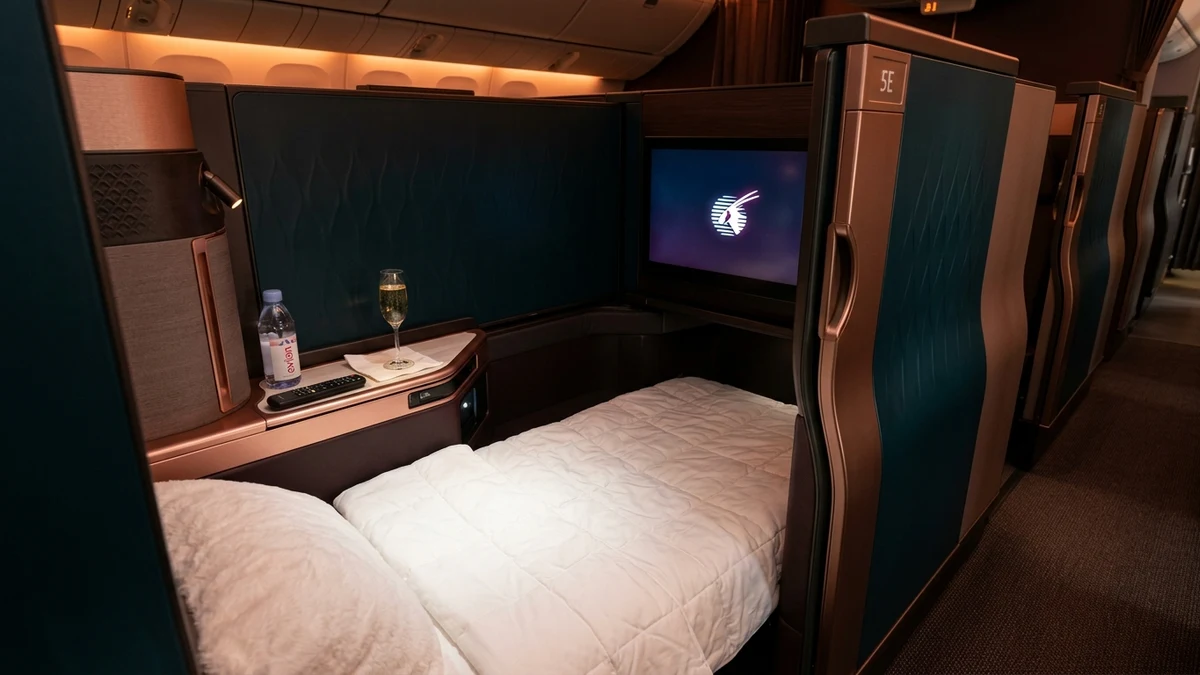
Window seats are where I personally prefer to sit. 1A, 1K, or if those are gone, further back in the cabin. The window seat gives you the most storage, slightly more privacy, and the door — when closed — feels genuinely enclosed rather than just screened off. The door is the thing that separates QSuite from most competitors. It's not a full floor-to-ceiling panel, but it's tall enough that when you're lying down, you're not visible to people walking past. That matters on a 14-hour flight when you've taken a sleeping pill and you don't want to wake up to someone staring at you from the aisle.
Seat width is 26 inches in the bed position, which is wide enough. Bed length runs around 79 inches for most passengers — I'm 6'1" and my feet touched the footwell but didn't press against it. The ottoman in front is large enough to put a bag on and still stretch your legs past it.
One thing that doesn't get mentioned enough: the tray table mechanism is slightly fiddly. It swings out from the side console and you have to position it carefully or it wobbles. For a product that's otherwise this polished, it's a minor annoyance that Qatar really should have sorted by now.
Old QSuite vs. new QSuite — is there actually a difference?
Yes, and it matters depending on which aircraft you're on.
The original QSuite debuted on the 777-300ER around 2017. Qatar has since been retrofitting their fleet and introducing updated versions on the A350-1000 and newer 777 deliveries. The differences aren't dramatic, but they're real.
The newer QSuite variants have slightly updated lighting controls — easier to use, with a proper "sleep" mode that dims the cabin progressively rather than cutting to dark. The storage compartments have been reorganized. The IFE screen on the newer installations is a 21.5-inch 4K panel versus the older 17-inch screens, and the difference is immediately visible when you're watching anything with fine detail. The remote control in the newer cabins is also more responsive — the older one had a lag that made it feel like you were controlling a television from across the room.
How do you know which one you're getting? Check the aircraft type on your booking. If you're on an A350-1000 or a newer 777-300ER delivered post-2022, you're likely getting the updated version. Older 777s in the fleet — particularly some of the high-frequency routes — may still have the original spec. Qatar's own website doesn't make this easy to verify, which is frustrating. Seat maps on SeatGuru can help, but they're not always current.
The honest truth is that even the older QSuite is still a top-tier product. I'd take the original over most competitors' current business class without hesitation. But if you have a choice of routing and one puts you on a newer aircraft, it's worth considering.
Route availability from US gateways — where you can actually book this
This is where a lot of readers get tripped up. QSuite isn't on every Qatar Airways route. It's not even on every long-haul route. Qatar operates a large fleet, and not all of it is QSuite-equipped. If you book a US gateway without checking, you might end up in their older business class product — which is fine, but it's not what you're paying for.
As of 2026, Qatar Airways operates QSuite on flights from the following US gateways with reasonable frequency: New York JFK, Los Angeles, Chicago O'Hare, Washington Dulles, Houston Bush Intercontinental, Dallas Fort Worth, Boston, Miami, and Atlanta. JFK and LAX get the most reliable QSuite deployment because they're the highest-demand routes and Qatar prioritizes premium product on those.
The catch is "with reasonable frequency" — Qatar sometimes swaps aircraft, and QSuite availability on a given departure isn't guaranteed just because the route typically has it. If you're booking a flight specifically to experience QSuite, I'd recommend checking the specific aircraft registration closer to departure (FlightAware or FlightRadar24 can help with this) and watching for equipment swaps in the weeks before you fly.
Connections through Doha to onward destinations — Singapore, Bangkok, Nairobi, Sydney, Tokyo — almost always have QSuite on the long-haul leg if the originating US flight does. Qatar's Hamad International hub is well set up for connections, and the Al Mourjan Business Lounge there is genuinely one of the best airport lounges in the world. More on that in a moment.
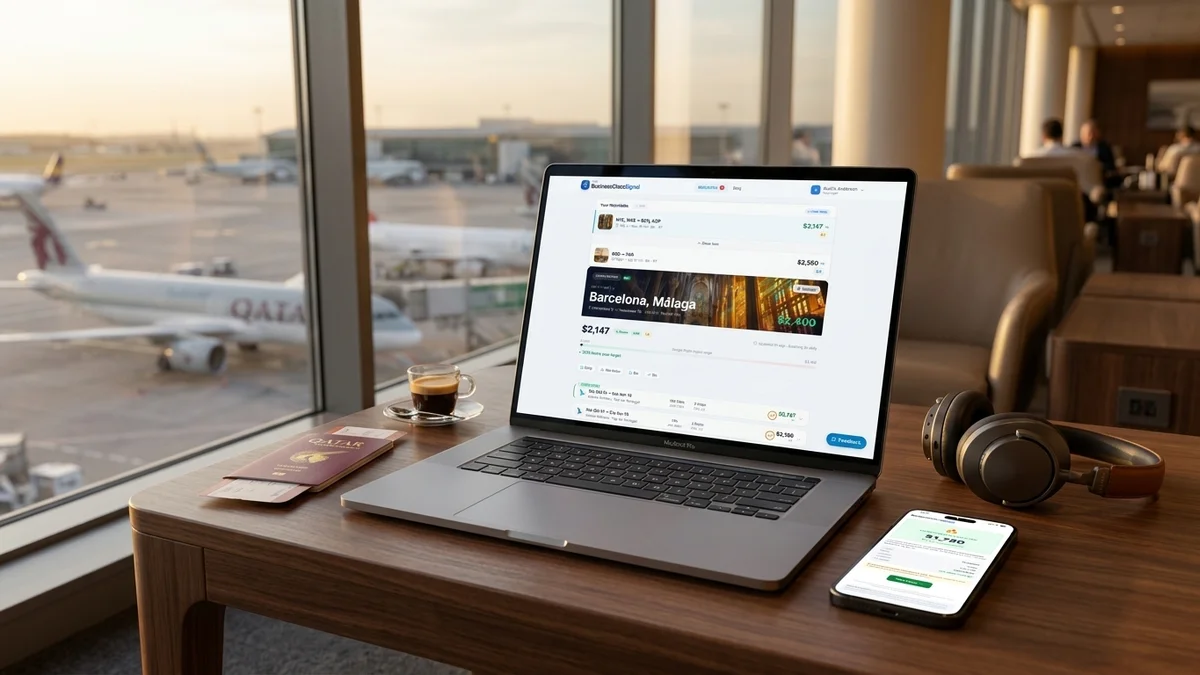
Pricing from US gateways varies significantly. I've seen JFK-Doha in business class range from roughly $2,200 round-trip on flash sales all the way to $6,500 or more at standard pricing. The sweet spot — deals that are genuinely good without being suspiciously cheap — tends to sit in the $2,400–$3,200 range for transatlantic segments. For US-to-Asia itineraries through Doha, $3,000–$4,500 round-trip is where I'd call something worth booking. Start monitoring this route if you're flexible on dates — the price swings are real and they happen fast.
Qatar Airways QSuite review: the dining experience
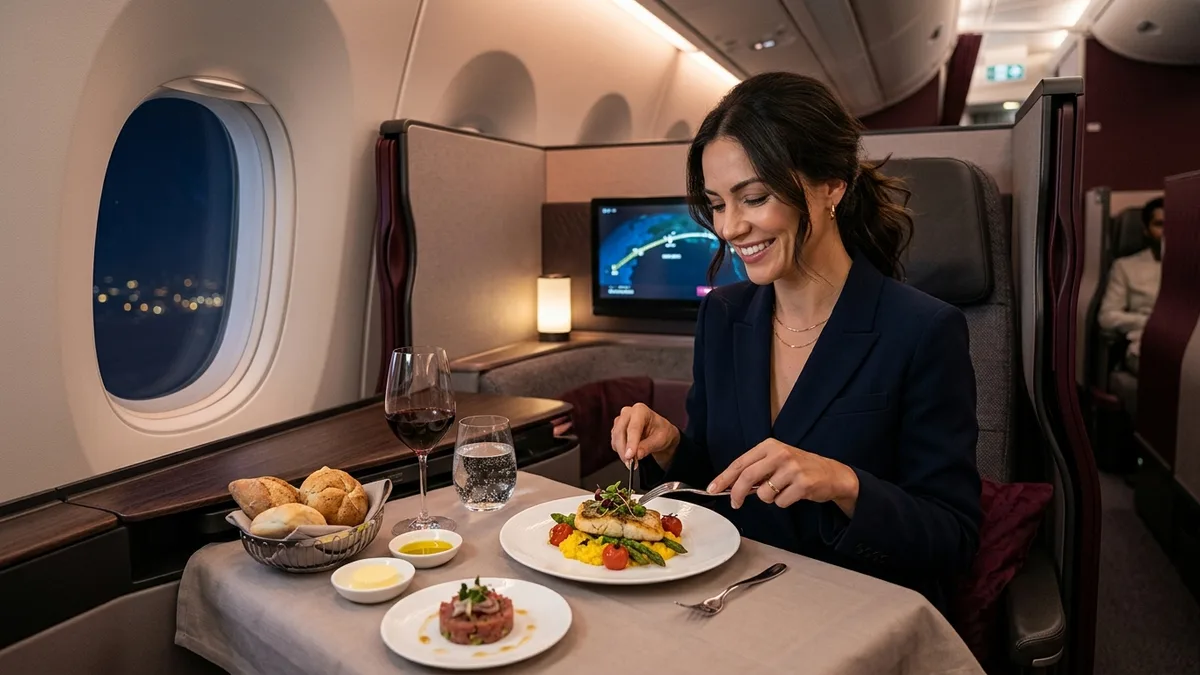
Food on Qatar in business class is genuinely good, which is not something I say lightly. I've eaten a lot of airline food. Most of it is tolerable. Qatar's is actually worth looking forward to.
The menu on long-haul routes runs to four or five courses: a mezze starter, a soup, a main, cheese, and dessert. On my JFK-DOH flight last year the mezze plate included a solid hummus, tabbouleh, and what they described as a "fattoush salad" — and it tasted like actual fattoush, not a sad approximation of it. The lamb kofta main was properly spiced and not dried out, which is the miracle of airline cooking. The cheese course had three options including a decent aged cheddar and a soft French-style cheese I couldn't identify but ate anyway.
The "Dine on Demand" service means you can eat when you want rather than when the crew decides to do the service run. This is more useful than it sounds on a 14-hour flight. I tend to eat shortly after takeoff, sleep for eight hours, and have something light before landing, and Dine on Demand makes that easy.
Wine selection is solid. They typically carry a Burgundy, a Bordeaux, a New Zealand Sauvignon Blanc, and a Champagne — I've consistently seen a Billecart-Salmon or similar mid-to-upper-tier house on board, not a supermarket brand poured into a fancy glass. The crew actually knows what's on the trolley, which sounds like a low bar but isn't.
One honest note: the food quality can vary by route. Doha-London and Doha-Singapore tend to get the better catering. Some of the secondary routes — particularly shorter segments — have noticeably simpler menus. If you're connecting through Doha and your onward leg is under six hours, don't expect the full production.
The Al Mourjan lounge: actually worth the layover
Hamad International Airport in Doha gets a lot of praise, and most of it is deserved. The terminal itself is genuinely impressive — high ceilings, good wayfinding, a massive stuffed bear sculpture that you either love or find bizarre. The Al Mourjan Business Lounge, which Qatar Airways business class passengers access during connections, is consistently one of the best transit lounges I've been in.
It's large enough that it doesn't feel crowded even during peak connection windows. The food spread is substantial and rotates — I've had genuinely good Arabic mezze, a carved lamb station, fresh pasta, and a dessert section that would embarrass most hotel buffets. There's a proper à la carte dining room if you want to sit down and be served rather than graze. Shower suites are plentiful enough that waits are rarely more than 15–20 minutes during off-peak hours, though during the morning rush (roughly 6–9am Doha time when the European-bound connections all stack up) it gets busier.
The lounge has a pool — an actual swimming pool — which I've never used because I've never had a long enough layover and I refuse to unpack my bag for a 45-minute swim. But it exists, and the fact that it exists tells you something about the scale of the operation.
One thing I will flag: the lounge is enormous, and the far reaches of it can feel a bit quiet and slightly forgotten. The food stations are concentrated in the central section, and if you wander too far toward the quieter seating areas, you're a long walk from a refill. Minor complaint for a very good lounge.
The IFE, the Wi-Fi, and the things that still frustrate me
The Oryx One entertainment system is genuinely extensive. Several thousand hours of content, good film selection, noise-canceling headphones (Bose on most routes, though I've occasionally seen a house-brand substitute on shorter sectors). The 4K screen on the newer cabins is excellent. The older 17-inch screens are still fine for watching films but start to feel cramped if you're doing anything that requires reading on screen.
Wi-Fi is where I have to be honest with you: it's mediocre. Qatar offers it, it works, and it's priced at various tiers depending on the package you buy. But the speeds are inconsistent. On my JFK-DOH flight I had roughly 15–20 minutes of decent speed followed by stretches where it was barely functional. Sending emails: fine. Video calls: don't count on it. If you need reliable connectivity for work on a long-haul Qatar flight, I'd plan around having it fail rather than planning around it working.
The pajamas they hand out in business class are comfortable enough — a soft cotton blend, proper trousers and a top rather than a onesie situation. The amenity kit (Diptyque branded, in recent years) is one of the better ones in the industry. The mattress topper they lay down for sleeping is thick and genuinely improves the comfort of the lie-flat bed. These are details, but they add up.
And then there's the crew. This is where QSuite's reputation gets a bit inconsistent. On my best Qatar flights, the crew has been attentive, warm, and genuinely interested in making the flight good. On a couple of others — particularly a DOH-LHR sector a few years back — the service was perfunctory and a bit rushed. Qatar's crew training is good, but like any large airline, execution varies. Don't assume the product guarantees the service.
How to actually find QSuite at a price worth paying
Here's the practical part, because the whole point of this site is helping you fly better for less.
Qatar Airways QSuite business class at full fare is expensive — typically $5,000–$8,000+ for a round-trip from a US gateway to Asia or Australia. That's not a price most people can justify paying out of pocket. But Qatar does run genuine sales, and the discounts can be dramatic. I've seen JFK-Singapore round-trip in QSuite at $2,800. I've seen LAX-Doha at $2,100. These prices don't last long — often a few hours, sometimes less — and they appear without much pattern.
The way most people miss them is simple: they're not watching the right routes at the right time. Qatar tends to drop prices on specific departure windows, often 6–10 weeks out, and the deals are gone before most people even see them on a casual Google Flights search.
This is exactly the kind of deal that our monitoring system is built to catch. BusinessClassSignal scans Qatar's pricing across US gateways multiple times daily, scores deals on a 1–10 scale based on how far below market rate they are, and sends you an alert when something worth booking appears. The QSuite deal in the showcase above — JFK to Doha at $2,490 round-trip against a standard fare of $5,800 — was caught and alerted within minutes of appearing. It was gone in about four hours.
You can browse all routes we monitor, including every Qatar Airways US gateway, and set up alerts on the routes you actually care about. The free tier gets you one watchlist route. Core ($36/month) gets you unlimited route monitoring plus AI market briefings that tell you whether now is a good time to book or whether prices are likely to drop further. Pro ($78/month) adds priority alerts — useful for routes like JFK-Doha where the best deals evaporate fastest.
If you're serious about flying QSuite without paying full fare, the math is simple: the monitoring pays for itself the first time it catches you a deal. A $3,000 saving on a single booking against a $36/month subscription is not a hard calculation.
One more thing worth knowing: Qatar's award redemptions through their Privilege Club program can also be excellent value, particularly if you've accumulated Avios through British Airways or Iberia's programs (all in the same Avios ecosystem now). The cash-and-points redemptions sometimes make sense when cash fares are high. But that's a whole separate conversation — the short version is that if you have Avios sitting around, check Qatar availability before you assume you need to pay cash.
The Doha routing through HIA is genuinely one of the better hub experiences in the world for connecting travel, which makes Qatar's network more useful than it might look on a map. If you're going anywhere in the Middle East, East Africa, South Asia, or Southeast Asia, the Doha connection is worth considering on its own merits — the QSuite is just the reason to enjoy the journey rather than endure it.