Why timing your business class purchase actually matters
I've booked a lot of business class tickets. Some of them were embarrassingly cheap — a $1,400 round-trip to London that made me feel like I'd broken the system. Others I paid full fare for because I waited too long, or booked too early, or just had terrible luck with timing. After twelve years of watching these prices move, I can tell you with confidence: when you book matters almost as much as where you're flying.
Business class fares aren't random. They follow patterns — airline inventory logic, corporate booking cycles, seasonal demand, and competitive pressure all create predictable windows where prices drop. The problem is those windows are short. A fare that's $2,200 round-trip on Tuesday might be $4,800 by Friday. I've watched it happen dozens of times.
This guide is about understanding those patterns well enough to actually use them. Not just vague advice about "booking early" — specific timing data, month-by-month context, and the day-of-week quirks that most people never pay attention to.

The best time to book business class: advance purchase windows explained
Let's start with the most common question: how far out should you book? The honest answer is that it depends heavily on the route, but there are general patterns worth knowing.
For transatlantic routes — New York to London, Chicago to Frankfurt, that kind of thing — the sweet spot tends to be somewhere between 6 and 10 weeks before departure. Book earlier than that and you're often paying full published fares, because airlines haven't started managing unsold premium inventory yet. Book later and you're either paying last-minute premium prices or picking through whatever's left.
Transpacific is different. Routes like Los Angeles to Tokyo or San Francisco to Hong Kong typically show their best pricing in the 8 to 14 week window. These are longer, more expensive routes, and airlines are more aggressive about filling premium cabins. I've seen genuinely good fares on SFO–HKG pop up around 10 weeks out with some regularity.
Europe to Southeast Asia routes — London to Bangkok, Amsterdam to Singapore — tend to follow a similar 8 to 12 week pattern, though budget pressure from carriers like Singapore Airlines and Qatar Airways can produce outlier deals at almost any point.
The one exception to all of this: error fares and flash sales. Those don't follow any advance purchase logic. They appear when an airline makes a pricing mistake or decides to clear inventory fast, and they're gone within hours. That's a completely different game, and we'll get to it.

Month-by-month breakdown: when prices actually drop
The calendar has more influence on business class pricing than most people realize. Here's how I think about the year, based on what I've watched over a long time.
January and February
These are genuinely good months to find deals — not for travel in January and February, but for booking travel in the spring and early summer. Corporate travel budgets reset in January, and airlines are often sitting on unsold inventory from the holiday period. I've consistently seen discounted fares to Europe and Asia appear in the first three weeks of January for travel in March through May.
If you're flexible on destination, this is one of the best windows of the year. Browse all routes and set up alerts in early January — you'll often catch fares that are 30 to 40 percent below what you'd pay if you waited until spring to start looking.
March
Prices start firming up as spring travel demand kicks in. Spring break drives up transatlantic fares significantly, particularly in the last two weeks of March. If you haven't booked by early March for spring travel, you're probably paying more than you needed to.
April and May
Mixed bag. April can still have pockets of value on routes where spring break traffic has cleared. May is generally expensive because it's peak Europe season without the off-peak pricing. This is when I see a lot of people overpay.
June, July, and August
Peak season. Fares are high, inventory is tight, and the deals are rare. If you need to fly business class in summer, book early — and I mean 3 to 4 months out — or be prepared to pay close to full fare. That said, even in summer, midweek departures (more on that below) can produce surprising drops, especially on routes with heavy leisure traffic.
September and October
Probably my favorite time of year to fly business class, and the pricing reflects it. Demand drops sharply after Labor Day, kids are back in school, and airlines are suddenly very motivated to fill premium seats. I've found some of my best-ever fares for September and October travel — sometimes even booking just 3 to 4 weeks out. If you have flexibility in your schedule, this is worth protecting.
November
Early November is still good. The week of Thanksgiving is a bloodbath — avoid it if price matters at all. The week after can actually soften again as airlines clear out seats for December.
December
Two distinct periods. Early December (roughly the 1st through 15th) can have solid value, particularly for transatlantic routes where European travel demand is lower. Mid-December through the holidays is peak pricing again. January 2nd through the 10th is sometimes surprisingly affordable as the holiday rush clears.
Day-of-week patterns that most people ignore
This is one of the least discussed aspects of business class booking, and in my experience, it's one of the most reliable edges you can have.
Airlines typically load new inventory and adjust pricing overnight. The practical result is that Tuesday and Wednesday tend to show lower fares than Thursday through Sunday. The reason is straightforward: corporate travelers book heavily on Mondays (planning the week ahead), and the surge in searches and bookings drives prices up. By Tuesday evening, some of those bookings have completed, inventory has shifted, and prices often settle lower.
I'm not saying you'll always find a deal on Tuesday. I'm saying that if you're going to check prices, check them Tuesday or Wednesday morning rather than Friday afternoon. The difference can be $300 to $800 on a transatlantic fare.
Departure day matters too. Business class fares on Tuesday and Wednesday departures are typically lower than Monday or Friday departures, which are peak corporate travel days. If you can fly out Wednesday instead of Monday, that flexibility alone can save you real money.
And returning on a Saturday instead of a Sunday? Often cheaper. The Sunday evening rush back to New York or London is real, and airlines know it.
How deal alerts change the math entirely
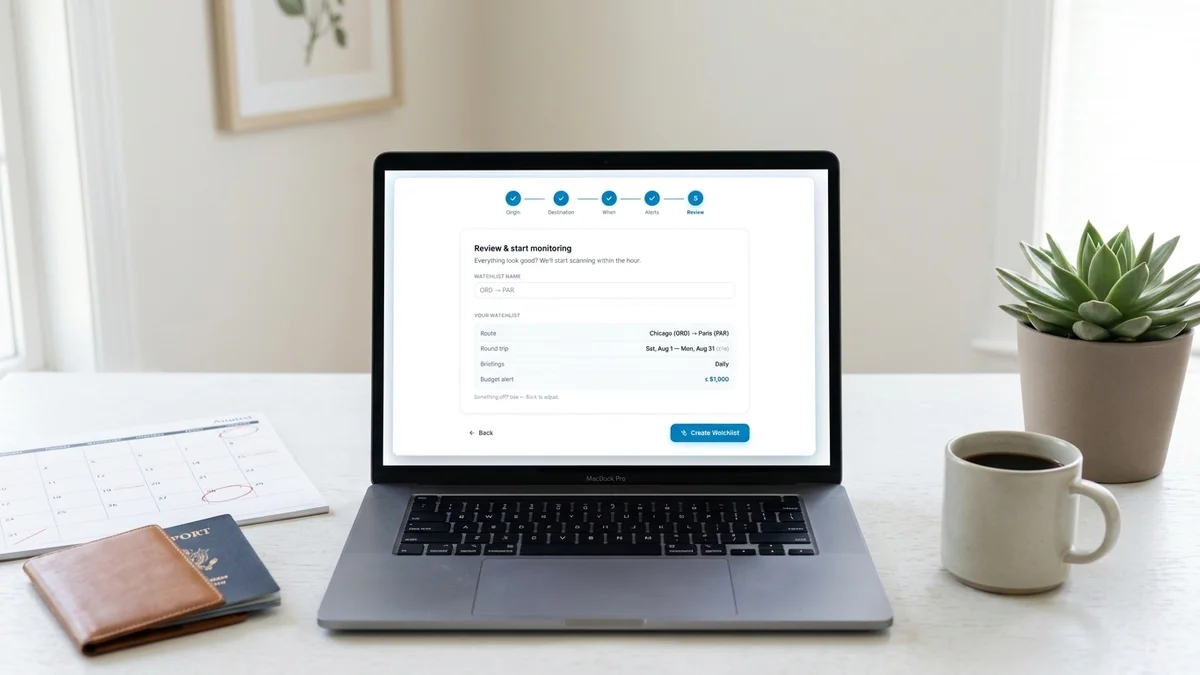
Everything I've described above is about optimizing your timing within a normal fare environment. But the biggest savings in business class — the ones where you're paying $1,400 instead of $4,200 — usually come from catching deals that exist for 12 to 48 hours before the airline notices or demand fills them.
That's not something you can do by manually checking Google Flights every few days. You need something watching the route for you continuously and alerting you the moment pricing drops below a threshold worth acting on.
That's the core of what how the monitoring system works at BusinessClassSignal. We scan Google Flights data multiple times daily on hundreds of routes, score every deal from 1 to 10 based on how far below market the fare is, and send alerts before the window closes. A score of 7 means genuinely good. A score of 9 means drop everything and book.
The free tier gives you one route to monitor, which is honestly enough if you have a specific trip coming up. Core at $36/month lets you watch multiple routes with full deal scoring. Pro at $78/month adds AI market briefings that give you context on whether a fare is a genuine outlier or just a mild dip — useful if you're managing a lot of travel or booking for a team.
I use it myself. I have alerts set on routes I fly regularly. When a 9/10 deal shows up on a route I care about, I know to book within the hour, not the day.
Start monitoring this route if you already know where you're going — setup takes about two minutes.
The FlightKitten angle: when economy is the honest answer

Flying economy on part of the trip?
FlightKitten monitors economy fares across 220+ airlines — including budget carriers — and pings you when prices drop below your target. AI-powered briefings, starting at $4.99/mo.
Try FlightKittenLook, I write about business class. I love business class. But I'm not going to pretend it's the right call for every trip. A 4-hour hop to a beach destination where you're going to be horizontal in a hammock anyway? Economy is fine. A 14-hour overnight to Singapore where you have meetings the next morning? Business class pays for itself in terms of what you show up able to do.
For shorter routes or budget-conscious trips, FlightKitten is worth knowing about — it's built for finding the best economy and premium economy fares with a similar deal-hunting approach. Different tool, different use case. Both have their place depending on what you're actually trying to do.
The point is, the best time to book business class is also worth asking alongside whether business class is the right product for that particular trip. Sometimes premium economy on a carrier like Lufthansa at $1,100 round-trip beats business class on a carrier with a mediocre product at $2,800. Context matters.
Route-specific timing: not all routes behave the same
I want to make this concrete, because generic advice only gets you so far.
North America to Europe
The busiest and most competitive business class market in the world. Competition between carriers is fierce — American, United, Delta, British Airways, Virgin Atlantic, Air France, Lufthansa, Iberia, and others are all fighting for the same passengers. That competition creates real price drops, particularly in the 6 to 9 week window. Watch for sales around January and September especially. London is the most monitored route we track, and it shows the most deal activity of any transatlantic corridor.
North America to Asia
Longer booking windows (8 to 14 weeks), and deals tend to be more dramatic when they appear — because base fares are higher, a 40% drop is a lot of money. Japan and Korea routes have been particularly active in recent years as capacity has expanded. Hong Kong routes have been competitive with carriers like Cathay Pacific running strong product and aggressive pricing to rebuild traffic.
North America to South America
Honestly a harder market for deals. There are fewer competitors, and the premium cabin market is smaller. LATAM and American dominate a lot of these routes. Deals happen, but less frequently and with shorter windows. If this is your route, you need alerts running — don't expect to find deals by searching manually.
Intra-Europe
Business class on short European routes is a different product entirely — often just a blocked middle seat with a meal. The pricing is more corporate-contract driven and less susceptible to the patterns I've described. I don't spend much time optimizing intra-Europe business class fares because the premium over economy often isn't worth it for a 90-minute flight.
What actually triggers a fare drop
Understanding why prices drop makes you better at anticipating them.
Airlines manage premium cabin inventory in buckets — essentially different pricing tiers for the same seat. When lower-priced buckets open up, that's what creates the "deal." This happens for several reasons: the airline has more inventory than expected demand, a competitor has dropped their price and the airline is matching, a corporate account has released held seats back into retail inventory, or it's an automated yield management adjustment that briefly overshoots.
The last one is where error fares come from. Yield management systems make mistakes, and when they do, the gap between the published fare and what the system briefly shows can be enormous. These close fast — sometimes within minutes, sometimes within a few hours. Airlines will typically honor them if you've ticketed, but not always. It's worth understanding the risk before you build a trip around an error fare.
More common than error fares are genuine promotional drops — airlines clearing inventory for a specific travel period, or reacting to competitive pressure. These are the deals you can reliably act on, and they typically stay open for 24 to 72 hours. Long enough to book, short enough that you can't afford to sleep on them.
The seasonal and day-of-week patterns I've described above increase the probability of these drops appearing. They don't guarantee anything. But if you know that September transatlantic fares tend to soften, and you have an alert running, you're positioned to catch it when it happens rather than hearing about it afterward.
That's really the whole game.