Quick summary
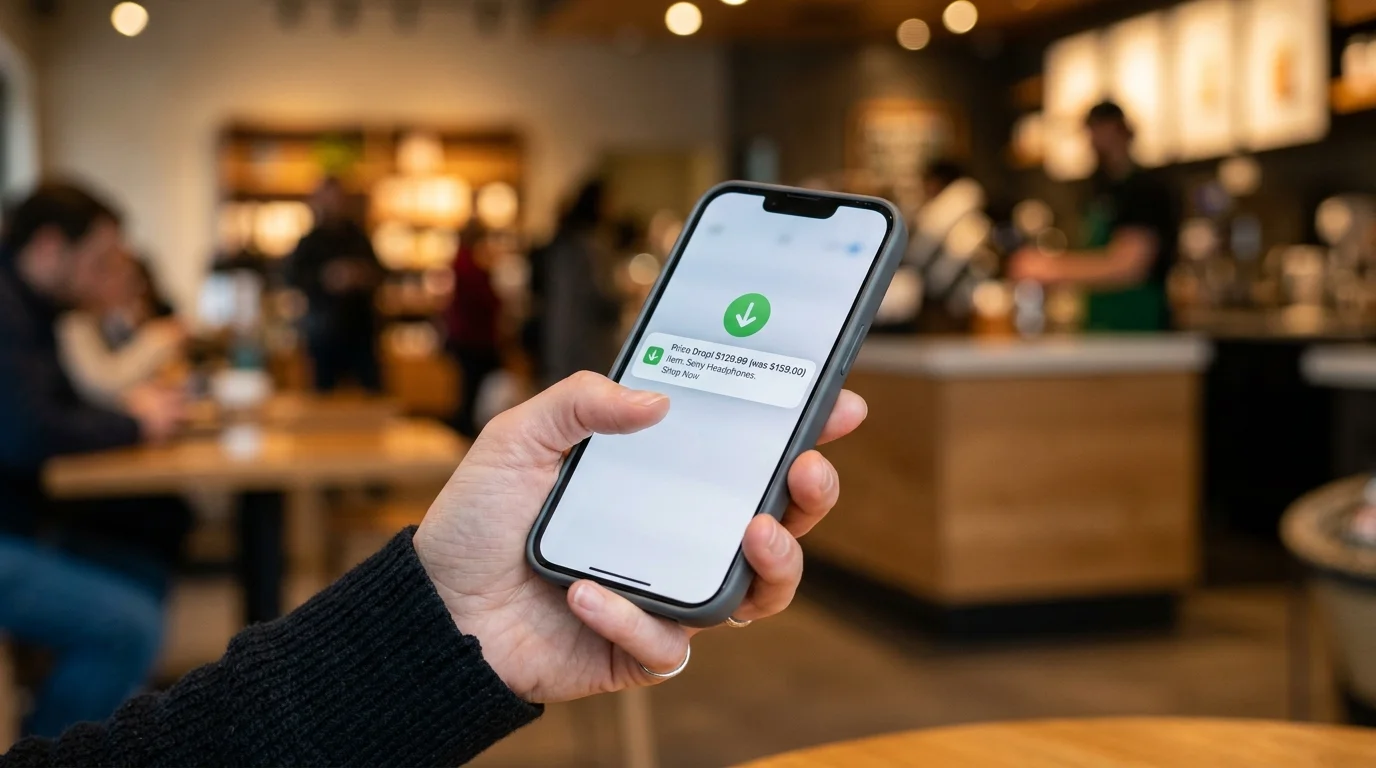
A business class price tracker monitors specific routes continuously, alerts you when fares drop below a price you set, and uses historical data to tell you whether what you're seeing is actually a deal. BusinessClassSignal does exactly that — scanning 800+ routes twice daily so you don't have to sit refreshing Google Flights at midnight.
Why watching prices manually doesn't work
I've been covering premium air travel for twelve years. And one thing I've watched people get wrong over and over again is how they shop for business class fares. They check once, see a number that looks high, and either book in a panic or give up entirely. Or they spend weeks checking the same route every morning, watching the price bounce around, never quite sure if they're looking at a good number or a terrible one.
The problem isn't effort. It's information. You're looking at a price with no context.
A $2,800 round-trip from JFK to Heathrow might be an absolute steal — or it might be $400 above where that route has been sitting for the past six weeks. Without knowing which, you can't make a smart call. And airline pricing systems are deliberately opaque. They're built to make you uncertain. Uncertainty makes people book.
This is why a business class price tracker exists. Not as a novelty or a convenience feature, but as a genuine fix for a real problem in how premium fare shopping works.
What a business class price tracker actually does
BusinessClassSignal is a fare monitoring tool that scans 800+ business class routes twice daily and alerts subscribers when prices drop below their target threshold. You tell it the route you care about, the price point you're willing to pay, and it watches on your behalf. When a fare drops to that level, you get an alert. Simple in theory. But the mechanics underneath it are worth understanding, because they're what separate a useful tool from one that just sends you noise.
The core of any price tracker is the data layer. BusinessClassSignal pulls fare data continuously across major carriers and booking classes — not just the cheapest published fare, but actual bookable business class inventory. That distinction matters more than most people realize. Some aggregators show you fares that technically exist but aren't available on the dates you need, or they lump in premium economy under a "business class" label. Neither is useful.
What you actually want is a system that:
- Checks the route frequently enough to catch flash sales (which can open and close within hours)
- Compares current prices against historical data for that specific route
- Sends you an alert with enough context to act quickly
BusinessClassSignal hits all three. The twice-daily scans are intentional — most business class flash sales don't vanish in 90 minutes the way economy mistake fares do. They tend to last a day or two. But they do disappear, and checking once a week won't cut it.
How does historical pricing data help you?
This is the part most people don't think about until they've been burned once.
Say you're watching New York to Tokyo in business class. You've got a number in your head — maybe $3,500 round-trip — and you're waiting for a fare to hit that. But here's the thing: if that route has been averaging $2,900 for the last 90 days, you're waiting for a price that's actually above average. You'd have booked better three weeks ago without even trying.
Historical data inverts that problem. When BusinessClassSignal shows you a current fare, it also shows you where that price sits relative to recent history on the same route. Is this the lowest this route has been in six months? Is it 15% below the 90-day average? Or is it slightly elevated because of a school holiday window? That context is what turns a price into a decision.
I've found, across a lot of routes, that the "deal zone" for a given route is usually pretty consistent. JFK–LHR in business has a pretty well-defined floor — it doesn't often go below $1,800 round-trip on British Airways or Virgin, and when it does, it moves fast. Knowing that floor exists means you can set your alert at $1,950 and catch the approach before it spikes back. Without historical data, you'd have no idea where to set that threshold.
When do business class prices actually drop?
There's a lot of folklore about this. Tuesdays at midnight. Six weeks before departure. Never on weekends. Some of it has a grain of truth, some of it is just travel blog mythology that gets repeated until it sounds authoritative.
What I've actually observed, both from covering this space and from the data BusinessClassSignal collects: the most reliable drops happen in a few specific windows.
First, there's the inventory release window — roughly 330 to 360 days before departure, when airlines first load fares into their systems. Early availability sometimes comes in at promotional prices before revenue management kicks in fully. It's not guaranteed, but long-haul routes to Europe and Asia are worth watching at this stage.
Second, and more reliably for most people, is the 60-to-21-day window before departure. Airlines are trying to fill remaining premium cabin seats. If they're sitting on unsold J-class inventory three weeks out, they'd rather sell it below their target price than fly it empty. This is when you see flash sales, error fares, and quiet discounting that doesn't get announced anywhere.
Third is the post-holiday trough — the weeks after Christmas, mid-January through February, and the stretch after Labor Day. Demand collapses, and airlines still need to fill planes. Some of the best business class fares I've ever seen on transatlantic routes have come in that January-February window. I once saw JFK–CDG in Air France business class hit $1,650 round-trip in the second week of January. Gone within 36 hours.
Set your BusinessClassSignal alert 10–15% below the current average fare for your route. That's usually where genuine sale territory starts. Setting it too aggressively (say, 40% below average) means you'll never get alerted — those prices exist but almost never surface on premium long-haul routes.
How the alert system is set up
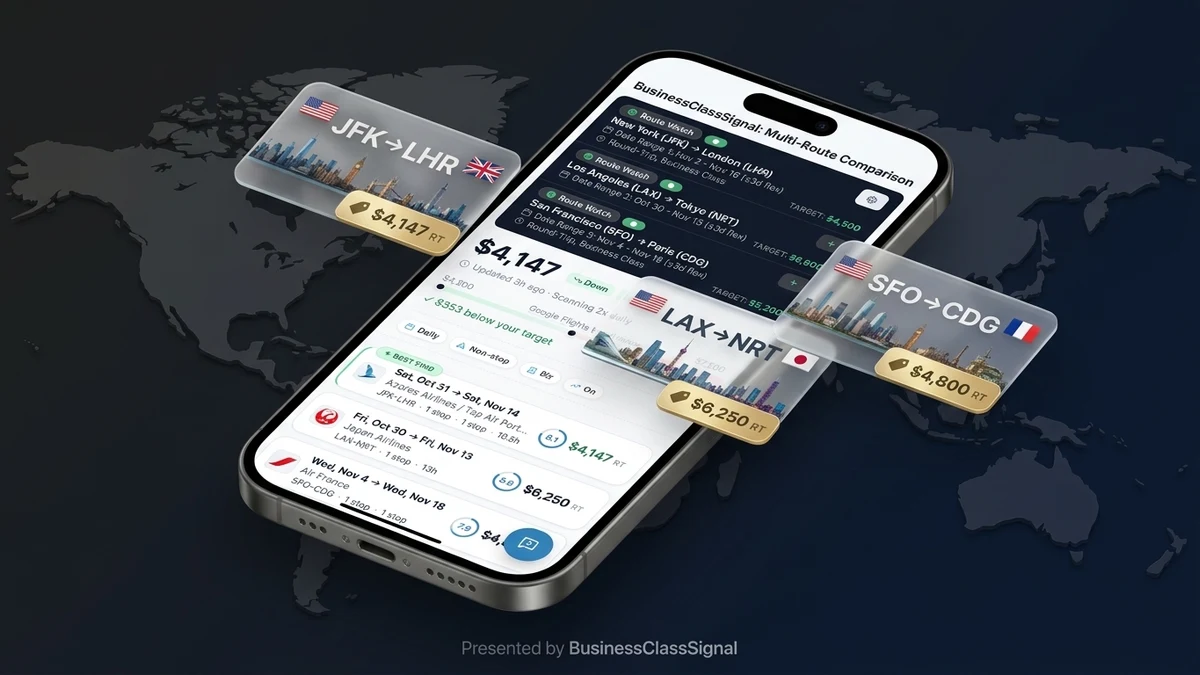
Setting up a fare alert on BusinessClassSignal takes about two minutes. You pick your origin, destination, travel window, and target price. The system does the rest. But there are a few settings worth thinking about rather than just accepting the defaults.
The travel window is the one I see people misconfigure most often. If you set a narrow window — say, exactly March 14 to March 21 — you'll only get alerted if a fare drops on precisely those dates. That's useful if your dates are completely fixed. But if you have a two-week window of flexibility, open it up. BusinessClassSignal will scan across that range and alert you when any departure date within it hits your target. You'll be surprised how often the price on a Tuesday departure is $400 less than the Saturday you had in your head.
You can also set alerts for specific airlines or leave it open to all carriers on the route. I'd generally recommend leaving it open unless you have a hard reason to stick to one airline — like protecting elite status or a specific seat you love. Locking to one carrier means you might miss a competing airline's sale on the same city pair.
Alerts come by email, and they include the fare, the airline, the travel dates it applies to, and a direct booking link. No treasure hunt required. The booking link goes directly to the airline or a major OTA where the fare is available — not a third-party site you've never heard of.
Check your alert price against the historical chart
When you get an alert, don't just click the booking link immediately. Take 30 seconds to check the historical chart for that route. If the current fare is at or near an all-time low, book fast. If it's just slightly below average, you might have a day or two to think about it.
The trend analysis piece — and why it's not just a gimmick
Trend analysis gets thrown around as a feature on a lot of travel tools, but most of them are showing you something pretty shallow — basically just a line chart of recent prices with no real interpretation. BusinessClassSignal's approach is more specific than that, and it's the part I find genuinely useful in practice.
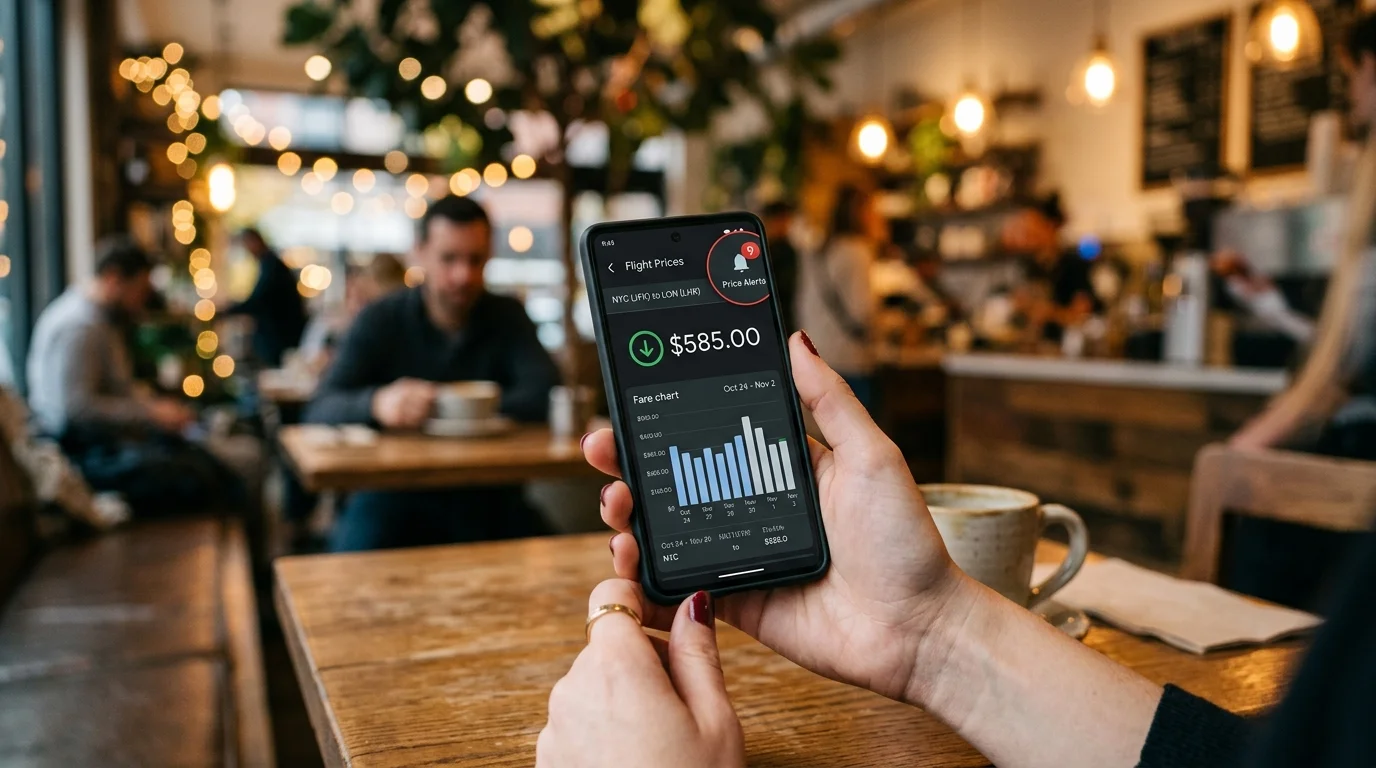
The trend data shows you a 90-day price history for a route, broken down by departure month. So you're not just seeing "prices have been going up" — you're seeing that business class on this route in October is currently 18% above where it was in October last year, or that March fares have been falling for the past three weeks. That second-order information changes how you respond.
If prices are falling on a route you're watching, there's an argument for waiting. If they've been climbing steadily for six weeks and your travel date is ten weeks out, that's a different calculation. You're not guessing anymore — you're working with actual trajectory data.
I want to be honest about the limits here, though. No price prediction tool is going to tell you with certainty that a fare will drop next Thursday. Airlines can and do reverse course. A geopolitical event, a fuel spike, a competitor pulling capacity — any of these can move prices fast in ways no algorithm anticipates. What trend analysis gives you is a better-informed guess, not a guarantee. Anyone selling guarantees on fare predictions is selling you something else.
Using a business class price tracker for aspirational routes
One of the underrated uses of a business class price tracker is for routes you want to book eventually but haven't committed to yet. I call these "aspirational monitors" — you're not booking a trip in the next 30 days, but you want to know when that Singapore Airlines business class fare to Singapore gets interesting, so you can plan around it rather than the other way around.
This is actually how I use BusinessClassSignal myself. I've got a standing alert on SFO to SIN in Singapore Airlines business class. My target is set at $3,200 round-trip. When that hits, I'll find a reason to go to Singapore. Until then, I don't think about it.
The same logic applies if you're building a points strategy. If you're deciding whether to transfer points to Avianca LifeMiles or book a paid fare, knowing the current cash price on a route helps you calculate the redemption value. A $4,000 business class fare redeemed for 70,000 miles is a very different calculation than a $2,200 fare for the same mileage. The monitoring system gives you the cash price data you need to make that math work.
What it won't do — being honest about the limits
A business class price tracker is a tool, not a magic button. There are things it does well and things it can't help you with, and I'd rather be straight about both.
It won't find award availability. If you're hunting for Saver award space on United Polaris or Qantas Classic Rewards, that's a different problem requiring a different tool. BusinessClassSignal tracks cash fares and published fare classes — it's not pulling live award inventory from frequent flyer programs.
It also won't help much with routes that almost never go on sale. Some city pairs — certain Middle East hubs, some African routes, niche Pacific routes — have pricing that barely moves. You can monitor them, but don't expect dramatic alerts. The tool is most powerful on high-frequency routes with lots of competition: transatlantic, trans-Pacific on the major carriers, key intra-Asia routes where Singapore Airlines, Cathay Pacific, and ANA are all fighting for the same passengers.
Don't over-optimize on a single route
If you're monitoring JFK–LHR and you've got your alert set at $1,400 round-trip, you're probably going to be waiting a very long time. That price exists approximately never in business class on that route with any reputable carrier. Know your route's realistic floor before you set a target you'll never see.
And look — the tool doesn't book for you. When an alert hits, you still need to go and book it yourself, which means having your passport details and a payment method ready to go. I've seen people get an alert, think "I'll book it tonight," and come back six hours later to find the fare gone. When a good alert fires, treat it like the clock is running.
Setting up your first business class price tracker alert
If you're new to browsing routes on BusinessClassSignal, the fastest way to start is to pick the two or three routes you actually care about — not a wishlist of twenty cities, but the trips you realistically might take in the next 12 months. Set an alert on each one with a target price about 15% below the current fare shown.
Then leave it alone.
That's the whole discipline of fare monitoring. Set it up right, then stop refreshing things manually. The alerts will come. When they do, you'll have the historical chart right there to tell you if you're looking at something real.
The full walkthrough of how the monitoring system works is worth reading if you want to understand the fare class logic in more detail — particularly the bit about how J, C, and D class fares behave differently from each other, which affects when alerts fire and why a "business class" fare at the same price can sometimes mean very different things in terms of what you actually get.
When you first set up an alert, note the current price on the route. That becomes your baseline. An alert at 15% below that number will catch most genuine sales without firing on minor, meaningless fluctuations.
One more thing worth knowing: the 14-day free trial gives you full access to all monitored routes and alerts. You don't need to commit to anything to see whether the tool actually catches something useful for your routes. In my (admittedly biased) experience, most people get at least one meaningful alert in that window just because they're watching routes during a period when they wouldn't have been checking manually.
Whether that alert turns into a booking is up to you. But at least you'll know what you're looking at when it arrives.
Start monitoring business class fares — 14-day free trial, full access to all 800+ routes
Try Free