Quick summary
Real-time price intelligence for flights means automated systems scan fare data continuously and alert you the moment a route drops below your target price — instead of you manually checking Google Flights every morning and missing deals that expire in hours. BusinessClassSignal does this specifically for business class, monitoring 800+ routes twice daily and sending alerts with enough context to know whether a fare is actually good or just mediocre.
Why checking fares manually is a losing game
I've spent twelve years writing about premium air travel. In that time, I've watched smart, well-traveled people overpay for business class by thousands of dollars — not because they weren't trying, but because they were playing the game the wrong way.
Here's the situation: a business class seat from New York to London on British Airways might sit at $4,800 round-trip for six weeks straight. Then, for about 14 hours on a Tuesday afternoon, it drops to $1,950. Then it's back up. If you happened to check during that window, you got a spectacular deal. If you didn't, you never knew it happened.
That's not a hypothetical. I've tracked that specific pattern on JFK-LHR more times than I can count.
Manual fare checking is essentially a lottery. You're not researching the market — you're sampling it. Randomly. And the airlines know this. Yield management systems are designed to release discounted inventory in short bursts, gauge demand, and reprice accordingly. They're not waiting for you to log in on Saturday morning.
The only rational response to a system like that is automation. Which is what price intelligence actually means when we're talking about flights.
What price intelligence for flights actually is
Price intelligence flights monitoring isn't just "setting a price alert on Google Flights." That's closer to a smoke detector — it tells you something happened, but it doesn't tell you much else. Real price intelligence has a few layers to it.
At the base level, it's continuous scanning. Not once a day. Not "we'll check when you open the app." Actual scheduled queries across multiple data sources, multiple times per day, on every route you care about.
Above that, you need context. A $2,200 round-trip JFK-LHR in business class is genuinely good. A $2,200 round-trip JFK-LHR in business class on a 767 with the old Club World seat — the one that puts you almost face-to-face with a stranger in a herringbone configuration — is a different calculation. Price without context is just a number.
And above that, you need trend data. Is this fare unusual? Is it lower than anything we've seen in the last 90 days, or is this basically the route's normal price? That's what separates a monitoring system from a simple alert.
BusinessClassSignal's monitoring system runs at all three levels. It's built specifically for business class, which matters — business fares behave differently than economy fares, they're more volatile in both directions, and the spreads between a good deal and a bad one are measured in thousands of dollars, not hundreds.
How does price intelligence actually work under the hood?
The short version: fare data is pulled from GDS (Global Distribution System) sources and aggregated airline feeds, run through a pricing model that accounts for historical baselines on each route, and filtered against your personal thresholds before anything gets sent to you. You don't get an alert every time a fare moves. You get an alert when a fare moves below a price that's actually meaningful.
BusinessClassSignal scans 800+ business class routes twice daily. The system maintains a rolling 90-day price history per route, which is what makes it possible to say "this fare is 34% below the 90-day average" rather than just "this fare is $2,100." That distinction matters enormously if you're trying to make a fast decision.
The AI layer — and I'm going to be honest about what this actually does rather than overhype it — is primarily pattern recognition and anomaly detection. It's looking for fares that don't fit the expected curve for that route and that date range. It also flags correlations that aren't obvious to human scanners: for example, that a specific airline tends to drop transatlantic fares 53-60 days before departure when their load factors on that corridor are soft. That kind of signal is genuinely useful. It's not magic, but it's faster than anything a person could replicate manually.
Market briefings: the part most people ignore
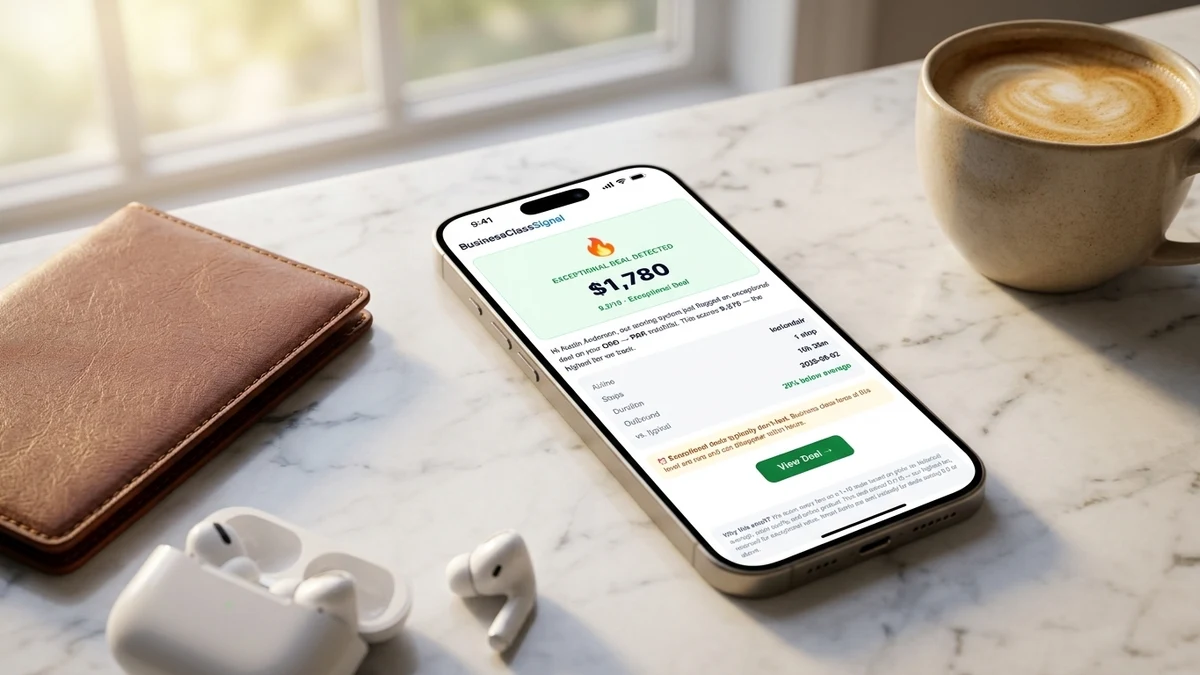
Here's something I've noticed: people set up fare alerts and then mostly forget about them until they get a notification. Which is fine — that's the point of automation. But the subscribers who get the most value from a tool like BusinessClassSignal are the ones who actually read the weekly market briefings.
A market briefing, in this context, is a short report on what's happening with fares across the routes you're monitoring. Not "here are all the prices" — that's just data. A useful briefing tells you things like: transatlantic business fares have softened 8% over the past two weeks as summer inventory opens up; Emirates has been releasing J-class award space more aggressively on DXB-JFK; the BA sale that ran last month is showing signs of repeating based on historical patterns.
That's price intelligence flights analysis in its most useful form. It shifts you from reactive (waiting for an alert) to informed (understanding the shape of the market before you need to book).
If your travel dates are flexible by even 2-3 weeks, read the market briefing before you decide when to fly — not after. The briefing often reveals that a fare on your route is trending down, which means waiting a bit longer could save you significantly.
I'll admit I was skeptical of market briefings when we first added them. Felt like filler. But the feedback from subscribers changed my mind pretty quickly. The people who read them book better deals, more consistently, because they're not making decisions in a vacuum.
Using price intelligence to decide when — not just where — to book
Most people think about flight research as a destination question. "I want to go to Tokyo, what's the best price?" But experienced travelers know that timing is often more important than routing.
Price intelligence flights data makes the timing question answerable in a way that gut instinct can't. When you have 90 days of fare history on a route, you can actually see the patterns: when prices typically bottom out, how far in advance deals tend to appear, whether there's a consistent day-of-week effect on releases.
JAL JFK-NRT in business class, for example, tends to see its best fares in the 60-75 day booking window for shoulder season departures. Not always. But often enough that if you're watching the route and you see a fare drop in that window, you should take it seriously. If you see the same price at 120 days out, historical data suggests patience is probably the right call.
None of that is something you'd figure out from checking Google Flights a few times. It comes from sustained monitoring and trend analysis.
When should you actually pull the trigger on a business class fare?
This is the question I get most often, and it's the one where price intelligence earns its keep.
The honest answer is: when the fare is materially below the 90-day average for that route and date range, and when you have a credible reason to think it won't go lower. That second part is the hard part. You're never going to be certain. But trend data helps.
If a fare has been dropping steadily for two weeks and is now 30% below baseline, that's a different situation than a fare that spiked down for 18 hours and is already recovering. The first might keep falling. The second is probably a brief inventory release that's already closing. Monitoring systems can show you which one you're looking at.
My personal rule: if a fare is more than 25% below the 90-day average and I can live with the routing, I book. I've missed a few deals by being too patient. I've also saved myself from booking a fare that dropped further two weeks later. On balance, the 25% threshold has worked well for me on transatlantic routes. On transpacific routes, where fares are more volatile, I tend to act faster.
The difference between a price alert and actual price intelligence
I want to be specific about this because the distinction gets blurred by a lot of marketing language in this space.
A price alert is a notification. It tells you a price crossed a threshold. That's useful. It's not intelligence.
Price intelligence adds the layer of interpretation. It tells you why the price moved, whether it's likely to hold, how it compares to historical norms, what the seat product is actually like at that price, and whether the routing is worth the fare. It turns a data point into a decision-support tool.
BusinessClassSignal's alerts include a fare context score — a quick indication of whether this deal is exceptional, good, or just okay relative to what we've seen on this route. That score has saved subscribers from booking "deals" that were actually just normal prices they hadn't seen before. It's also pushed people to act quickly on fares that looked expensive in isolation but were historically rare.
Singapore Airlines LHR-SIN in business class is a good example. The Suites and Business Class products on that route are genuinely excellent — I've done the trip twice and the food alone is worth writing about. But the fare can swing dramatically. I've seen it at $2,800 round-trip and I've seen it at $5,400 for the same dates six weeks apart. Without historical context, you wouldn't know which is which.
Trend analysis and AI insights: what they're actually good for
AI in travel is one of those areas where the hype has completely outrun reality. So let me be straightforward about what the AI layer in a price intelligence system is actually good at, and what it isn't.
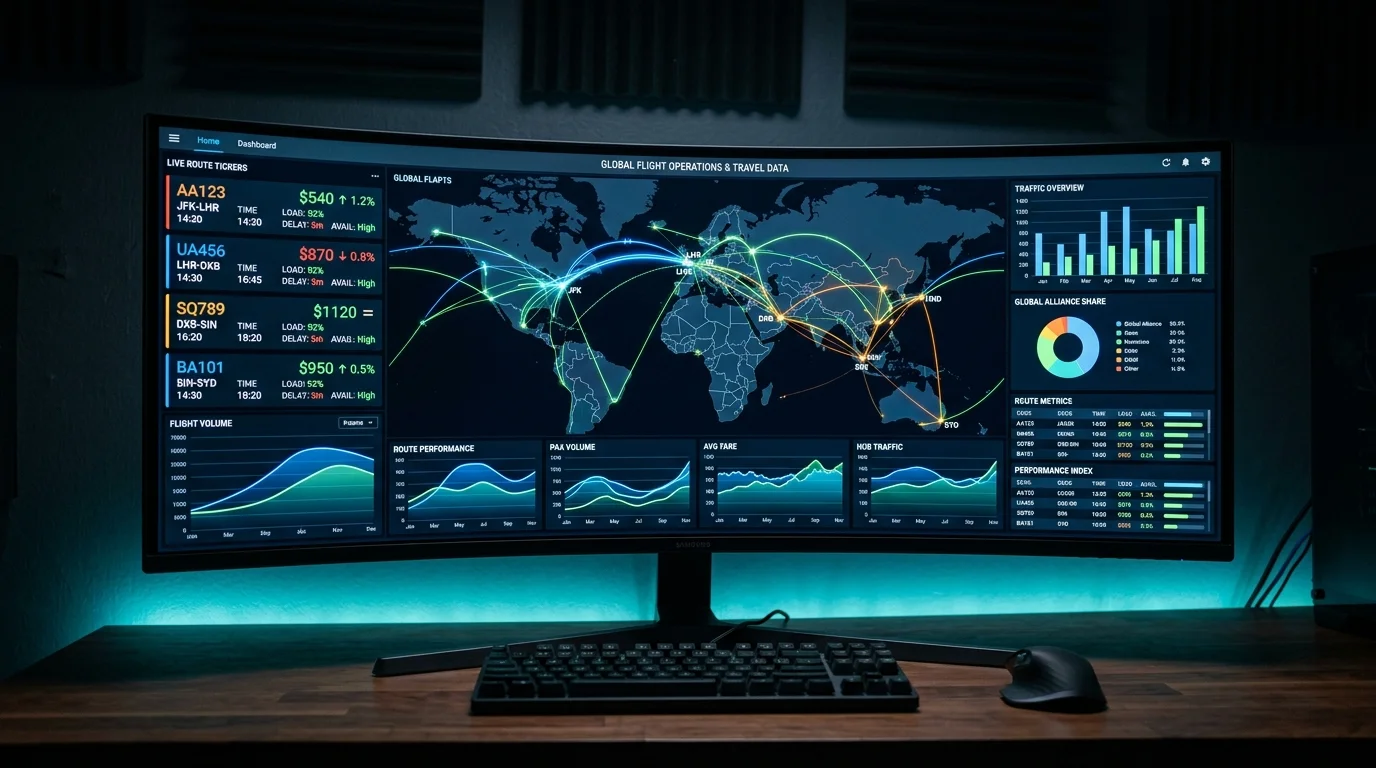
It's good at spotting patterns across large datasets faster than any analyst could. When you're monitoring 800+ routes and building fare histories across hundreds of airlines, seat classes, and date combinations, there are correlations that simply aren't visible to the human eye. An AI model can flag, for instance, that United tends to release discounted Polaris inventory on routes where Air Canada has just dropped its own fares — a competitive response pattern that repeats often enough to be predictive.
It's also good at anomaly detection. When a fare appears that's far outside the expected range — either much lower or much higher than the model predicts — it gets flagged for immediate alert. That's how flash sales get caught within minutes of going live rather than hours.
What AI isn't good at: predicting the future with any real confidence. Anyone who tells you their system can reliably forecast where fares will be in 30 days is overselling. The models can identify probabilities and tendencies. They can't account for a sudden capacity change, a new route announcement, or a fuel price shock. Use the insights as one input, not as gospel.
If you're also looking at economy for part of a trip — maybe positioning flights to reach a hub, or mixing cabins on a long itinerary — FlightKitten does the same kind of continuous monitoring for economy fares across 220+ airlines. It's about $4.99 a month and works well alongside BusinessClassSignal if you're planning a trip where not every segment needs to be in business.
How price intelligence applies to specific routes
Abstract principles are fine, but let me get concrete about a few routes where this kind of monitoring pays off most dramatically.
Transatlantic — JFK or EWR to London, Paris, Frankfurt — is probably where price intelligence flights monitoring generates the most savings per booking. These are heavily competed routes with a lot of inventory movement. BA, Virgin, United, Lufthansa, Air France, and AA are all competing, and their yield management systems are constantly adjusting against each other. The fare volatility is real, and the difference between a good deal and a bad one is often $1,500 or more on a round-trip.
Transpacific routes — US to Japan, South Korea, or Southeast Asia — are less volatile day-to-day but have more dramatic periodic drops. Airlines like JAL, ANA, and Korean Air release promotional fares on these routes a few times a year, and they go fast. If you're not monitoring, you'll read about it on a deal forum two days after it's expired.
Browse all monitored routes to see which corridors we're tracking and what the current fare baselines look like. The route page gives you a quick sense of historical ranges before you even set up a monitor.
Intra-Europe business class is a different animal — the fares are lower but the seat products are often mediocre (I've sat in more recliner-style "business" seats on European routes than I care to remember), and the value calculation is different. Price intelligence still matters here, but the savings percentages tend to be smaller in absolute terms.
Setting up a monitoring strategy that actually works
There's a right way and a wrong way to set up fare monitoring, and I've seen subscribers do both.
The wrong way: set a wildly optimistic target price, never get an alert because the fare never reaches it, and conclude that the tool doesn't work. I've seen people set a $900 round-trip target for JFK-LHR in business class. That's not a fare. That's a fantasy.
The right way: look at the 90-day average for your route, set your target at 20-30% below that average, and treat any alert as a genuine buying signal. You'll get fewer alerts, but the ones you get will be real.
Set separate monitors for different date windows on the same route. A fare that never drops 30% below average at 120 days out might drop significantly at 60 days. Monitoring both windows gives you more shots at a deal without requiring you to be flexible about your actual travel dates.
The other thing I'd recommend: don't set up monitors for routes you're not actually going to book. It sounds obvious, but I've seen people monitor 20 routes out of curiosity and then get alert fatigue. Keep it focused on the trips you're actively planning. The signal-to-noise ratio matters.
For subscribers who want to understand the full mechanics of how the alerts are generated and what the fare context scores mean, the how it works page goes into more detail than I will here. Worth reading before you configure your first monitor.
What price intelligence won't fix
I'd rather tell you the limits of this stuff than pretend it's a cure-all.
Price intelligence won't help you if your dates are completely fixed and non-negotiable. A monitoring system gives you the best possible price within the market conditions that exist. If you absolutely have to fly JFK-LHR on December 23rd in business class and come back January 2nd, the market is what it is. Monitoring might save you a few hundred dollars, but the fare is structurally high around the holidays and no algorithm changes that.
It also won't compensate for a bad seat product. I've been on British Airways Club World in the old herringbone configuration — the one where your feet point toward a stranger's head — and no amount of fare savings fully makes up for 7 hours of that. Price intelligence tells you what something costs. Knowing whether it's worth it still requires you to research the aircraft and seat configuration separately. Check SeatGuru, check the airline's fleet page, check which aircraft is scheduled for your specific flight.
And price intelligence monitors published fares. It doesn't track award availability or credit card partner redemptions. If you're primarily using miles, you need different tools. BusinessClassSignal is built for cash fares and revenue tickets.
Monitor your routes with BusinessClassSignal — 14-day free trial, no credit card required
Try FreeIf you've been manually checking fares for a trip you're planning, the trial is worth setting up just to see what the 90-day baseline looks like on your route. You might find the fare you've been watching is actually quite normal, or you might find it's already near a historical low. Either way, you'll be making the decision with actual data rather than a guess.
London, Tokyo, Singapore, Dubai — the routes where business class price intelligence pays off most are also the routes most people care about most. That's not a coincidence. These are the long-haul segments where the difference between a good fare and a bad one is measured in thousands of dollars, and where sitting in a decent seat for 12 hours actually matters.
The market moves fast. The tools exist to keep up with it. Whether you use them is the only variable you actually control.