
Quick summary
Turkish Airlines runs the best-value business class product on nonstop flights from the US to Istanbul, with fares regularly dropping to $2,200–$2,800 round-trip if you catch the right window. The Istanbul Airport lounge is genuinely one of the best airport lounges in the world — not just hype. And IST has quietly become one of the most useful connecting hubs if you're continuing into the Middle East, Central Asia, or Africa.
Why Istanbul keeps showing up on my radar
I've been watching the US-to-Istanbul route for a few years now, and it's one of those markets that consistently surprises people. Most travelers assume the best business class deals are on routes like New York to London or Chicago to Frankfurt. Those routes are competitive, sure, but Istanbul tends to fly under the radar — and that's exactly where the deals live.
Istanbul sits at a genuinely useful geographic crossroads. It's roughly 10–11 hours from the East Coast, which puts it in that sweet spot where a flat business class bed actually matters. You land, you need to function. And if you're connecting onward — to Nairobi, Riyadh, Karachi, or a dozen other places that don't have great direct service from North America — IST makes a lot of sense as a hub.
But the real story here is Turkish Airlines. They operate nonstop service to Istanbul from New York (JFK), Los Angeles (LAX), Chicago (ORD), Miami (MIA), Boston (BOS), San Francisco (SFO), Houston (IAH), and Washington Dulles (IAD). That's more US gateways than most people realize.
What business class to Istanbul actually costs
Let's talk numbers, because this is where things get interesting.
The published business class fare from JFK to IST can run anywhere from $3,500 to well over $6,000 round-trip. That's the rack rate. You'll occasionally see it there during peak summer and holiday windows, and honestly, it's not worth it at that price when there are other options.
But the fare drops are real and they happen more often than you'd think. I've tracked round-trip business class fares from JFK to Istanbul dipping to $2,200–$2,400 during off-peak windows, particularly in late January through March, and again in early November. From LAX, the floor tends to be a bit higher — around $2,600 — simply because the routing involves a longer transcon leg and Turkish prices it accordingly.
The pattern I've noticed: Turkish tends to drop fares on Tuesday and Wednesday mornings US Eastern time, and the sales windows are short — sometimes 24 to 48 hours. If you're not watching the route actively, you'll miss them. That's exactly the problem BusinessClassSignal was built to solve. The monitoring system scans routes like JFK–IST and LAX–IST twice daily and sends you an alert the moment the fare crosses below your target threshold. You can read more about how the monitoring system works if you want the specifics.
Is business class to Istanbul worth it at these prices?
At $2,200–$2,500 round-trip, yes. Clearly yes. That's roughly what you'd pay for a decent premium economy ticket to Europe on some carriers, and you're getting a fully flat bed on a 10-hour flight.
At $4,000+, the math gets murkier. You could position to a European gateway and connect on a shorter haul, or look at miles redemptions. Turkish Miles&Smiles is a useful program, but award availability in business class on Turkish metal has gotten tighter over the last couple of years. The sweet spot for cash fares is under $3,000 round-trip, and those fares do exist — you just have to be ready to move when they appear.
Miles alternative worth knowing
Star Alliance partners can book Turkish Airlines business class using their own miles. United MileagePlus prices JFK–IST at 70,000 miles round-trip in business class. Not a steal, but worth knowing if your miles are sitting in a United account.
The Turkish Airlines business class product

Turkish flies a mix of widebody aircraft on US routes — primarily the Boeing 777-300ER and the Airbus A350-900. The experience varies a bit depending on which aircraft you're on, and it's worth checking before you book.
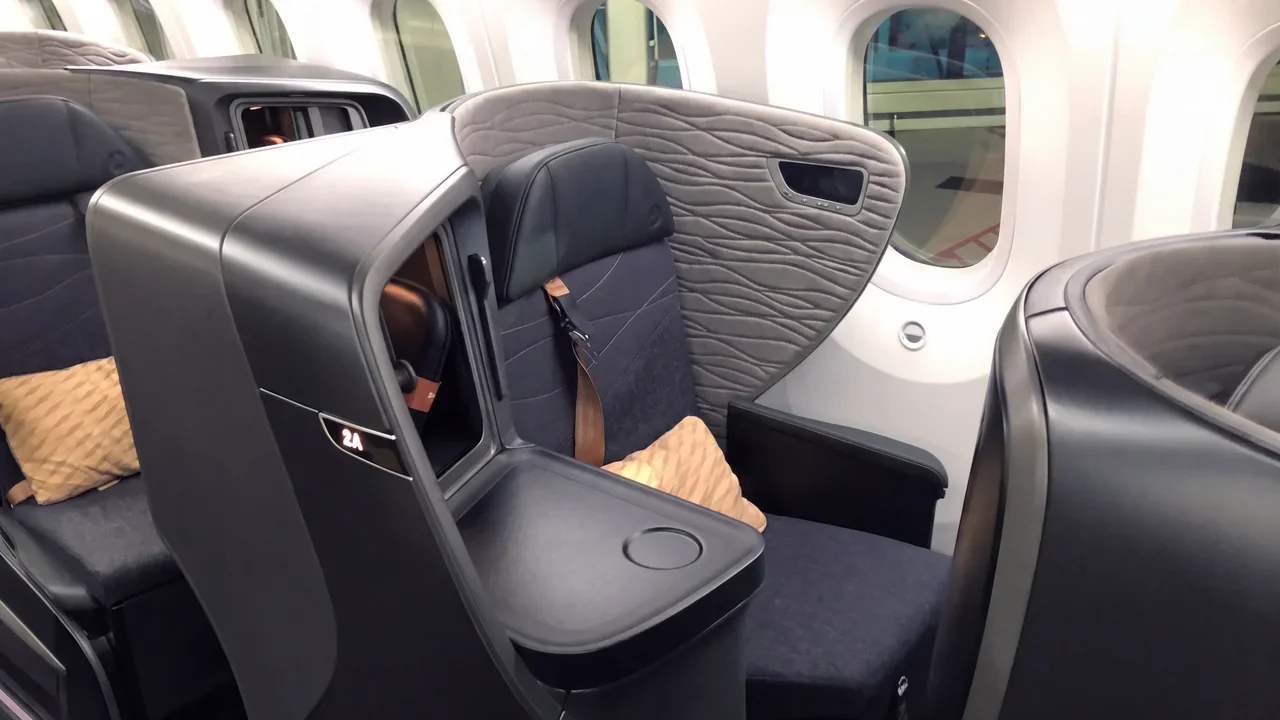
The 777-300ER configured for long-haul routes has a 2-2-2 business class layout in most configurations. That means the middle seats require climbing over your neighbor if you're in a window seat, which is annoying on a 10-hour overnight. The seats themselves are fully flat and reasonably wide, but the privacy isn't what you'd get on a Qatar Qsuites or a Singapore product. If you're traveling solo, I'd push for a window seat — 4A or 4K are typically the ones to target on the main 777 configuration.
The A350 is the better aircraft. Turkish has been expanding A350 service on transatlantic routes, and the seat is more modern, with better individual storage and a slightly quieter cabin. Check the aircraft type at booking — and check again 72 hours before departure, because Turkish does swap equipment occasionally.
How does the food compare to other airlines?
Better than most. This is one area where Turkish genuinely earns its reputation. The catering is handled in part by DO&CO, the Austrian catering company that also supplies Austrian Airlines and a few other carriers. What that means in practice: the food is actually good.
On the JFK–IST overnight, the dinner service typically starts with a meze selection — stuffed vine leaves, hummus, tabbouleh — followed by a proper main course. I've had a very decent lamb shish on the New York departure that I'd put up against business class meals on most European carriers. Breakfast before landing is lighter, usually pastries and fruit with Turkish tea service, which is a nice touch.
The wine list is adequate but not exceptional. Turkish is a dry airline officially, but they do serve alcohol in business class on international routes. The selection tends toward standard European labels. Don't expect anything remarkable.
The Turkish tea service — proper çay in those small curved glasses — is worth staying awake for. Ask for it specifically if the crew doesn't come around after the meal service.
One honest note on the service: it can be inconsistent. I've had flights where the crew was attentive and warm, and I've had flights where the middle section of the cabin was basically ignored for two hours. The product is there. The execution varies.
The Istanbul Airport lounge — let's actually talk about it
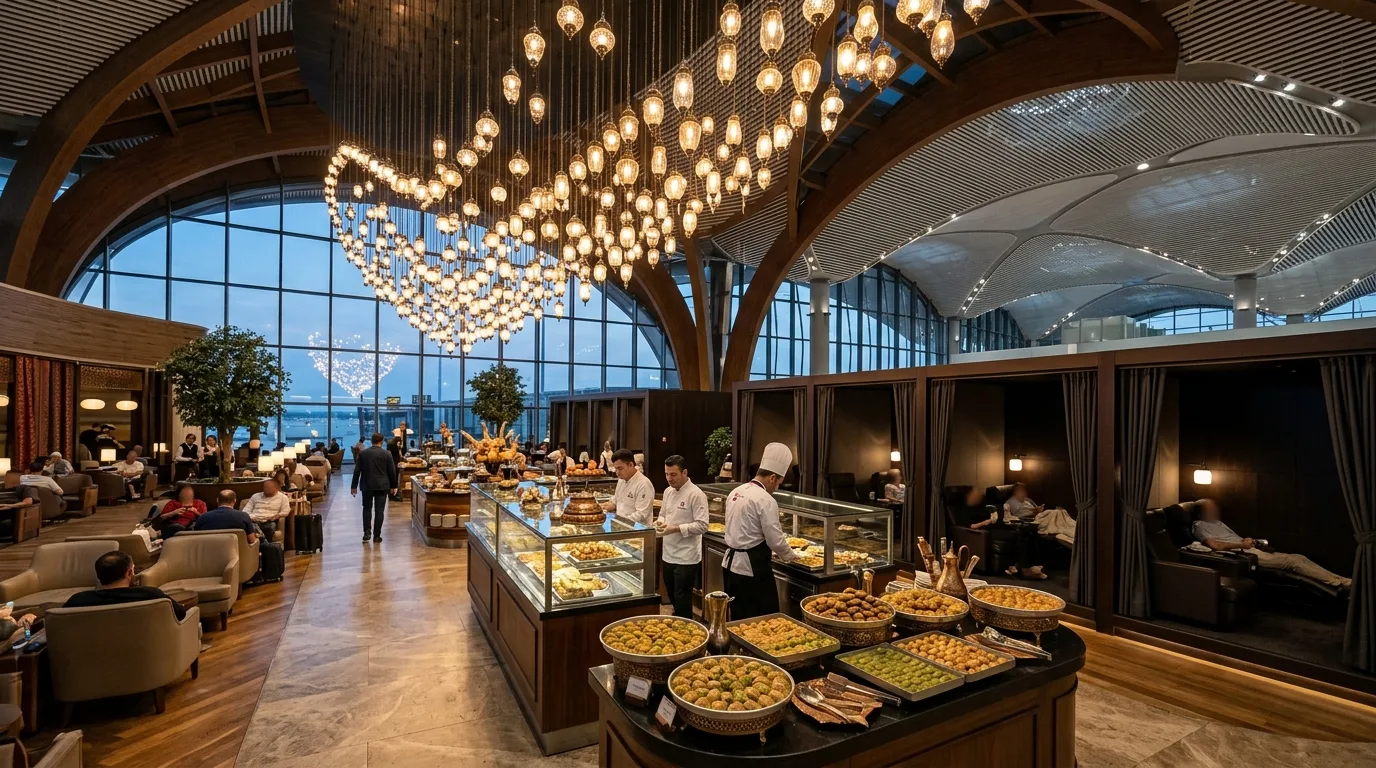
The Turkish Airlines lounge at Istanbul Airport (IST) gets called the best airport lounge in the world fairly regularly. I've been through it multiple times now, and I think that ranking is roughly accurate — with some caveats.
The lounge occupies about 53,000 square feet across two floors in the international terminal. It has a restaurant with live cooking stations, a library, a cinema room, a golf simulator, spa facilities with proper massage rooms (bookable, not just walk-in), a kids' area, and sleeping pods. The scale of it is genuinely impressive the first time you walk in. It doesn't feel like an airport lounge. It feels like someone built a business hotel inside a terminal.
The food is the headline. The live cooking stations produce fresh gözleme, Turkish breakfast spreads with multiple types of cheese and olives and eggs cooked to order, and proper hot mains throughout the day. The baklava is freshly made. I've eaten better in that lounge than in some restaurants I've paid for in airports elsewhere. The JFK Flagship Lounge, which used to be the benchmark for transatlantic business class lounges, isn't in the same league for food.
Here's the caveat: Istanbul Airport is enormous, and connecting through it during peak periods means the lounge gets crowded. Specifically, the 8–11am and 4–7pm windows when half of Europe and the Middle East is transiting can feel overwhelming. The seating fills up, the cooking stations have queues, and the spa books out hours in advance. If you're transiting, get to the lounge early.
Spa booking fills fast
The massage and spa services at the IST lounge are complimentary for business class passengers, but you need to book a slot at the desk immediately when you arrive. Walk past the desk on your way to the food stations and you'll find it fully booked for your entire layover.
Access to the lounge is for Turkish business class passengers and Star Alliance Gold members traveling on Turkish. If you're transiting through IST on a Turkish business class ticket — even a discounted one — you're in.
Flying into IST: what to know about the airport
Istanbul Airport (IST) opened in 2018 and replaced the old Atatürk Airport, which has been closed to commercial traffic since. The new airport is massive — it's designed to handle 90 million passengers annually in its current phase, with expansion underway. Architecturally it's impressive. Operationally, it can be a bit of a slog.
Arrivals from the US clear Turkish immigration at IST, which has improved significantly. There are e-gates now for US passport holders that typically move faster than the staffed desks. Budget about 20–30 minutes for immigration during normal hours, more during summer peak. Baggage claim on the international level is reasonably efficient.
Getting into Istanbul from IST is not quick. The airport is about 35–40 kilometers northwest of the city center. The Havataş airport bus runs regularly to Taksim Square for around 100 Turkish lira (roughly $3 at current rates), and the M11 metro line connects to the main Istanbul metro network. A taxi or rideshare to central Istanbul runs about 400–600 TL depending on traffic, which is still cheap in dollar terms given the exchange rate. But traffic on the O-7 highway into the city can be brutal. Don't book a taxi and assume you'll make a dinner reservation in two hours. Give it three.
If you're spending time in Istanbul before or after your flight, the Karaköy and Beyoğlu neighborhoods are far more interesting for food and hotels than the tourist-heavy Sultanahmet area. The hotel prices in Karaköy are also lower for equivalent quality.
Booking business class to Istanbul: timing and strategy
The best fares on Turkish Airlines tend to appear 4–8 weeks before departure. This is a bit shorter than the typical 8–12 week sweet spot on many transatlantic routes, which catches people off guard. I've seen genuinely good fares appear as close as 3 weeks out when Turkish is filling seats.
Avoid booking in June, July, August, and the two weeks around Christmas and New Year's. Those windows are expensive and the fares don't drop. Late January through March is consistently the best window for low fares, and the city itself is perfectly pleasant in that period — fewer tourists, cooler weather, no problems getting into restaurants.
One thing worth checking: Turkish sometimes prices the outbound and return separately in a way that creates weird asymmetries. I've seen round-trip fares where adding a second destination (say, flying JFK–IST–DXB and then DXB–IST–JFK as an open jaw) was actually cheaper than the straight round-trip. Turkish's hub structure makes this possible. If your trip has any flexibility at all, it's worth playing with the routing.
Open-jaw routing trick
JFK to Istanbul outbound, then connecting to a second city (Dubai, Nairobi, Amman), and returning to JFK via IST can sometimes price lower than a straight IST round-trip. Turkish's network into Africa and the Middle East is genuinely extensive — over 340 destinations worldwide — which gives you options.
BusinessClassSignal monitors the JFK–IST, LAX–IST, ORD–IST, and other US-to-Istanbul routes as part of its standard coverage. You can start monitoring this route or browse all routes to see what else is being tracked. The alert system doesn't require you to check manually — you set a target price and it tells you when the fare crosses it.
Other airlines flying business class to Istanbul
Turkish Airlines is the obvious choice, but it's not the only one.
Lufthansa, Swiss, Air France, and British Airways all offer connections to Istanbul via their respective hubs. The business class products on those carriers are fine — I have no complaints about the Lufthansa Business product or the Air France flat bed — but you're adding a connection, and the connection time at FRA or CDG or LHR adds hours to a trip that's already long enough. You're also giving up the IST lounge on the far end if you're flying a different carrier into Istanbul.
The connection math sometimes works in your favor on price. I've seen JFK–FRA–IST on Lufthansa price around $2,100 round-trip during sales, which is genuinely cheap for two business class segments. But you're looking at a 15+ hour total travel time versus 10 hours nonstop on Turkish. For most people, the nonstop is worth a few hundred dollars more.
Qatar Airways through Doha is another option worth knowing about. The Qsuites product is the best business class seat currently flying, and QR's prices to Istanbul via DOH can be competitive. The catch is that you're adding 3–5 hours of connection time in Doha, and the total journey from the US East Coast to Istanbul on Qatar runs 17–20 hours depending on the connection. If Istanbul is your final destination and not a hub stop, that's a lot of time in the air for a trip that Turkish does nonstop in 10.
Is IST worth using as a connecting hub?
This is something I get asked a lot, and my answer is: yes, under the right conditions.
Turkish Airlines has one of the widest networks of any carrier into Africa, the Middle East, and Central Asia. If you're flying from the US to Nairobi, Accra, Lagos, Islamabad, Almaty, or Tbilisi — and you want to do it in business class — IST is often the best routing available. The connections are generally efficient (the airport is designed for it), the business class cabin continues on the onward leg, and the lounge time in Istanbul is genuinely pleasant rather than a punishment.
Where it falls apart is on very short connections. Turkish minimum connection time at IST is 60 minutes, but I wouldn't book anything under 90 minutes, and two hours is more comfortable. The airport is large, and if your inbound flight is slightly delayed — which happens — a 75-minute connection becomes a sprint. I've made it. I've also missed it once, which required a rebooking conversation I don't need to repeat.
For pure Istanbul trips, the hub question is moot. But if Istanbul is your entry point into a broader region, it's one of the better-positioned airports in the world for exactly that purpose.
Monitor business class fares to Istanbul — get alerted when prices drop below your target
Try Free for 14 Days