Quick summary
Business class to New Delhi from the US runs $2,800–$5,500 round-trip at standard pricing, but fares drop into the $1,800–$2,400 range a few times a year on Air India and occasionally on United. The nonstop options from JFK and EWR are genuinely good — Air India's new A350 product in particular is worth the seat. Set up a fare alert and wait for a price drop before you book.
The state of business class to New Delhi right now
Delhi is a long haul. From New York, you're looking at roughly 14–15 hours nonstop, and if you're connecting through the Gulf or Europe, add another four to six hours on top of that. Doing that in economy is doable, technically, but it's the kind of trip where the upgrade math actually starts making sense. Not just for the flat bed — for the ability to arrive in Indira Gandhi International and function like a human being.
The good news: there are now more decent options for business class to New Delhi from the US than there were five years ago. Air India has been genuinely investing in its product since the Tata acquisition. American is running a nonstop that's worth knowing about. And United, while not flashy, is a solid choice depending on your home airport and loyalty situation.
The bad news: published fares on this route are expensive. You'll regularly see $4,000–$5,500 round-trip business class on this route, which is hard to justify unless someone else is paying. The route rewards patience, specifically the patience to wait for a fare drop.
The nonstop question: who flies it and from where
There are currently three meaningful options for nonstop business class to New Delhi from the US East Coast. Let me run through them honestly.
Air India operates daily nonstop service between JFK and DEL on the A350-900. This is the one I'd steer most people toward right now. The A350 cabin Air India has configured is a real step up from the old 787 product — 1-2-1 layout in business, decent seat width, and a direct-aisle seat for everyone. The catering has improved noticeably since the Tata takeover, though service consistency is still a work in progress depending on which crew you get. I've had genuinely excellent service on this route and I've had service that was... fine. Expect variability.
Air India's business class lounge access at JFK is through the Air India lounge in Terminal 4 — it's not going to win any awards, but it's functional and the food skews Indian, which I actually appreciate on this particular route. The real lounge experience on this run is at the Delhi end, where the Air India First/Business Lounge in T3 is a solid product.
American Airlines runs a nonstop between JFK and DEL on the 777-200ER. Here's the honest take: the American 777 business class seat is showing its age. It's the Zodiac Aerospace seat in a 2-2-2 layout, which means if you're in the middle section, you're climbing over someone to get to the aisle. Book a window seat in this cabin or don't book it at all. The aisle-access seats (A, K on most configurations) are what you're targeting. That said, American's network and AAdvantage redemption opportunities can make this route attractive if you're already deep in that ecosystem.
United flies EWR–DEL nonstop on the 787-9, which is a better seat than the American 777 product. United's Polaris configuration on the 787-9 is 1-2-1, direct aisle access for everyone, and the seat itself is genuinely comfortable for a 14-hour flight. United's food has never been the thing people rave about, but the seat does the job. If you're based in New Jersey or can easily get to Newark, this is worth a serious look.
Connecting options: when a stop actually makes sense

If you're flying from somewhere other than New York, or if the nonstop prices are painful and you have flexibility, connecting through a Gulf hub is worth considering. Emirates via Dubai, Qatar Airways via Doha, and Etihad via Abu Dhabi all serve Delhi with strong business class products — and they originate from cities like Houston, Dallas, Chicago, Los Angeles, and Washington.
Qatar's business class to New Delhi via Doha is genuinely excellent. The QSuites product, if you get it on the outbound long-haul leg, is the best business class seat I've personally sat in. The tradeoff is a longer total travel time — you're adding a connection and often a few hours — but if QSuites are available and the price is right, I'd take it over the American 777 product without hesitation.
Emirates through Dubai is another solid option. The Dubai–Delhi leg is short (3.5 hours), so you spend most of your time on the JFK–DXB or LAX–DXB segment, where the product is well established. The DXB airport connection is smooth if you know the terminal layout.
Gulf hub connections from the US West Coast
If you're flying business class to New Delhi from Los Angeles, San Francisco, or Seattle, Emirates, Qatar, and Etihad are your most competitive options. Air India's nonstop from SFO to DEL is also worth checking — it's a long flight but the A350 makes it manageable, and San Francisco fares sometimes come in cheaper than the New York–Delhi route.
How much does business class to New Delhi actually cost?
Published fares on this route are genuinely all over the place. I've seen Air India JFK–DEL business class listed at $5,200 round-trip in peak season (December, January, spring breaks) and drop to $1,900 during slower booking windows. United and American tend to hold their prices higher, but they occasionally have sales, particularly around the mid-January and late-September windows when demand softens.
The sweet spot I've tracked on this route over the past few years: Air India fares tend to drop most aggressively in February and early March, late September, and mid-November. Not always, and not on a schedule you can set your calendar to — but those are the periods worth watching. United tends to have its best prices in October and early February. American is less predictable.
If you're targeting an award ticket, Air India miles and United miles are both useful here. Air India's FFP (Flying Returns) has improved but still has quirks. United MileagePlus pricing on the EWR–DEL route is generally 70,000–88,000 miles round-trip in business, which is reasonable if you have the miles. American AAdvantage to DEL in business class runs around 57,500 miles one-way, which can be good value depending on how you accumulated those miles.
When do business class fares to Delhi drop?
There's no single answer, but there are patterns. The Delhi route is heavily influenced by Indian diaspora travel, which means fares spike around Diwali (October/November), the Christmas–New Year window, and the spring wedding season (roughly February–May). If your travel dates land anywhere near those periods, expect to pay more.
The windows I'd target for deals: early-to-mid October (before Diwali pricing kicks in), the first two weeks of February, and late September. Summer (June–August) is actually mixed — business travel dips but leisure travel picks up, so it's not reliably cheap.
One thing that catches people off guard: Air India has been running flash sales that last 48–72 hours and don't get widely publicized. These have come in $800–$1,200 below standard pricing. You won't catch them by checking Google Flights once a week. You need an alert system that's scanning the route regularly.
For Air India JFK–DEL, check fares on Tuesday and Wednesday mornings US Eastern time. Air India has historically loaded fare sales overnight Monday–Tuesday, and they often disappear by Thursday.
What the Air India A350 business class is actually like
I want to spend a minute here because Air India's reputation in the US is still trailing its actual current product. The Tata Group acquisition closed in early 2022, and the improvements since then have been real, even if they haven't been uniform.
The A350-900 that Air India deploys on JFK–DEL has 28 business class seats in a 1-2-1 configuration. The seat is the Collins Aerospace Super Diamond — same basic seat you'll find on British Airways Club World, though Air India's version has better soft product these days than BA's, which is not a high bar to clear. Direct aisle access from every seat. The window seats (A and K) have a bit more privacy. The middle pairs (D and G) work well for couples traveling together.
The IFE system is Panasonic eX3, decent selection, touchscreen works properly. The Wi-Fi is available but I wouldn't rely on it for video calls — it's adequate for email and messaging.
Food is where Air India has made the most visible effort. The business class menu on the JFK–DEL route has a proper Indian food selection and it's genuinely good. The dal makhani I had on my last flight was better than what I've gotten in some actual Delhi restaurants. The Western options are fine but unremarkable. Order Indian. There's no reason not to on this particular route.
Older Air India aircraft still in service
Air India is still flying some older 787-8 aircraft on certain routes and during irregular operations. The 787-8 business class seat is a noticeably inferior product to the A350. When booking, check which aircraft is scheduled for your specific flight — it matters more on a 14-hour haul than almost any other variable.
The United Polaris option from Newark
United's EWR–DEL route doesn't get enough attention. If you're in the New York metro area and you don't have a strong preference for JFK, Newark is worth considering — and the United Polaris product on the 787-9 is genuinely good.
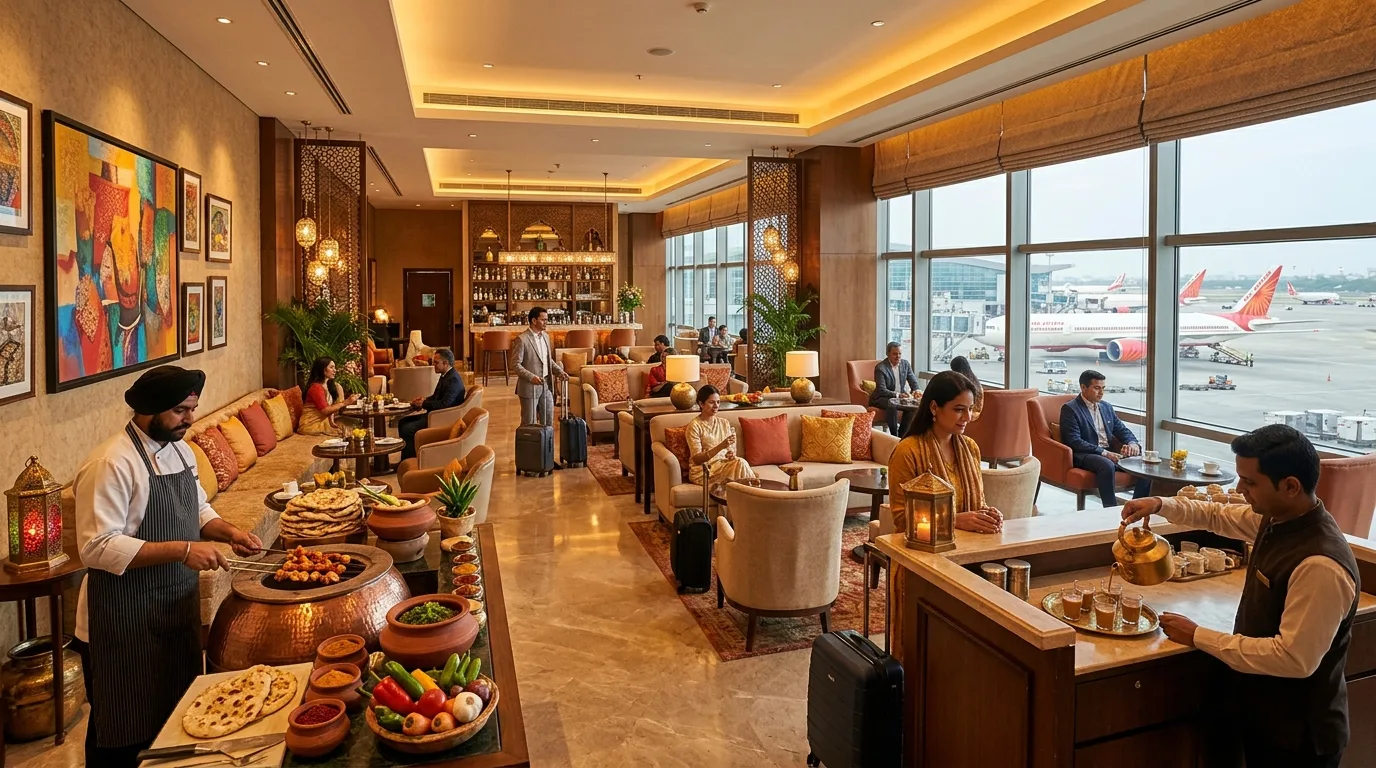
The Polaris seat is 1-2-1, which means everyone gets direct aisle access. The seat converts to a fully flat bed at 6'6" — longer than most business class seats, which matters if you're tall. United's bedding partnership with Saks Fifth Avenue is functional without being fussy. The mattress pad makes a real difference on a 14-hour flight.
The Polaris Lounge at Newark (Terminal C) is one of United's better domestic lounge offerings, though it gets crowded during peak evening departure windows. The EWR–DEL flight typically departs in the evening, so you'll be there during a busy period. Go early, find a seat, eat something — the lounge food is better than what you'd find airside at most terminals.
Where United falls short: the food in the air is inconsistent. I've had Polaris meals on this route that were genuinely good and I've had meals that felt like they were assembled without much thought. The service quality depends heavily on the crew, as it does on most carriers. United has been making noise about improving their catering, but I'd set your expectations at "solid" rather than "impressive."
Getting to and from Indira Gandhi International
This part gets skipped in most route guides and it shouldn't. Delhi's airport (IGI, IATA: DEL) is large and functional, but the ground experience matters, especially if you're arriving after a 14-hour overnight flight.
Terminal 3 handles all international arrivals, including all the carriers mentioned here. Immigration at T3 can be slow — 45 minutes to an hour is not unusual during peak arrival windows, and the 6–9am arrival cluster (when most US overnight flights land) is the worst of it. Priority lanes exist but aren't always meaningfully faster. Budget the time.
The Delhi Metro Airport Express Line connects T3 directly to New Delhi Railway Station and central Delhi. It's fast (about 20 minutes to New Delhi station), cheap, and runs from roughly 4:45am to 11:30pm. I've used it probably eight times and it's consistently the best way to get into the city if you're not going to a specific hotel that offers a pickup. Taxis and app-based cars (Ola, Uber) are available but traffic into central Delhi can be brutal depending on the time of day.
If you're arriving at T3 and plan to take the Metro, your baggage claim and the Metro station entrance are in the same building. Follow the signs for "Airport Express" — it's a short walk, not a shuttle. Most first-time visitors don't know this and end up waiting for a transfer that isn't necessary.
How to actually find a good fare on this route
I'll be straightforward here: checking Google Flights a few times and hoping for the best is not a strategy for this route. Business class fares to Delhi are volatile in a specific way — they spike fast and they drop fast. The sales that Air India runs are real, but they move in and out of availability quickly enough that casual checking will miss most of them.
BusinessClassSignal monitors the JFK–DEL, EWR–DEL, and SFO–DEL routes twice daily and sends alerts when prices drop below your target threshold. You set the price you'd actually book at — say, $2,200 round-trip — and you get notified when it hits. That's how this works. You can start monitoring this route on a 14-day free trial, no credit card required to start. I built the tool because I was tired of manually checking routes I was planning to fly myself.
The monitoring system scans 800+ business class routes and catches fare drops that typically last 24–72 hours. On the Delhi route specifically, I've seen alerts go out at $1,950 round-trip on Air India — that's roughly $1,000 below what the same seats were selling for two days earlier.
If you're also looking at economy options — maybe you're planning a longer trip with multiple people and mixing cabins — FlightKitten does similar fare monitoring for economy across 220+ airlines. It's about $4.99 a month and useful if you're booking a mixed itinerary or sending family members economy while you're up front.
Avoid booking too far out at high prices
Business class fares to Delhi don't reward early booking the way economy fares sometimes do. Booking 11 months out at $4,800 because "it's there" is usually a mistake. Airlines reprice these seats regularly. Unless you're booking around a fixed event (a wedding, a conference) where you absolutely cannot miss the date, wait for a fare drop.
A few things nobody tells you about flying business class into Delhi
The Air India lounge at T3 Delhi is actually worth your time. The food is good, there are private shower suites that are clean and well-maintained, and the pre-departure lounge for long-haul flights has a proper sit-down dining area. I've eaten better meals there than I have on some competitor flights.
On the return trip, T3 departure security for business class passengers has a separate lane that's genuinely faster. Use it — don't follow the signs to the main queue out of habit.
Air India's check-in at JFK Terminal 4 can be slow during evening departure rushes. The business class check-in counter is in a separate section but it doesn't always have enough staff. Give yourself 2.5 hours before departure if you're checking bags. That sounds like a lot but I've seen the queue back up in ways that will stress you out if you're cutting it close.
One more thing: Delhi's T3 has a 24-hour pharmacy and a proper food court on the departures level that's open late. If you're on an early morning departure and the lounges haven't opened their full service yet, it's a reasonable fallback.
You can browse all the routes we monitor if you're also looking at other destinations in South Asia — we track Mumbai, Bangalore, Hyderabad, and Chennai as well, and the fare patterns on those routes have their own rhythms worth knowing.
Monitor business class fares to New Delhi — get alerted when prices drop below your target
Try Free for 14 Days