The $2,000 ceiling is real — if you know where to look
I get some version of the same email every week. Someone's planning a trip to Europe or Asia, they've heard business class fares occasionally drop to sane prices, and they want to know if it's actually true or just internet folklore. The answer is yes, it's true. And no, you don't need to be a points hoarder with three credit card accounts and a spreadsheet addiction to take advantage of it.
Business class under $2,000 round-trip exists. I've personally booked it. The catches are real — timing, flexibility, and knowing which routes to watch — but the fares themselves aren't mythological.
What I want to do here is give you a working map of where these deals actually appear, when they tend to happen, and what you should realistically expect when you get there. Not every sub-$2K business class seat is worth celebrating. Some are genuinely excellent. Some are fine. A couple are seats you'll want to avoid even if the price is right.

Routes where business class under $2,000 is achievable
Let's start with geography. Transatlantic routes are where most of these deals concentrate, for a few reasons: there's real competition on the North Atlantic, airlines run a lot of capacity, and when seats don't fill, prices move. Fast.
The routes I watch most closely — and where I've personally seen or booked sub-$2K fares — cluster around a handful of city pairs.
New York to Dublin or Shannon
Aer Lingus flies this route and they are, without question, one of the most aggressive pricers in transatlantic business class. Their business cabin on the A330 — called "Business Class" simply, no fancy branding — uses a 2-2-2 configuration with fully lie-flat seats. It's not the most private setup in the world. You're next to a stranger if you're traveling solo. But the seats are solid, the food is genuinely good (the Irish smoked salmon starter is a real thing, not airline food theater), and pre-clearance through US customs in Dublin or Shannon means you land and walk straight out.
I've seen fares on this route hit $1,650–$1,900 round-trip during shoulder season. The trick is that Aer Lingus tends to release these fares quietly, often mid-week, and they don't last more than a day or two before filling or reverting. You can start monitoring this route and get notified the moment one surfaces.
Chicago or Boston to London
British Airways and Virgin Atlantic both operate these routes heavily, and competition between them keeps fares honest. When one drops, the other sometimes follows. Round-trips in the $1,800–$2,100 range appear a few times a year, particularly in the fall shoulder season (late September through mid-November) and again briefly in January and February.
A word on British Airways Club World from Chicago O'Hare: the seats are old-generation on some aircraft, with alternating forward- and rear-facing seats in a 2-4-2 layout. It's not terrible, but it's not what you'd call comfortable for a couple traveling together — you might be facing away from each other. Check the aircraft type when you book. The newer Club Suite on some 777 and A350 routes is a completely different experience, with a door and real aisle access. Same airline, very different product.
Virgin's Upper Class on the A330 is more consistent — same herringbone-style layout across the cabin — and their Heathrow Clubhouse lounge at T3 is legitimately one of the best airport lounges I've been in. The spa bookings fill up fast, though. Book before you leave home.
East Coast US to Reykjavik on Icelandair
Icelandair's Saga Class doesn't get enough attention. The product is honest — no door, no suite language, just a proper lie-flat seat in a quieter cabin — and the prices regularly fall below $1,800 round-trip from Boston, New York, or Seattle. Iceland itself is obviously the draw for some people, but Reykjavik also works as a positioning city if you're continuing into Europe.
US to Scandinavia on SAS
SAS Business runs on routes from Newark, Chicago, and Los Angeles to Copenhagen, Oslo, and Stockholm. The fares can be volatile — sometimes they're genuinely expensive, other times they crack under $2,000 with almost no warning. The SAS Plus product is what some routes carry rather than full business class, so read the fine print carefully. You want SAS Business, which has lie-flat seats in a 1-2-1 configuration on the A330 and A350. The 1-2-1 means every seat has direct aisle access, which matters on a seven-hour overnight flight.
West Coast to Tokyo or Seoul
This one's harder to hit under $2,000 but it does happen, particularly on Korean Air and Asiana routes from Los Angeles or Seattle. I've seen Korean Air Prestige Class (their business product) drop to around $1,900–$2,100 round-trip on the LAX–ICN route a handful of times. These are usually error fares or aggressive sale pricing tied to Korean holidays or slow booking periods, and they go fast.
Korean Air's Prestige Suites on the 787 are excellent. Fully enclosed, direct aisle access, genuinely good bibimbap. If you ever see this route under $2,000, book first and ask questions later.
Shoulder seasons are where the money is
Airlines price based on demand. That's obvious. But the specific windows where demand drops just enough to pull business class fares under $2,000 are narrower than people think, and they're different for every route.
For transatlantic routes, the windows I've tracked over the years look roughly like this:
- Late September to mid-November: Post-summer, pre-holiday. This is the most reliable window across European routes. Weather's still decent in most of Europe, crowds are down, and airlines have unsold inventory to move.
- January 10 through February: After the holiday rush collapses, there's a real lull. Fares can get aggressive. The downside is obvious — weather in northern Europe in January is what it is.
- Early May: Before Memorial Day kicks off summer demand. A two-to-three week window where fares sometimes soften before climbing hard through June, July, and August.
For Asia routes, the shoulder seasons shift. The period around Chinese New Year (typically late January or February) is heavily booked. But late October through early December can produce good fares on transpacific routes. March is underrated for Japan specifically — cherry blossom season starts in late March, so early-to-mid March fares are often lower before the demand spike hits.
The other variable is days of the week. Business class fares on Tuesday and Wednesday departures are consistently lower than Friday or Sunday. This holds across almost every route I monitor. If you have any flexibility on travel days, build your trip around a mid-week outbound and mid-week return.

Positioning flights — the move most people skip
Here's something I do regularly that most casual business class travelers don't think about: I fly to a different departure city to catch a better fare.
If you live in, say, Cleveland or Charlotte or Denver, you're often looking at connecting itineraries anyway. The question is whether it's smarter to book a connecting flight through a hub on the same ticket, or to buy a cheap positioning flight separately and catch the international leg as a standalone booking.
The math works more often than you'd expect. A $150 Southwest or Spirit flight from a smaller city to JFK, EWR, BOS, or ORD — plus a $1,800 transatlantic business class fare — often beats a $2,800 connecting itinerary originating from your home airport. You're also buying flexibility: if your positioning flight gets disrupted, you haven't put the whole trip on one booking.
The cities worth positioning through for transatlantic deals, in my experience: New York (JFK and EWR both matter — different airlines, different fares), Boston (Aer Lingus and Norse both operate here), Chicago O'Hare (United, American, British Airways, Finnair all compete), and Miami (sometimes overlooked but Iberia runs good fares to Madrid).
For transpacific, Los Angeles is the obvious hub. Seattle has gotten more interesting with Alaska's partnerships and some Korean Air/Asiana competition. San Francisco has United's Polaris product, which is genuinely good — the Polaris Business Class cabin on the 777-300ER with the new seats is one of the better products flying the Pacific right now.
How to actually catch these fares before they disappear
The honest answer is that manual searching doesn't work well for sub-$2,000 business class deals. Not because the fares aren't there, but because they're usually gone within 24–72 hours, often less. Airlines don't announce sales with fanfare. A fare drops, seats fill, it's over.
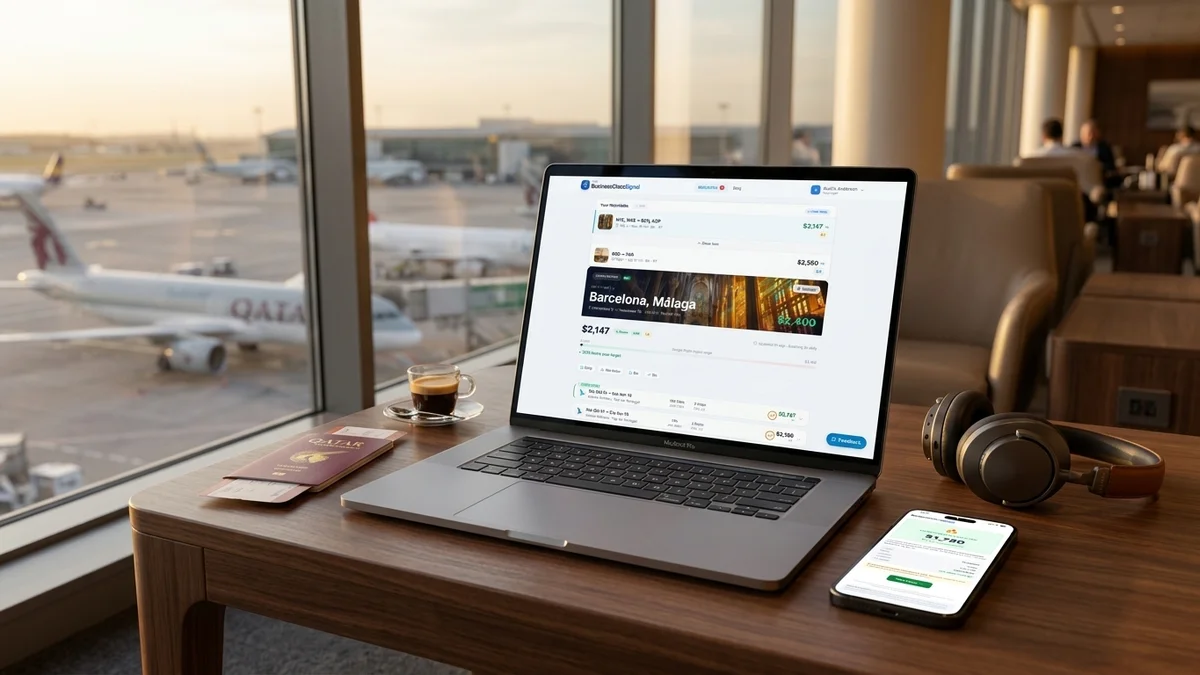
I built BusinessClassSignal around exactly this problem. The system scans Google Flights data multiple times a day, scores every deal it finds on a 1–10 scale (based on how far below market the fare is, how much inventory appears to remain, and how the route has historically performed), and sends alerts when something worth acting on appears. The AI market briefings give you context — whether a fare is a one-off or part of a broader pricing pattern on that route.
The free tier gets you one route to watch. If you have a specific trip in mind, that's enough to get started. The Core plan at $36/month makes sense if you're monitoring a handful of routes for an upcoming trip or two. Pro at $78/month is for frequent travelers who want full access across all routes and the deeper market analysis.
What I'd suggest: pick your two or three most likely routes, browse all routes we cover to see if yours are in the system, set up your monitoring, and then let the alerts do the work. The deals are real. You just need to be notified before they close.
A few tactical notes on what to do when an alert fires:
- Check the aircraft type immediately. Not all business class is equal. A 767 with old-generation seats in a 2-1-2 layout is a different experience than a 787 with proper suites. Google the aircraft and cabin before booking.
- Look at the layover, if any. A $1,750 business class fare with a two-hour connection in a cramped terminal is still a good deal. A fare with a six-hour layover at an airport with no usable lounge is worth thinking about twice.
- Book directly with the airline when possible. It's easier to manage changes, and some airlines restrict upgrades or lounge access on third-party bookings.
- Don't overthink it. I've watched people spend three days "researching" a fare that disappeared in 36 hours. If the price is right and the route works, book it.
What you're actually getting at this price point
One thing I want to be straight about: business class under $2,000 is not always the best business class. Sometimes it is. Sometimes it's a solid product at a fair price. And sometimes it's a discounted fare on an aging aircraft with a cabin that hasn't been refurbished since 2009.
The Aer Lingus A330 business class I mentioned earlier? Decent seats, no direct aisle access from window seats, but a genuinely good service and pre-clearance is a real perk. Worth it at $1,700. Worth it at $2,200 too, honestly.
Some older British Airways Club World configurations are less exciting. The seat works as a flat bed, but the alternating forward/rear-facing layout means the person "sleeping" across from you is essentially feet-to-head with you. It's not intimate. It's not terrible. But I wouldn't call it a premium experience — more like a functional one.
Icelandair's Saga Class is honest about what it is: a proper lie-flat seat, attentive service, decent food, no door, no suite. If you want the bells and whistles, you'll need to spend more or wait for a Singapore Airlines or Qatar deal to surface (they do occasionally, but sub-$2K on those carriers is rarer).
Korean Air Prestige on the 787 is legitimately excellent. If you catch that LAX–Seoul fare under $2,000, you're getting a product that competes with carriers charging $4,000 for the same route.
And that's sort of the point. The gap between a $1,800 business class fare and a $4,500 business class fare is not always a gap in product quality. Sometimes it's just a gap in timing and information. You paid attention, you were flexible, and you booked when the window opened.
Airlines and routes worth keeping on your radar
If I were building a watchlist right now for someone trying to fly business class under $2,000 in the next six to twelve months, here's where I'd focus:
- Aer Lingus from JFK, BOS, or ORD to Dublin or Shannon — Most reliable source of sub-$2K transatlantic business class deals. Watch fall and January windows closely.
- SAS from EWR or ORD to Copenhagen or Stockholm — Less consistent but worth monitoring. The A350 product is very good when you get it.
- Virgin Atlantic from JFK or BOS to London Heathrow — Upper Class drops occasionally, particularly in off-peak months. The Clubhouse lounge makes the layover part almost enjoyable.
- Finnair from JFK or ORD to Helsinki — Often overlooked. The A350 business class has a proper 1-2-1 layout and the fares occasionally dip below $2,000. Helsinki also works as a gateway to the rest of Scandinavia and the Baltics.
- Korean Air from LAX to Seoul (ICN) — Harder to catch but worth it when it happens. The Prestige Suite on the 787 is excellent.
- Iberia from MIA or JFK to Madrid — Iberia Business on the A350 is a sleeper pick. Good flat bed, decent food, and Madrid is an underrated arrival city. Fares occasionally crack $1,900 during slow periods.
You can browse all the routes we cover and set up monitoring on any of these. The system will do the watching; you just need to act when something worth booking comes through.
Business class under $2,000 round-trip isn't a fantasy. It's a timing problem. And timing problems are solvable.