Why summer business class is harder than people think
Every year around February, I start getting the same email from readers. Some version of: "I want to fly business class to Europe this summer — when should I book?" And every year I give them the same answer, which is: it depends on which airline you're watching, which route you're on, and whether you're willing to move fast when something breaks your way.
Summer 2026 business class deals exist. I've already seen early signs of them. But the window to catch them is narrower than most people expect, and the routes where they show up aren't always the ones you'd guess.
The problem is that summer is genuinely peak season for most transatlantic and transpacific routes. Airlines know this. Revenue management teams are good at their jobs. So when a fare drops — and they do drop, sometimes dramatically — it's usually because of a specific set of circumstances: a new route needing to fill seats, competitive pressure from a rival carrier on the same city pair, a schedule change that created unsold inventory, or just an algorithm doing something the airline didn't fully intend. These windows open and close in hours, sometimes minutes.
That's the whole reason BusinessClassSignal exists. But more on that later.
The booking timeline for summer 2026 — and why earlier isn't always better
Here's something that surprises people: booking business class too early can actually cost you money.
Airlines open long-haul routes roughly 330 to 355 days in advance. At that point, they typically price business class conservatively — they're not discounting seats they expect to sell at full fare. The real deals tend to fall into one of two windows. The first is 5-8 months out, when airlines start loading promotional fares to stimulate early demand. The second is 6-10 weeks out, when unsold premium inventory starts getting marked down aggressively.
For summer 2026 — let's call that June through August — that puts your sweet spot roughly between October 2025 and January 2026 for the first window, and April through June 2026 for the last-minute push. Right now, if you're reading this in late 2025 or early 2026, you're sitting in the middle of the best time to be watching.
The catch with the last-minute window is obvious: you need flexibility. You can't plan a family trip to Rome on six weeks' notice if your kids are in school. But if you're a solo traveler or a couple with loose schedules, that second window can be extraordinary. I've seen transatlantic business class drop below $1,500 round-trip with six weeks to departure. Not often, but it happens.
What I tell most readers is this: start monitoring now, set your alerts for the routes you care about, and be ready to book within 24 hours when something moves. Waiting to "think about it" is how you lose a deal.

Routes most likely to produce summer 2026 business class deals
Not all routes are created equal when it comes to fare drops. Some city pairs have enough competition — multiple carriers flying the same route — that pricing pressure is structural. Others have one dominant airline that has no reason to discount. Here's where I'd be focusing my attention for summer 2026.
Transatlantic: the competitive corridors
The New York to Europe corridor remains the most reliably productive for deal hunters, specifically because so many carriers compete on it. You've got United Airlines, American, Delta, British Airways, Iberia, Lufthansa, Air France, Norse Atlantic (in premium economy, not business), and others all fighting for the same passengers. When one of them blinks on price, the others sometimes follow — or don't, which creates a brief, obvious arbitrage that informed buyers can exploit.
JFK to Barcelona is a route I watch closely. Iberia's Airbus A350 business class — they call it Business Class, no fancy branding — is genuinely good. Fully flat beds, direct aisle access from every seat, and the food is better than most U.S. carriers at 35,000 feet. Standard pricing on this route runs $4,000-$5,500 round-trip in summer. But I've seen it drop to the $1,900-$2,400 range during promotional windows, and when it does, it moves fast.
Similarly, Lisbon has become an increasingly interesting target. TAP Air Portugal's business class (they call it Executive) isn't flashy, but the fares on the JFK and Newark runs have been competitive, and Lisbon itself is a legitimate alternative to the more crowded summer destinations. Worth having on your radar.
London is trickier. Because it's the default European destination for American travelers, airlines price it accordingly. You can find deals, but you have to work harder for them. I'd look at secondary U.S. gateways — Chicago O'Hare or Washington Dulles — where competition sometimes produces better yields than JFK or LAX.
Transpacific: where the real volatility lives
The transpacific market has been in genuine flux since the pandemic reshuffled carrier capacity. ANA and Japan Airlines both have excellent business class products — ANA's The Room on the 777-9 is one of the best seats in the sky, full stop — and both carriers have been aggressive on pricing to rebuild load factors on routes like LAX to Tokyo Haneda or JFK to Narita.
Summer pricing to Japan is typically brutal because demand is high. But the June window, specifically the first two weeks of June before peak summer really kicks in, has historically been softer. Round-trips from the West Coast to Tokyo in business class can occasionally be found in the $3,200-$4,000 range during promotional periods, versus the $5,500-$7,000 you'll pay at peak.
Seoul is worth watching too. Korean Air's business class — Prestige Class on most long-haul routes — has a strong seat product on the 787-9, and the ICN layover for connections into Southeast Asia is one of the more pleasant transit experiences in Asia. Fares from the U.S. West Coast to Seoul have been competitive, and the airline has been expanding its U.S. routes.
Latin America: the underrated option
If you haven't seriously considered South America for a business class trip, you might be missing something. Browse the route data sometime and look at what LATAM and Copa are doing on U.S. to South America fares. Business class to Buenos Aires or Lima can occasionally be found at prices that would embarrass a transatlantic ticket.
And honestly? LATAM's business class product on their 787 routes is solid. Fully flat, reasonable pitch, decent food. Not Cathay Pacific, but not United's older domestic recliners either.
Which airlines actually drop business class prices in summer
This is where I'll be direct with you, because there's a lot of wishful thinking in the points-and-miles community about which airlines discount premium cabins.
Some carriers almost never drop business class fares meaningfully during peak summer. Emirates is one. Their pricing discipline on the DXB routes and on the U.S. to Europe via Dubai runs is extremely tight. You might find a marginal reduction, but the dramatic drops people expect from a carrier of that reputation are rare in summer. Their product is excellent — the A380 business class is still one of the best ways to cross the Atlantic — but you're going to pay for it in July.
Singapore Airlines is similar. Their fares are premium and they hold them. The occasional promotional sale exists, but timing it to summer is difficult.
On the other hand, carriers that have shown consistent willingness to discount summer business class:
- Iberia: Their periodic sales, often tied to Spanish public holidays or end-of-quarter pushes, can be dramatic. The JFK-MAD and JFK-BCN routes are the most productive.
- TAP Air Portugal: Smaller airline, more price-sensitive revenue management. When they have unsold seats, they move on price.
- Lufthansa Group carriers: Austrian, Swiss, and Lufthansa itself will discount on routes where they face meaningful competition. Frankfurt and Munich to U.S. cities can get interesting.
- ANA: Their international sales, when they run them, are legitimate. The challenge is they don't run them on a predictable schedule.
- American Airlines: Counterintuitively, AA has been known to drop transatlantic business class fares aggressively when trying to fill Flagship Business seats. The JFK to London and JFK to Paris routes in particular.
The carriers that almost never produce meaningful summer deals: Qatar Airways (they'd rather upgrade frequent flyers than drop the fare), Air New Zealand (capacity is limited and demand is high), and most intra-Asian carriers on premium routes.
How to actually find summer 2026 business class deals before they're gone
Let me be honest about what doesn't work before I get to what does.
Checking Google Flights manually every few days doesn't work. Not for business class deals, anyway. The fares that represent genuine opportunities — the ones where an airline has mispriced or is clearing inventory — typically exist for 4-24 hours. By the time you happen to check, they're gone. I've seen $1,800 round-trip transatlantic business class fares disappear in under three hours. And that's on a Thursday afternoon, not even a high-traffic browsing period.
Following airline social media accounts is marginally better, but airlines don't announce their best sale fares on Instagram. Those posts are usually for economy promotions or credit card sign-up bonuses. The real business class drops don't get announced — they just appear in the booking engine.
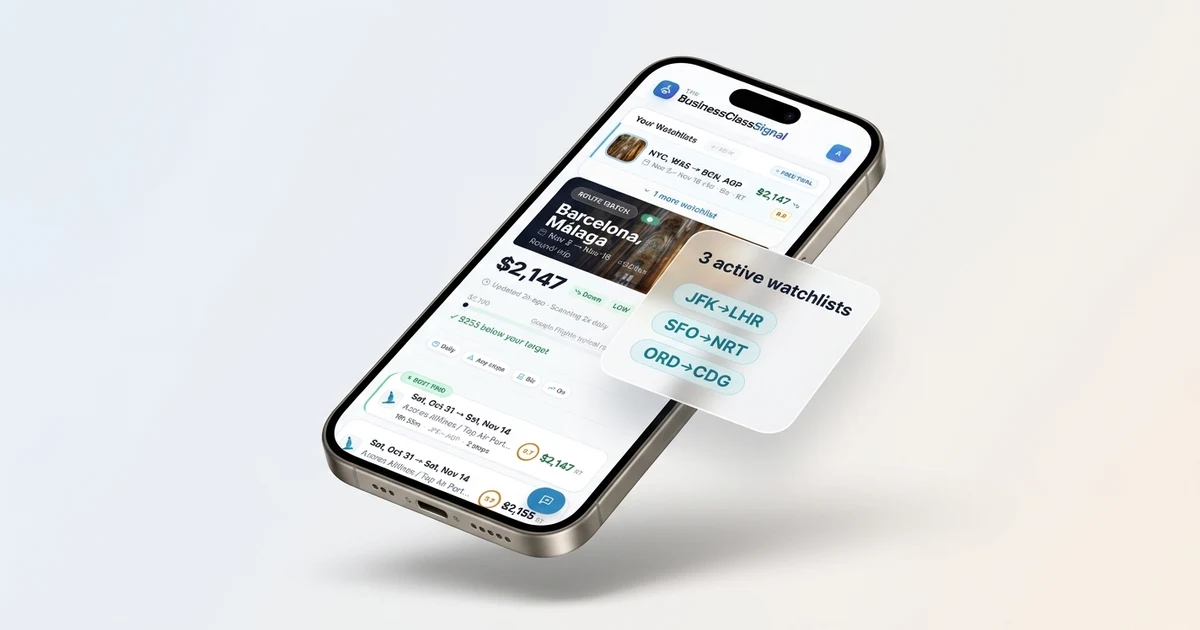
What actually works is systematic monitoring with alerts. You define the routes you care about, you set a price threshold that represents a genuine deal, and you get notified immediately when something hits that threshold. That's the model we built at BusinessClassSignal.
The monitoring system works by scanning Google Flights data multiple times throughout the day, running each fare through a scoring model that accounts for the route's typical pricing range, the time until departure, and the airline's historical discount patterns. Every deal gets scored from 1 to 10. A 9 or 10 means you should be looking at this immediately. A 6 or 7 means it's decent but not urgent. That context matters — a $2,800 round-trip to Tokyo might be a 9 if the route normally runs $5,500, but it's a 4 if there's been a sustained price war and $2,400 has been available for weeks.
The free tier gets you one route on watchlist. That's enough to test the system. Core ($36/month) opens up full route monitoring with email alerts. Pro ($78/month) adds AI market briefings — essentially a weekly summary of where pricing is moving on your routes and what patterns suggest about the next few weeks. For someone seriously planning a summer 2026 trip, Pro pays for itself the first time it catches a deal.
If you want to start monitoring this route — whatever your target is, JFK to Barcelona, LAX to Tokyo, ORD to Frankfurt — the setup takes about three minutes.
Booking strategy: what to do when you find a deal
Finding the deal is half the battle. The other half is actually booking it without talking yourself out of it.
I've watched people lose excellent fares because they wanted to check with their spouse, or look up hotel prices first, or sleep on it. I understand the impulse. Spending $2,000-$4,000 on airline tickets is not a small decision. But the math on hesitation is brutal. If the fare is a genuine deal — let's say it's a 9/10 score on our system — the expected cost of waiting 12 hours is higher than the expected cost of booking and potentially having to change dates for a fee.
A few tactical points that I've learned from doing this a long time:
- Book directly with the airline when possible. Third-party booking sites can be a nightmare if you need to change or cancel. The fare might be the same, but the service relationship is with the airline.
- Check change and cancellation fees before you book. Some airlines have become much more flexible post-pandemic. Others have quietly rolled back those policies. Know what you're committing to.
- Have your passport and credit card ready. This sounds obvious, but I've heard from people who found a deal and then spent 20 minutes looking for their passport number. That's 20 minutes you don't have.
- Look at the specific aircraft. A deal on a route where the airline is operating an older plane with angled-flat seats is a different proposition than the same price on a route with a new fully-flat product. Check SeatGuru or the airline's own seat map before you commit.
- Consider the layover honestly. A connecting business class fare through a hub you hate might be cheap for a reason. Six hours in a mediocre transit lounge at the wrong hour is not nothing.
One thing I do personally: I keep a running list of my target routes and approximate price thresholds in a notes app. When an alert fires, I don't have to think about whether this is the route I wanted or what price I was hoping for. I already know. Decision time drops from 10 minutes to 90 seconds.
What to realistically expect to pay — and what counts as a deal
Context matters enormously here. "Business class deal" means different things depending on the route, the carrier, and the time of year.
For transatlantic routes in summer 2026, here's roughly how I'd frame it:
- Under $2,000 round-trip: Exceptional. Drop what you're doing and book it.
- $2,000 - $2,800 round-trip: Very good. Still worth serious consideration if the routing and product work for you.
- $2,800 - $3,500 round-trip: Decent. Below average for peak summer, but not the kind of price that makes you feel like you won something.
- Above $3,500 round-trip: Standard or elevated summer pricing. Not a deal.
Transpacific benchmarks are higher given the distance. Round-trips from the U.S. West Coast to Tokyo or Seoul in business class: under $3,500 is excellent, $3,500-$4,500 is solid, above $5,000 is standard summer pricing.
Latin America is the wild card. Buenos Aires round-trip in business class from Miami can occasionally be found at $1,400-$1,800, which would be a remarkable value for a 10-hour flight. The baseline, though, is closer to $2,500-$3,500 in peak season.
The important thing is calibrating your expectations to the specific route. A "deal" on JFK to London and a "deal" on JFK to Tokyo are different numbers, and treating them interchangeably will either lead you to pass on something good or overpay for something mediocre.
Summer 2026 business class deals are out there. They will continue to surface between now and July. The question is whether you're positioned to catch them when they do.