Quick summary
Korean Air's Prestige Suite on the 787-9 is a genuinely good business class product — full doors, a solid flat bed, and some of the best airline food in the sky. It's not perfect, and the seat has a few quirks that'll matter depending on where you sit. But for the price, especially when fares drop below $2,000 round-trip on routes out of JFK or LAX, it's one of the stronger value plays in premium long-haul.
I've flown the Prestige Suite twice now — once on the Seoul to New York sector and once on a positioning flight from Narita. The product has genuinely improved. Korean Air spent years running a business class that was decent but felt a bit behind the curve compared to what Singapore or Cathay were doing. The Prestige Suite changes that conversation.
Here's what it's actually like.
What the Prestige Suite actually is
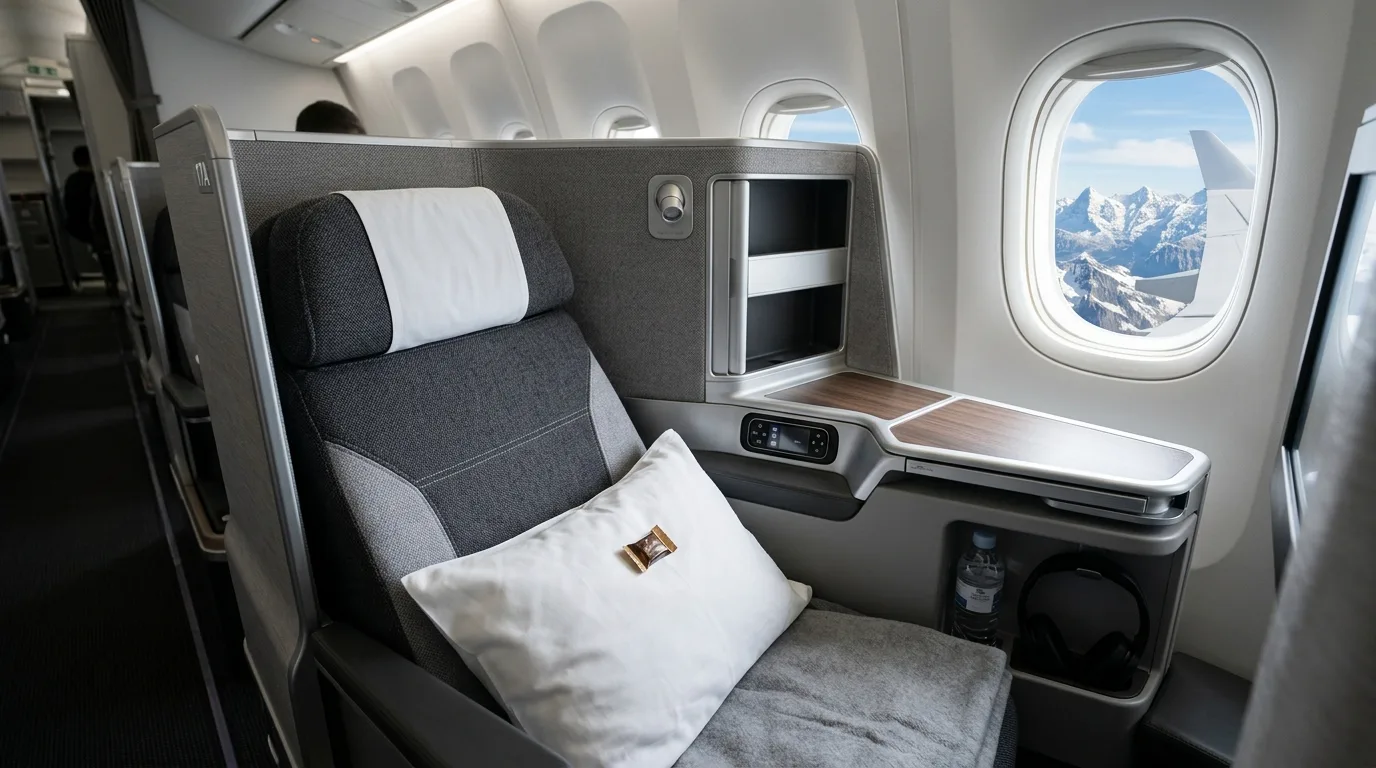
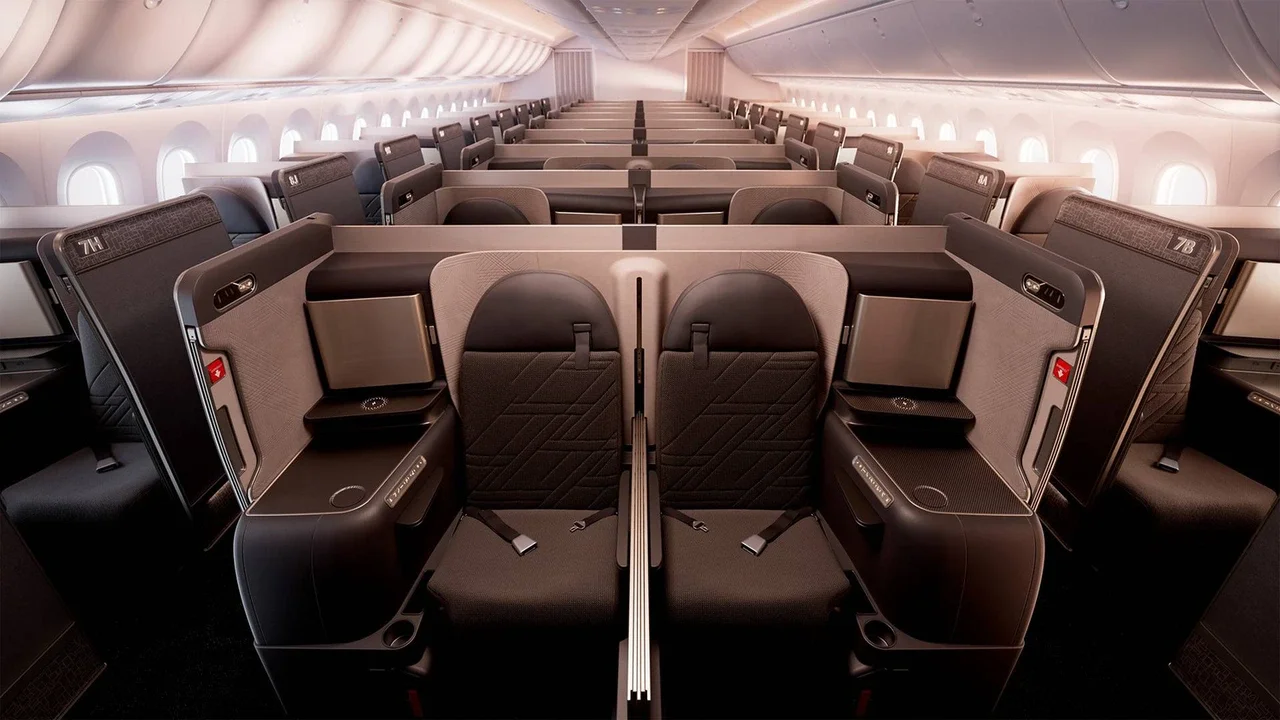
The Prestige Suite is Korean Air's flagship business class cabin, currently deployed on the 787-9 Dreamliner fleet. It's a 1-2-1 layout in a reverse herringbone configuration, which means every seat has direct aisle access. The cabin typically runs 30 seats across 10 rows.
The defining feature — and the thing that puts it in the conversation with Qatar and Singapore — is the full sliding door. You close it and you have a proper private space. It's not a half-door that stops at your shoulder. It's a full-height panel that actually seals the suite. I've used it on both flights and it works exactly as advertised.
The seat itself goes flat to 180 degrees, measures about 76 inches in bed mode, and is 23 inches wide at the shoulder. That's competitive. I'm six feet and I fit without my feet hitting anything. The mattress pad Korean Air provides is thicker than most — it's not an afterthought wedge of foam, it's a proper pad that makes a real difference over a 14-hour sector.
How does the Prestige Suite compare to other business class products?
Honestly? It sits in the second tier, but comfortably. Qatar's QSuites still lead on space and door quality, and Singapore's A380 First is in a different category entirely. But the Prestige Suite is ahead of most of what United and American are flying on transpacific routes right now, and it beats British Airways Club Suite on cabin finish quality — the materials feel more considered, less like they were value-engineered at the last minute.
The window seats (A and K) are the ones to book. You're next to the window with the seat angled slightly inward, and the door gives you more privacy than the center seats, which have doors but face the aisle more directly. If you're traveling solo, always go window. If you're with a partner, the center pairs (D and G) work well because the divider between them folds down.
Seat selection tip
On the 787-9, rows 1 and 2 are closest to the galley and get more noise. Row 6 or 7 window seats are the sweet spot — quieter, and you're not the last to be served. Avoid row 10 if you're light sleeper; the rear galley activity picks up on longer sectors.
The food — and why it matters more on Korean Air than most carriers
This is where Korean Air earns real loyalty. The catering on long-haul flights out of Incheon is handled differently than most Western carriers, and you can taste the difference.
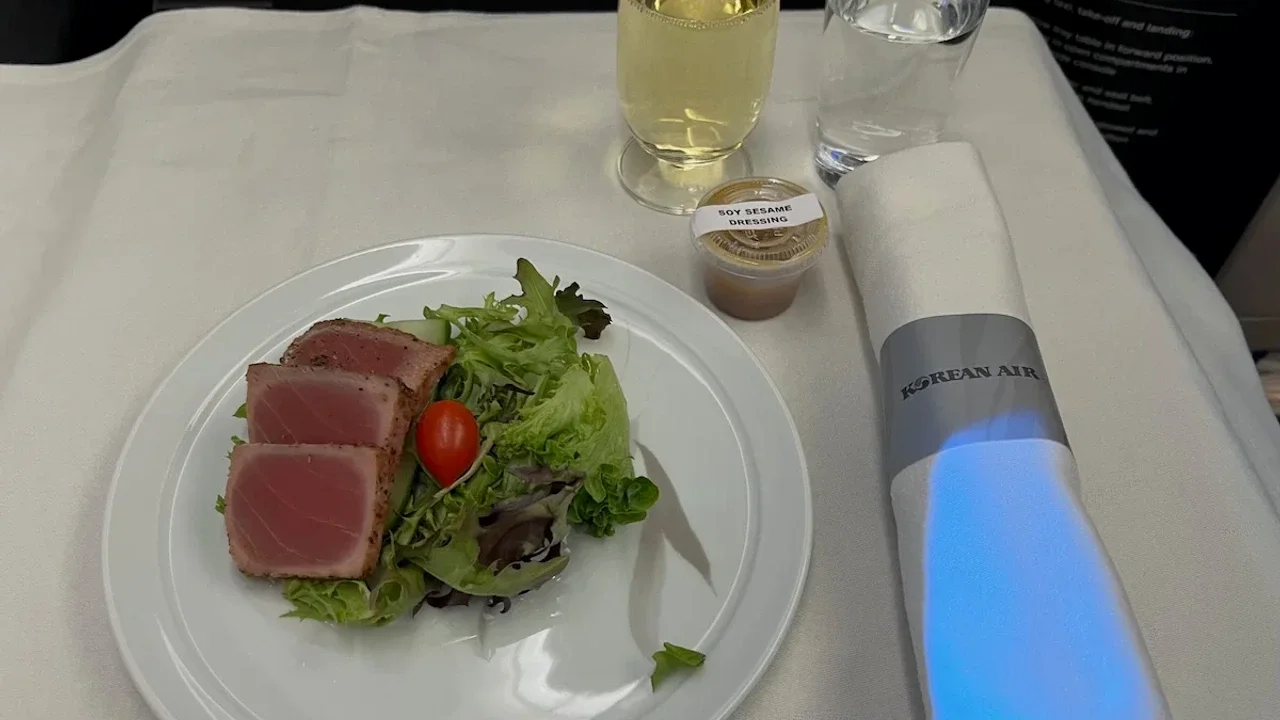
The meal service opens with a proper amuse-bouche and a choice of Western or Korean. Take the Korean option. Every time. I've had bibimbap served in a stone bowl at 38,000 feet that was better than what I've eaten in airport restaurants. The rice had a proper crust at the bottom — that's not easy to achieve in a galley oven. The doenjang jjigae on my JFK-ICN sector was served with banchan: kimchi, japchae, seasoned spinach. Real side dishes, not one sad garnish.
Always choose the Korean meal option when flying out of ICN. The Western menu is fine, but the Korean menu is where the catering team clearly puts the effort.
The Western options are decent but not remarkable. On my Narita positioning flight I had a beef tenderloin that was cooked properly (which is more than I can say for most business class beef, which arrives gray and disappointed). The bread service is good — they come around twice and the rolls are baked on board, not reheated from frozen.
Wine list is solid. Not Qatar-level extravagant, but they're pouring proper bottles. I had a Burgundy on the Seoul-New York run that I'd have been happy ordering at a restaurant. The champagne is Taittinger Brut Réserve as of late 2025 — not a prestige cuvée, but perfectly drinkable.
Breakfast before landing into JFK deserves a mention. The Korean porridge (juk) with pine nuts is one of those things that sounds simple but is exactly right at that point in a long flight. Most business class breakfasts are either too heavy or too nothing. This one lands well.
The ICN lounge situation
Incheon Terminal 2 is where Korean Air operates, and the First and Business Class Lounge on the Prestige Floor (Level 4) is genuinely worth arriving early for.
The space is large — probably 1,500 square meters — and rarely feels overcrowded in the morning wave before the long-haul departures. There's a sit-down dining area with a proper menu service, not just a buffet. I ordered the galbi-tang (short rib soup) at 10am and it was excellent. The noodle bar runs until about two hours before the last departure. The buffet section is fine but the made-to-order food is better.
Showers are plentiful and the booking system works. You don't queue. You book a slot at the desk when you arrive and they text you when it's ready. The water pressure is good, the towels are thick. Small details, but after a long connection they matter.
Terminal note
If you're connecting through ICN from another Korean Air domestic flight, you arrive at Terminal 1 and need to take the internal transfer train to Terminal 2. Build in 20-25 minutes for this — it's not complicated but it takes time, and the lounge is only accessible from Terminal 2 security.
The lounge bar is stocked better than most. They're pouring Korean craft beers and there's a small whisky selection. I had a Hwayo rice soju, which is worth trying if you haven't — it's smoother than the standard green-bottle stuff and the lounge pours it cold.
One honest criticism: the wifi in the lounge is mediocre. It works for email but don't plan on uploading anything large. I've had better speeds in the United Polaris lounge at ORD, which is not a high bar to clear.
Korean Air business class fares — what to actually pay
Korean Air publishes business class fares on the JFK-ICN route that regularly sit around $4,000–$5,000 round-trip. That's the rack rate, and you shouldn't pay it.
The fares that make this product genuinely compelling come in the $1,800–$2,400 range for round-trips from JFK, LAX, and occasionally SEA. These show up most often in January, late February, and in the September-October window after the summer peak ends. They don't stay up for long — typically 24 to 72 hours before either selling out or reverting.
The LAX-ICN route tends to throw out slightly lower prices because there's more competition on that corridor. Delta and Asiana both run direct service and that keeps Korean Air honest on pricing. JFK fares drop less frequently but when they do, they're worth jumping on — it's a 14-hour nonstop and the Prestige Suite holds up well for that distance.
When do Korean Air business class fares drop?
There's no single day of the week that reliably produces the best prices — that's a myth that gets recycled endlessly. What I've actually observed is that fare drops tend to cluster around:
- Periods when load factors are soft (January after the holiday rush, late February)
- When a competing carrier drops price on the same route
- Around Korean national holidays when domestic demand spikes but international bookings soften
- Occasionally, when Korean Air adjusts its award inventory and discounted revenue fares show up briefly as a side effect
The fares that drop to $1,800-ish round-trip are usually in a specific booking class — typically C or D — and they're not always visible on the main Google Flights interface. They show up in GDS searches and on the Korean Air website directly. Sometimes they appear on third-party OTAs first, sometimes on Korean Air's own site. There's no single place to watch.
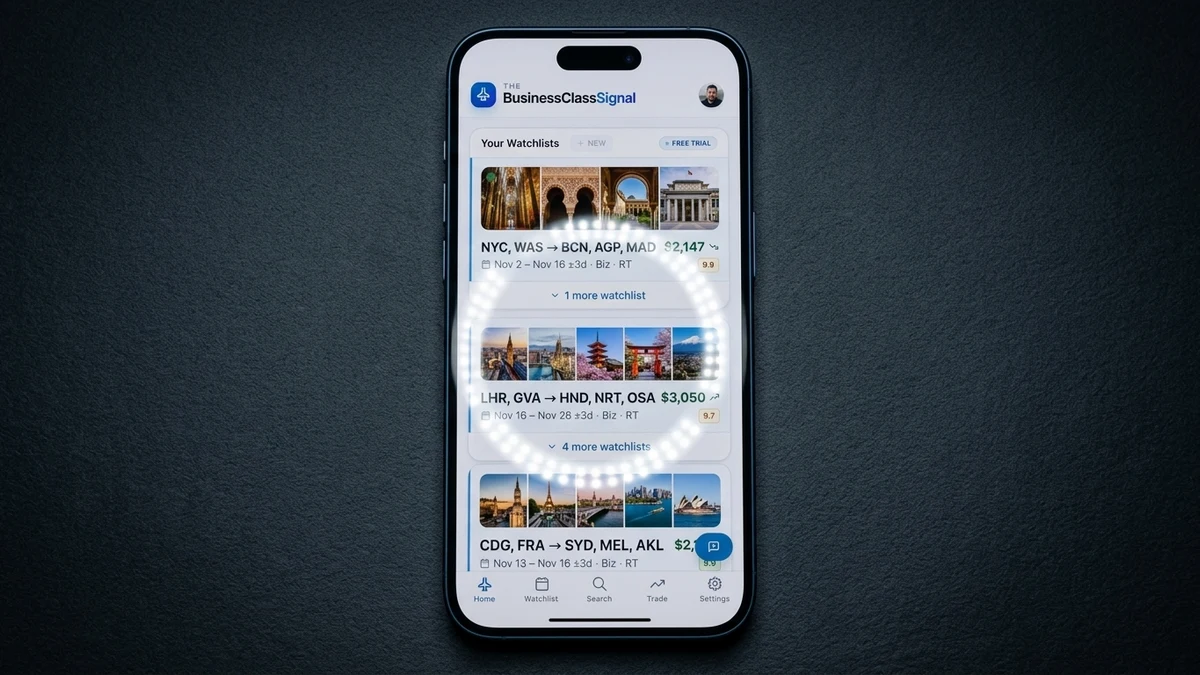
This is exactly the kind of thing the monitoring system at BusinessClassSignal was built for. It scans Korean Air fares twice daily across the JFK-ICN, LAX-ICN, and SEA-ICN routes and sends an alert when prices drop below whatever threshold you set. I built it because I was tired of manually refreshing flight search pages at 6am.
Booking timing
Korean Air's own website sometimes offers a small discount on direct bookings versus OTAs — not always, but worth checking. For award bookings, SkyTeam partners like Delta SkyMiles and Air France/KLM Flying Blue can sometimes price Korean Air business class at lower rates than Korean Air's own SKYPASS program.
The cabin experience at night — what sleeping is actually like
The Prestige Suite does well here. Close the door, recline to flat, and the ambient noise from the 787's GEnx engines is low enough that most people can sleep without earplugs. The Dreamliner cabin pressure (6,000 feet equivalent versus 8,000 on older jets) makes a real difference over a 14-hour sector. I've arrived into JFK feeling significantly better than I do after a similar-length flight on an older 777.
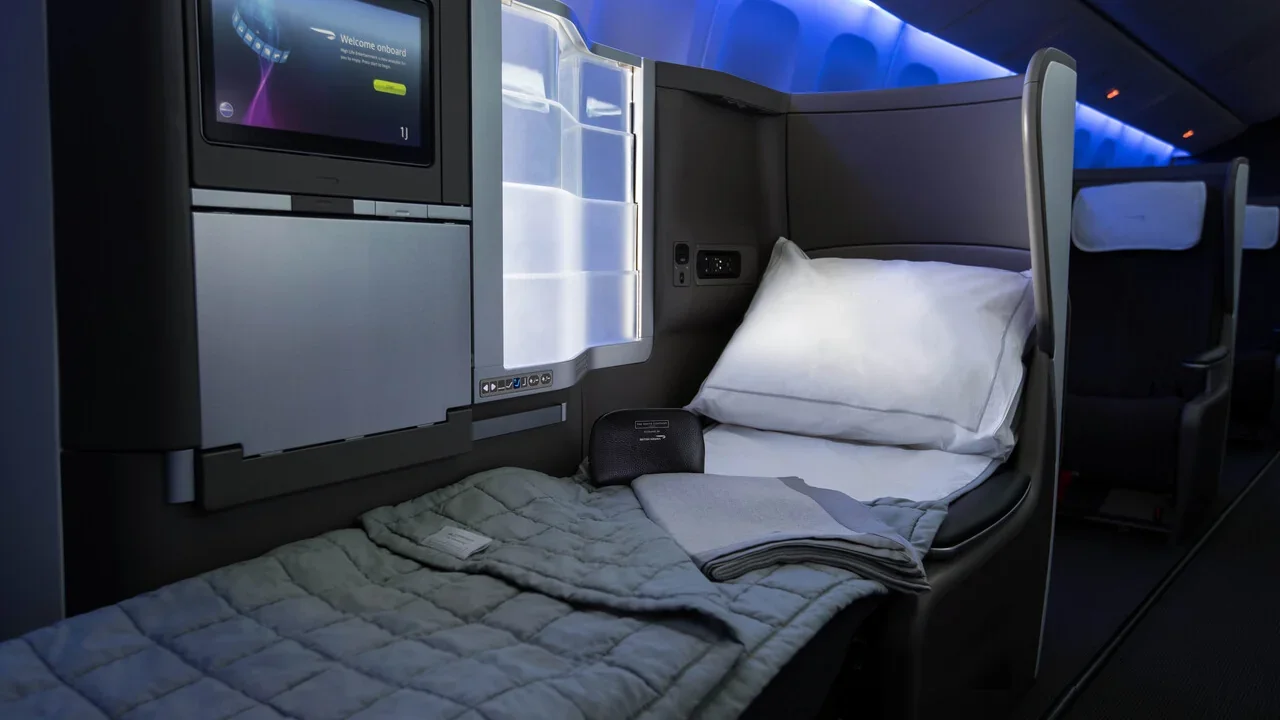
The bedding set is one of the better ones in the sky. The blanket is substantial — not the thin fleece most carriers hand you — and the pillow is real pillow-sized, not the small rectangular thing that passes for one on some carriers. Korean Air uses a Serta collaboration for the mattress pad, and while I'd normally roll my eyes at branded bedding partnerships, this one is actually comfortable.
The suite itself is 28 inches wide in seated mode and the footwell is genuinely roomy. My one complaint: the storage is not great. There's a small cubby near the shoulder and a compartment by the footwell, but if you're traveling with a laptop bag and a jacket and a water bottle, things get cluttered fast. The seat was clearly designed for people who pack light or use the overhead bins more than I do.
The window shades on the 787 are electronic — no physical shade, just a button that cycles through tint levels. I prefer a blackout shade. The darkest setting on the 787 isn't full blackout, and on daytime sectors heading east, the sun angle means you'll still get light bleed. It's a 787 issue, not a Korean Air issue, but worth knowing.
Bring a sleep mask. The 787's electronic window shades don't go fully dark, and on the eastbound crossing into JFK, you'll be flying into sunrise for the last few hours.
The IFE and connectivity
The screen is a 24-inch 4K touchscreen. It's big, it's sharp, and the touch response is better than average. The content library leans heavily Korean — which makes sense — but the English-language film selection is solid. On my last flight they had a current theatrical release I hadn't seen yet, which doesn't happen often.
The noise-canceling headphones Korean Air provides in Prestige Suite are their own branded set, not Bose or Sony. They're fine. The noise cancellation is decent but not class-leading. If you have your own headphones, use them — the audio quality through the seat's audio jack is good enough to justify it.
Wifi is available via the Viasat system and it's paid. Pricing runs around $19 for a full-flight pass, which is standard. The speeds are acceptable for streaming music and light browsing but video streaming is unreliable on the transpacific crossing. Don't plan on Zooming from 40,000 feet over the Pacific.
Is Korean Air business class worth it at current prices?
At $4,500 round-trip, it's harder to justify unless you're locked into the routing or have SKYPASS miles to use. There are competitive products available in that price range.
At $2,000 round-trip? It's a strong yes. You're getting a full-door suite, a flat bed with a proper mattress pad, food that's genuinely good, and a lounge in Seoul that's worth arriving early for. The Prestige Suite isn't the most talked-about product in business class circles, but it's one of the more consistently executed ones I've flown.
Korean Air also has a reasonably good on-time record on the transpacific routes — better than most US carriers — and the crew service is attentive without being intrusive. I've had flights where I was never once bothered unnecessarily, and my water glass was refilled before I noticed it was empty. That's the standard, and they hit it.The product is on more routes than just JFK and LAX. If you're originating from Chicago or Seattle, Korean Air connects through ICN to a wide network of Asian destinations and the Prestige Suite flies on those sectors too. The 787-9 configuration isn't universal across the fleet — some routes still see the older 777 with the previous-generation Prestige seat, which is a full flat bed but no door — so check the equipment before you book.
One thing I'll say plainly: if you're serious about flying Korean Air business class without paying full fare, the fare monitoring approach works. These discounts are real, they happen multiple times a year, and they're gone fast. I've seen the JFK-ICN route drop to $1,750 round-trip in Prestige Suite twice in the past 18 months. Both times the fare was gone within 48 hours.
BusinessClassSignal monitors Korean Air fares on the major US gateway routes twice daily and sends email alerts when prices cross your target. The free trial runs 14 days and you don't need a credit card to start. If a fare drops while you're in the trial, you'll catch it.
Monitor Korean Air Prestige Suite fares — get alerted when prices drop
Start free trial