Quick summary
Mistake fares — also called error fares — are business class tickets priced dramatically below normal, usually caused by a currency conversion glitch, a missing fuel surcharge, or a fat-finger entry in the airline's fare database. They're real, they get ticketed, and airlines honor them more often than you'd expect. This guide explains how they happen, how to spot them, and how to book fast enough to actually get one.
What actually is a mistake fare?
An error fare is exactly what it sounds like: a ticket priced incorrectly. Not a sale. Not a flash deal. A genuine pricing mistake, usually caused by a technical failure somewhere in the chain between the airline's revenue management team and the global distribution system that travel agents and booking sites pull from.
The airline meant to charge $4,800. You see $480. That's an error fare.
They happen more often than the industry likes to admit, and the reasons vary. Sometimes it's a currency conversion that goes sideways — a fare filed in Vietnamese dong gets mistakenly treated as US dollars, and suddenly a Hanoi to London business class ticket is showing up for $200. Sometimes a fuel surcharge just doesn't attach to the base fare. Sometimes someone in the pricing team enters a figure with one too many decimal places and doesn't catch it before it propagates across booking systems. The global airline pricing machine is enormous and surprisingly fragile. Fares flow through ATPCO (the Airline Tariff Publishing Company), get picked up by GDS platforms like Amadeus and Sabre, and then fan out to hundreds of booking sites — and at any point in that chain, something can go wrong.
The window before an airline catches and kills the fare can be anywhere from 20 minutes to 72 hours. I've seen some last a weekend. Most are dead within a few hours of the first tweet.
A brief history of the good ones
If you've been following mistake fares business class for any length of time, a few legendary examples come up again and again — and they're worth knowing because they tell you a lot about how these situations play out.
In 2015, United Airlines accidentally filed business class fares from the US to Hong Kong for around $50. The fare spread fast on frequent flyer forums. United initially said they wouldn't honor it, then reversed course after pressure and ticketed the bookings. Some passengers got to fly Polaris (well, the pre-Polaris product at the time) to Hong Kong for the cost of a Metrocard top-up.
The same year, Cathay Pacific loaded fares from Vietnam to the US in business class at around $675 round-trip — a route that normally runs $5,000+. That one stemmed from a currency filing error. Cathay honored it. Thousands of people flew.
Delta had a memorable one in 2015 as well: first class fares to Hawaii for under $200 round-trip. They honored those too.
Going further back, British Airways once filed a transatlantic business class fare at £1 round-trip — plus taxes and fees, so the actual out-of-pocket was around £100 — due to a fuel surcharge being omitted. That one didn't get honored across the board, but it showed just how consequential a single missing line item in a fare filing can be.
The 2015 cluster
2015 was an unusually active year for mistake fares. Several major carriers had pricing system migrations underway, and the transition errors fed directly into public booking channels. If you weren't paying attention then, you missed some genuinely extraordinary tickets.
Do airlines actually have to honor mistake fares?
What does US law say about this?
This is the question everyone asks, and the honest answer is: it depends, and it's changed over time.
Before 2015, the US Department of Transportation had a clear rule: airlines had to honor any fare that was purchased in good faith, regardless of whether it was a mistake. The consumer got the ticket, the airline ate the loss. Simple.
In 2015, the DOT quietly amended its rules. The new position allowed airlines to cancel mistake fare tickets as long as they promptly notified passengers and offered a full refund. That was a significant shift, and it reduced the legal leverage consumers had.
But here's the thing: airlines still honor a lot of them. Voluntarily. Why? Because the PR cost of mass-canceling tickets that thousands of people have already booked hotels and plans around is often worse than just letting the fares fly. United's reversal on the Hong Kong deal is the clearest example of that math playing out publicly.
The general pattern I've observed over 12 years is this: if the fare gets widely publicized before the airline catches it, they're more likely to honor it, because the cancellation backlash would be enormous. If only a few hundred people booked it quietly, the airline is more likely to cancel and refund with minimal fuss.
Don't book non-refundable hotels yet
If you snag a suspected mistake fare, hold off on booking non-refundable accommodation until the ticket is confirmed and you've received a proper e-ticket number. A PNR alone isn't a guarantee you're flying.
How quickly do airlines usually cancel them?
Faster than you'd think. Once a fare gets posted to a deal-sharing site or forum — FlyerTalk, Secret Flying, the various frequent flyer communities on Reddit — it typically reaches the airline's attention within an hour or two. Their revenue management teams do monitor for anomalies, but social media often beats the internal alert systems.
The practical implication: when you see a suspected mistake fare, you have maybe two to four hours to act before the fare disappears from the booking system. Sometimes less. I've seen fares survive 48 hours. I've also seen them gone in 20 minutes.
Book first. Investigate whether it's real second.
How to recognize mistake fares business class before they disappear
There's no single tell, but a few patterns show up consistently.
The most obvious: the price is drastically out of step with comparable routes. If business class from New York to Paris is typically $2,800–$4,500 round-trip and you're seeing $400, that's not a sale. Sales move the needle 20–30%. Mistake fares move it 80–95%.
Taxes and fees behave strangely on error fares. Sometimes the base fare is $0 and you're just paying the government-mandated taxes — which on a transatlantic route might be $400–$600. That's still a remarkable deal for business class, and it's a pattern that shows up when a fuel surcharge or carrier-imposed fee fails to attach correctly.
Routing is another clue. If the fare is only appearing on one very specific routing — say, one particular connecting city — that's often a sign it was filed incorrectly for that market or that a partner carrier's zone pricing didn't integrate cleanly.
And the geography matters. Error fares disproportionately originate from certain markets: Southeast Asia (Vietnam and Thailand especially), Eastern Europe, and occasionally South America. This is partly a currency conversion issue and partly a function of how fares are filed in markets where the local currency is volatile.
Always check the fare on at least two or three booking platforms before assuming it's real. If it's showing up on Google Flights, Kayak, AND the airline's own site, it's almost certainly live in the GDS. If it's only on one third-party site, be more skeptical.
Where to find mistake fares before everyone else does
Let me be honest about how this ecosystem works. There are a handful of deal communities and monitoring services that surface these fares, and the speed at which you hear about them determines whether you can actually book them.
The main communities: FlyerTalk's "Mileage Run Deals" and "Consolidated Deals" forums have been tracking error fares for 20+ years. The r/churning and r/awardtravel subreddits surface them quickly. Secret Flying and Holiday Pirates aggregate deals including mistakes. Scott's Cheap Flights (now Going) covers them, though they tend to be cautious about flagging confirmed mistakes vs. genuine sales.
The problem with all of these is that by the time you see the post, several hundred people have already booked. The fare might still be alive, but you're racing against the clock and against the airline's alert systems simultaneously.
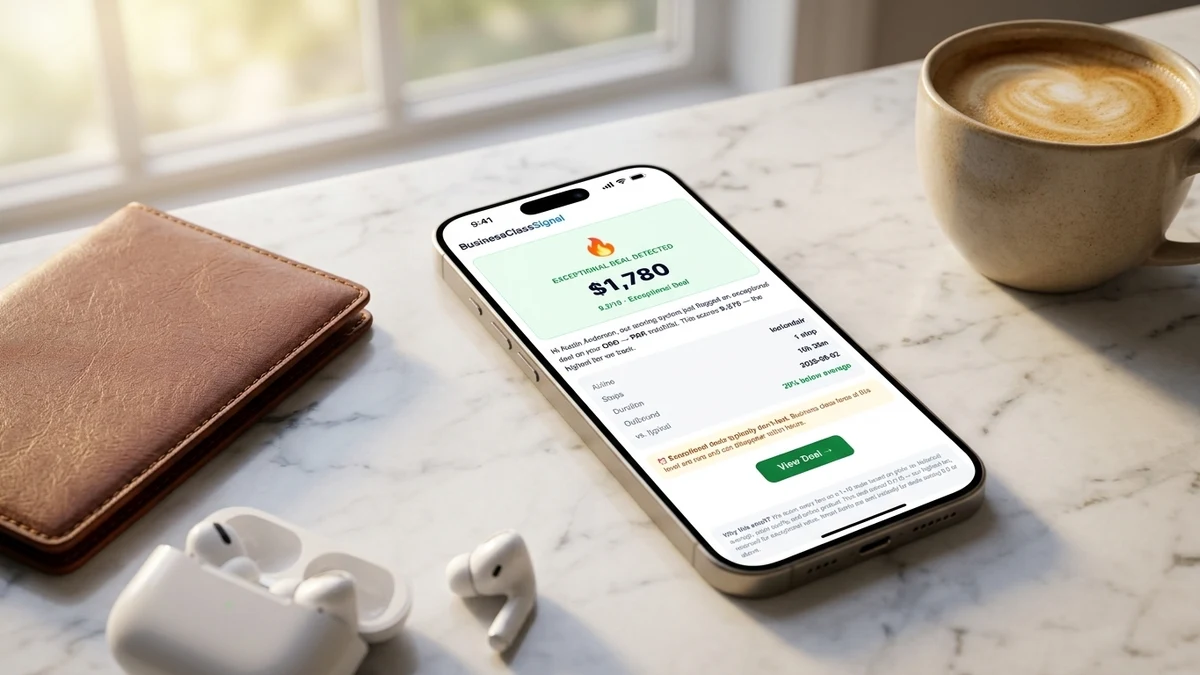
The better approach — and I'm obviously not unbiased here — is to have automated monitoring running on routes you actually care about. BusinessClassSignal monitors 800+ business class routes twice daily and alerts you the moment a price drops below your threshold. When a mistake fare hits a route you're watching, you get the alert before the deal community post goes viral. That's the window you want.
BusinessClassSignal isn't magic — it won't catch every error fare on every route. But on the routes you've set up, you're getting an alert faster than you would from passively scrolling deal forums. The system flags anything that looks anomalous relative to historical pricing on that route, which is exactly the pattern mistake fares produce.
For context, a JFK–LHR business class fare sitting at $2,200 round-trip is already a solid deal. When the monitoring flags $400, that's when you move immediately.
If you're planning a trip that mixes business class on the long-haul leg with economy connections, it's worth knowing that FlightKitten runs similar monitoring for economy fares across 220+ airlines — same idea, different cabin, about $4.99/month. Useful if you're cobbling together a mixed itinerary and want alerts on both ends.
How to book a mistake fare correctly
Speed matters more than anything else, but there's a right way to move fast.
First: book directly with the airline if at all possible. Third-party bookings through OTAs (online travel agencies) add a layer of complexity if the airline decides to cancel the fare. When you book direct, you have a cleaner relationship with the carrier, and in the event they do honor the fare, there's no middleman to navigate. If the airline is only showing the fare on their own site, that's actually a good sign — it means it came through their own pricing system and they'll have a harder time arguing it was an "obvious" error.
Pay with a credit card that has strong travel protections. If the fare gets canceled and the airline is slow to refund, you want the ability to dispute the charge. American Express Platinum and Chase Sapphire Reserve both have solid track records here.
Screenshot everything. The booking confirmation page, the fare breakdown, the email confirmation. If the airline later tries to say you should have known it was a mistake, documented proof that the site displayed a specific price and you paid it in good faith matters.
Don't overpay for add-ons during the booking. Seat upgrades, extra bags — if the fare gets canceled, you want your total exposure to be the ticket price, not the ticket price plus $300 in ancillary purchases you can't recover.
Wait for the e-ticket number
Your booking isn't really confirmed until you receive a proper e-ticket number (typically a 13-digit number starting with the airline's numeric code). A PNR (the 6-character booking reference) is just a reservation. The e-ticket means the ticket has been issued and is much harder for the airline to unwind without processing a refund.
What happens after you book
One of two things: the airline honors it, or they cancel and refund you.
If they honor it, you'll typically get a proper e-ticket confirmation within 24–72 hours and the booking will show up normally in their system. At that point, treat it like any other ticket. Check in normally. Don't call attention to it. Airlines have been known to cancel bookings when passengers call to "confirm" an error fare and inadvertently flag it to an agent who then reviews the pricing.
I know that sounds paranoid. It's happened.
If they cancel, you'll get a refund and usually a form email explaining there was a "pricing error." Under current DOT rules, US carriers are required to refund promptly — within seven business days for credit card purchases. European carriers operating to/from the EU are subject to different rules under EC 261/2004, though that regulation covers cancellations and delays more than pricing errors specifically.
The gray area is when an airline neither fully confirms nor cancels for an extended period. This happened with a few of the big 2015 fares — airlines left bookings in limbo for days while they decided what to do. In those cases, don't make non-refundable plans until you have clarity.
The ethics question (yes, really)
Some people feel weird about booking mistake fares. Is it taking advantage of a company's error? Are you somehow gaming the system?
Here's my honest take after watching this space for over a decade: airlines are not passive victims of their own pricing systems. They have revenue management teams, legal departments, and the DOT's 2015 rule change specifically to protect them from having to honor egregious mistakes. They have every tool they need to cancel fares they don't want to honor.
When an airline voluntarily honors a mistake fare, it's a business decision. They've calculated that the goodwill, the legal risk, and the PR math all point toward letting the bookings stand. You're not exploiting a loophole — you're transacting at a price they chose to accept.
The one thing I'd say: don't abuse it. Booking 12 seats "just in case" or trying to resell mistake fare tickets is the kind of thing that actually does cause harm and gives regulators ammunition to tighten the rules further. Book what you're going to use.
Setting yourself up to catch the next one
The honest reality of mistake fares business class is that you can't manufacture them. You can only be positioned to catch them when they happen.
That means: know your target routes. If you're planning to fly business class to Tokyo, Singapore, or London in the next 12 months, set up monitoring on those routes now. Not when you're ready to book — now. Error fares don't schedule themselves around your planning timeline.
It also means having your booking logistics ready. Know which card you're using. Have your passport details saved in your airline profile. The difference between catching a fare and missing it is often just the 90 seconds it takes to look up your passport number.
Follow two or three of the deal communities mentioned above with notifications turned on — not as your primary detection method, but as a backup. And honestly, browse the routes we monitor to see if your target routes are covered. If they are, the automated monitoring does the work for you.
The fares are out there. The United Hong Kong deal, the Cathay Vietnam deal, the Delta Hawaii deal — those weren't flukes. They were the result of a pricing infrastructure that moves fast, makes mistakes, and occasionally creates a window where the rules of airline economics briefly don't apply.
You just have to be watching when it opens.
BusinessClassSignal monitors 800+ business class routes and alerts you the moment a price drops below your target — including when something looks like an error fare. 14-day free trial, no credit card required.
Start monitoring free