Quick summary
If you're trying to find business class flights with the best food, the routes that consistently deliver are Turkish Airlines between Istanbul and New York, ANA between Tokyo and Los Angeles, and Qatar Airways on pretty much any long-haul segment out of Doha. This article breaks down 12 specific routes where the catering is genuinely worth planning around — plus the seat, timing, and ordering tricks that make a difference.
Why the route matters more than the airline
Most people pick a business class ticket based on price, points, or schedule. Food is usually an afterthought. That's a mistake, especially on a 13-hour overnight where dinner and breakfast are two of the only things standing between you and a miserable arrival.
The thing is, even within a single airline, catering quality swings wildly depending on the route. Singapore Airlines in business class from London to Singapore is a different experience than Singapore Airlines from Singapore to Sydney. The catering kitchen, the caterer on the ground, the local produce available — it all changes. So "which airline has the best business class food" is almost the wrong question. The better question is which specific routes are worth targeting.
I've eaten my way through a lot of these. Some were memorable. Some I'd rather forget. What follows is my honest take on 12 routes where the food in business class is genuinely part of why you'd book.
The routes that actually deliver on food
1. Turkish Airlines: Istanbul (IST) → New York (JFK)
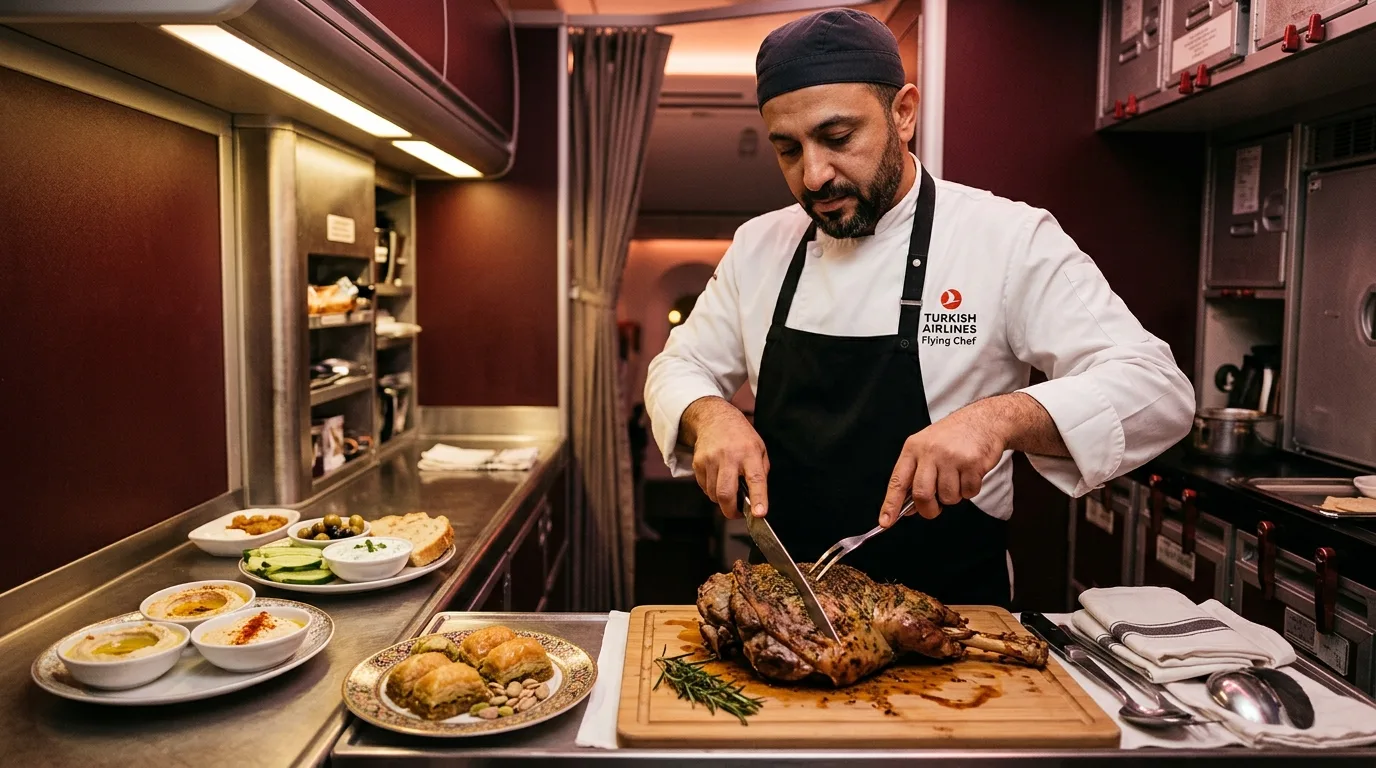
This is the one I recommend to anyone who asks about the best food in business class flights, full stop. Turkish Airlines runs a flying chef program on their long-haul routes — an actual chef who cooks to order in the galley, not a reheated tray operation. On the IST–JFK segment, which runs about 10 hours westbound, you can watch the chef prepare hot mezze, grilled proteins, and made-to-order eggs in the final hour before landing.
The appetizer spread alone is worth the fare premium: stuffed vine leaves, sigara böreği (fried cheese pastry), tabbouleh, hummus, and occasionally a cold seafood option. The main courses rotate, but I've had a lamb shish that was genuinely good at 35,000 feet — not "good for an airplane," just good.
Order the hot mezze first
Ask the chef for the hot mezze selection before the main service begins. It's not always proactively offered — you sometimes have to ask — and it runs out on full flights.
2. ANA: Tokyo (HND) → Los Angeles (LAX)
ANA's business class on this route is one of the more quietly impressive food experiences in the sky. The Japanese set meal is the thing to order: a lacquered bento-style presentation with seasonal items, rice, miso soup, and a protein that changes based on what was available at the Tsukiji market suppliers that week. I've had simmered black cod on this route that I'd have been happy to eat in a Tokyo restaurant.
The Western option exists but there's really no reason to order it. The Japanese set is the whole point. The flight is roughly 10.5 hours, departing Tokyo in the evening and arriving Los Angeles in the afternoon the same calendar day — which means you get a full dinner service and a lighter breakfast, both worth eating.
3. Qatar Airways: Doha (DOH) → London (LHR)
Qatar's Qsuites get most of the attention, and fair enough — the privacy is hard to beat. But the food has quietly become one of the stronger programs in the Middle Eastern carrier group. The dine-on-demand setup means you eat when you want, which on a 7-hour overnight to London is genuinely useful. I usually skip the initial dinner service entirely, sleep for four hours, and wake up for a proper pre-landing breakfast.
The Arabic mezze starter is reliable. The lamb ouzi has been on the menu in various forms for years and it holds up. What I appreciate is that Qatar doesn't overcomplicate things — the portion sizes are reasonable, the bread service is warm, and they're not shy about refills.
Qatar's pre-order meal system (available 24 hours before departure via their app) lets you lock in specific dishes before they run out on full flights. Use it.
4. Singapore Airlines: Singapore (SIN) → San Francisco (SFO)
The Book the Cook program on Singapore Airlines is one of the few pre-order systems that actually changes what ends up in front of you. On the SIN–SFO route — one of the longest in the world at around 17.5 hours — you get two meal services, and if you've pre-ordered, both can be genuinely good. The chilli crab pasta has been a popular option for years. The satay, served as a starter on departure from Singapore, is the thing people remember most.
What I'd say honestly: the quality is more consistent than most carriers, but it's not magic. The Book the Cook options are stronger than the default menu. If you forget to pre-order, you're eating whatever's left, and on a full flight that can mean limited choices.
5. Cathay Pacific: Hong Kong (HKG) → London (LHR)
Cathay's catering out of Hong Kong is strong. The dim sum starter on the outbound from HKG is a highlight — har gow, siu mai, and a rotating third item depending on the month. The main courses lean toward Cantonese preparations for the Asian option, which I'd always choose over the Western alternative.
The London–Hong Kong return is where things get slightly more inconsistent, since the catering is done by a different kitchen. It's still above average, but if you're flying the route specifically for the food, the outbound HKG departure is the better half.
6. Lufthansa: Munich (MUC) → Tokyo (NRT)
Not the obvious choice for a food list, but Lufthansa's catering out of Munich is meaningfully better than out of Frankfurt. The kitchen at MUC produces a Bavarian-inflected menu that occasionally surprises — I've had a Wiener Schnitzel on this route that was better than it had any right to be at altitude. The bread basket is excellent, which sounds like a small thing but matters on a 12-hour flight.
The Japanese arrival meal, served about 90 minutes before landing, is also well done — a lighter rice-based option that's easier on the stomach than a second heavy Western course.
7. Emirates: Dubai (DXB) → Sydney (SYD)
Emirates business class to Sydney gets points for sheer variety. The menu is long — longer than most airlines attempt — and the Arabic options are worth ordering. The slow-cooked lamb with saffron rice is a recurring item that works well. The cheese course is one of the better ones I've encountered at altitude, with actual variety rather than the usual two sad slices.
Where Emirates loses points: the desserts can be oversized and overly sweet, and the bread sometimes arrives cold. The bar program is strong if that matters to you — the Champagne selection in business is consistently decent.
8. JAL: Tokyo (NRT) → Chicago (ORD)
JAL and ANA are often mentioned in the same breath, but the JAL experience on NRT–ORD has its own character. The kaiseki-style Japanese meal is the standout — a multi-course arrangement with seasonal vegetables, a protein dish, miso, and pickles. JAL sources from specific Japanese producers, and the quality of the ingredients shows. The tableware on the Japanese course is also notably better than what most carriers use.
The Western option is fine, nothing more. The Japanese course is the reason you're here.
On JAL's long-haul routes, let the crew know when boarding that you want the Japanese meal course. On very full flights it occasionally runs short.
9. Air France: Paris (CDG) → New York (JFK)
Air France has leaned hard into its culinary identity, and the CDG–JFK route benefits from that. The rotating chef partnership program means the business class menu changes every couple of months, with named French chefs developing the dishes. When it's working, it's genuinely impressive — I had a duck confit preparation on this route two years ago that I still think about.
The cheese trolley is real and it's good. Multiple varieties, proper serving temperature, and the crew actually knows what they're serving. That alone puts Air France ahead of most carriers on a specific detail that matters.
The chef program rotates
Air France changes its chef partnerships roughly every quarter. If you're flying specifically because you saw a particular chef's menu featured, verify it's still current before booking — the menus don't always get updated promptly on the website.
10. Etihad: Abu Dhabi (AUH) → London (LHR)
Etihad has had a rough few years commercially, but the catering on the AUH–LHR route has stayed solid. The Arabic options are the highlight — a lamb kofta with tabbouleh and a properly seasoned hummus that isn't the bland catering-company version. The breakfast service before landing in London is better than most: eggs cooked to order, good pastries, decent coffee.
What's honest to say: the business class product overall has slipped a bit from its peak years, but the food specifically has held up.
11. Swiss: Zurich (ZRH) → Singapore (SIN)
Swiss doesn't get talked about enough for food. The ZRH–SIN route is long (about 12 hours) and the catering is genuinely Swiss in character — hearty, well-sourced, and not trying too hard. The Rösti with smoked salmon appears on this route semi-regularly and it's a smart call for altitude eating: filling without being heavy. The Swiss chocolate dessert service is the most predictable pleasure in business class aviation.
The wine list is also worth noting. Swiss puts real effort into their wine program, and the selection on long-haul routes includes some smaller Swiss producers you won't find on other carriers.
12. Qantas: Sydney (SYD) → Los Angeles (LAX)
Qantas has been pushing an Australian provenance angle in business class for several years now, and on the SYD–LAX route it shows. The Neil Perry partnership (which ended formally but whose influence lingers in the menu structure) gave the catering a restaurant sensibility — the barramundi preparation has been a consistent standout. The macadamia nuts in the pre-departure snack service are a small but genuine touch.
The return LAX–SYD is slightly less impressive, since the catering is handled from Los Angeles rather than Sydney. Still good, but not at the same level.
What actually separates good airline food from forgettable airline food

After eating on enough of these routes, a few patterns stand out.
Catering kitchen location matters enormously. Airlines that cater from their home hub almost always produce better food than when they're catering from a foreign city. This is why the outbound from Hong Kong on Cathay beats the return, why ANA from Tokyo is better than ANA from anywhere else. The local supply chain, the familiar processes, the kitchen that's been doing this for decades — it shows.
Dine-on-demand is only as good as the execution. Qatar and Singapore both offer it, but the experience depends on how the crew manages the galley. On a light flight, dine-on-demand is excellent. On a full A380 with 48 business class passengers all wanting dinner at different times, it can get chaotic. I've waited 45 minutes for a meal on a full Qatar flight. That's not a complaint, just a reality check.
The other thing: temperature. Hot food served hot is a baseline that more airlines fail than you'd think. Turkish Airlines, because of the flying chef setup, consistently gets this right. Reheated food that arrives lukewarm is one of the most common disappointments in business class, and it's something no amount of ingredient quality fixes.
When do airlines upgrade their catering menus?
Most carriers refresh their long-haul business class menus quarterly, though some do it every six weeks on competitive routes. Air France and Singapore Airlines tend to announce their seasonal menu changes. Turkish Airlines updates the flying chef menu seasonally but doesn't make a lot of noise about it.
The practical implication: if you had a particular dish on a route six months ago and are hoping to repeat it, there's a reasonable chance it's been rotated out. Menu cycle timing is one of those details that isn't tracked publicly anywhere, which is frustrating.
Does the seat type affect the dining experience?
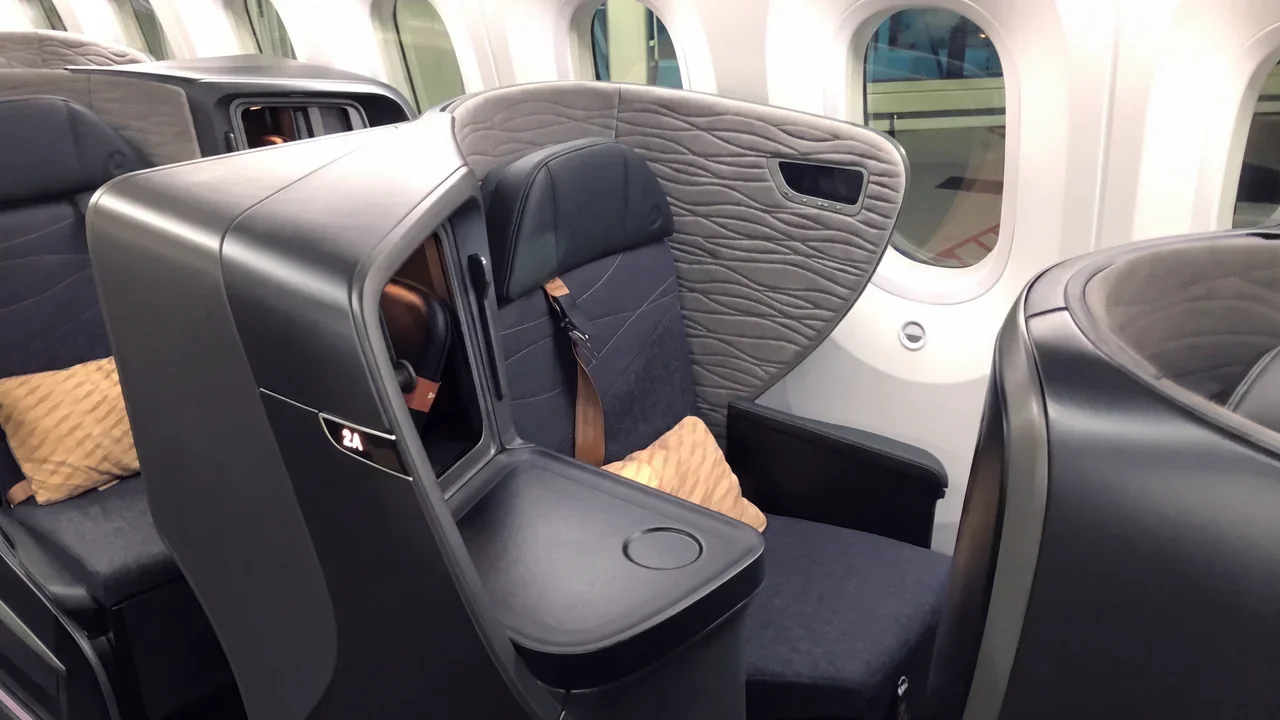
More than people expect. On seats with a fixed ottoman (like the older British Airways Club World configuration), eating a full meal with a tray on your lap is genuinely awkward. Seats with a proper flat surface at elbow height — Qatar's Qsuites, Singapore's new business class, Cathay's current product — make the dining experience much more comfortable.
I've had excellent food served in poor conditions and it was still frustrating. The Qatar lamb ouzi tastes better when you're not trying to balance it on a tray that's tilting toward your knees.
BA Club World is the exception
If you're on a British Airways 777 or older 747 in Club World, the reverse herringbone seat means you eat facing backward or sideways depending on configuration. The food has improved in recent years, but the dining ergonomics are still awkward. Factor that in.
How to actually find these routes at prices worth paying
Here's the practical problem: the routes with the best food in business class are also among the most expensive when booked at full fare. Turkish IST–JFK in business runs around $3,100 round-trip at regular pricing. ANA HND–LAX can hit $4,200 or more. These aren't fares most people pay without flinching.
But error fares and flash sales do happen on all of these routes. Turkish Airlines drops its transatlantic business fares a few times a year, sometimes to the $1,800–$2,200 range. ANA has periodic promotions on the Pacific routes, particularly in the shoulder season between October and February. Qatar runs competitive pricing on European routes fairly regularly, especially out of secondary UK airports.
The catch is that these windows are short — sometimes less than 24 hours. By the time a deal appears on a general travel blog, it's often gone. The way to actually catch them is to have an alert running on the specific route before the fare drops, not to go looking after the fact.
That's where the monitoring system behind BusinessClassSignal actually earns its keep. BusinessClassSignal scans over 800 business class routes twice daily — including all 12 routes on this list — and sends an alert when a fare drops below your target price. It's not a booking tool; it's an early warning system. You set a threshold (say, $2,200 for IST–JFK), and when a fare hits that number, you get the alert before it's been picked up by the deal forums.
I built the service because I was spending too much time manually checking fares on the routes I actually wanted to fly. If you're targeting a specific route for the food experience, start monitoring it now so you're not scrambling when the price drops.
You can also browse all monitored routes to see which ones are currently showing below-average pricing — sometimes a route you hadn't considered is sitting at an unusually low fare right now.
Monitor all 12 of these routes — get alerted when fares drop to your target price. 14-day free trial, no card required.
Try FreeA few routes that didn't make the list (and why)
I want to be honest about what I left out, because some omissions are intentional.
United Airlines polaris business class gets decent press, but I've found the catering inconsistent enough that I wouldn't include any specific United route here. The Polaris product looks good on paper, but the execution varies too much between flights to rely on.British Airways business class food is fine. Not bad, not good. The T5 lounge menu is mediocre, the onboard catering is competent, and the cheese selection is an afterthought. Nothing to plan a booking around.
Lufthansa Frankfurt routes are weaker than Munich, as I mentioned. The FRA catering kitchen has a scale problem — too many flights, too much standardization.
And honestly, a lot of Middle Eastern carrier food outside of the Arabic options is more impressive-looking than it tastes. The Western menus on Etihad and Emirates can be elaborate but sometimes lack seasoning in a way that suggests they've been designed to look good in press photos. Order the regional options and you'll eat better.
The 12 routes I listed are the ones where I'd actually factor the food into my booking decision. The others are just business class.