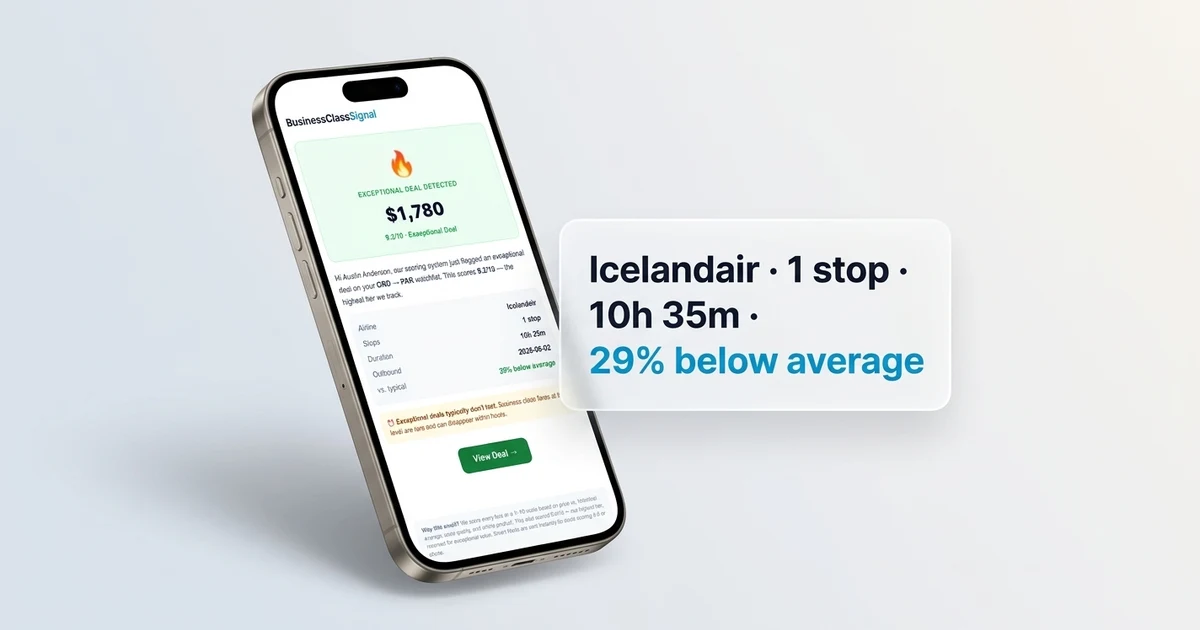
Why most people overpay for business class — and keep doing it
I've been writing about premium air travel for twelve years. I've sat in probably every major business class product worth talking about, from Qatar's Qsuites to the various incarnations of United Polaris, and one thing I see constantly is people paying full fare when they absolutely didn't have to. Not because they're rich and don't care. But because they didn't know the price had dropped.
That's the whole problem, really.
Business class fares are not fixed prices. They move constantly — sometimes multiple times in a single day — based on load factors, competitive responses, seat inventory, fare class buckets, and a dozen other variables that airlines don't publish and certainly don't explain. A seat that costs $4,800 on Monday might be $2,100 on Thursday. Same seat. Same flight. And unless you happened to check at exactly the right moment, you'd never know.
That's what business class flight alerts are designed to solve. The idea is simple: instead of you checking prices manually every few days (which doesn't work — the windows are too short), a monitoring system watches the route for you and tells you the moment something worth buying shows up.
But not all alert systems are built the same way, and the difference between a generic tool and one purpose-built for premium fares is significant. I'll get into that. First, let me explain what's actually happening with these prices so you understand why the monitoring piece matters so much.
How business class pricing actually works
Airlines don't just have "one business class price." They have fare buckets — lettered classes within the cabin that correspond to different price levels and refundability rules. On a given transatlantic flight, you might see fare class J at $6,200, C at $4,400, D at $3,100, and I at $1,900. Those are all business class seats. Same cabin, same service, wildly different prices.
When an airline needs to stimulate demand on a specific departure — maybe a competitor dropped their price, maybe a corporate contract fell through, maybe load is just looking soft — they'll open up lower fare buckets. Briefly. Sometimes for a few hours, sometimes for a day or two. Then they close them again.
This is not a sale in the traditional sense. There's no banner on the airline's website. No email to their loyalty members. It just quietly appears in search results, and then quietly disappears. If you're not watching at that exact moment, you miss it entirely.
I've personally caught fares like this on routes I fly regularly. Last year I grabbed a San Francisco to Tokyo round-trip in ANA's The Room for just under $3,000 — a fare that normally runs $5,500 to $7,000 depending on the season. It was available for about eighteen hours. A colleague who flies the same route regularly and checks manually didn't see it. He paid $5,200 two weeks later.
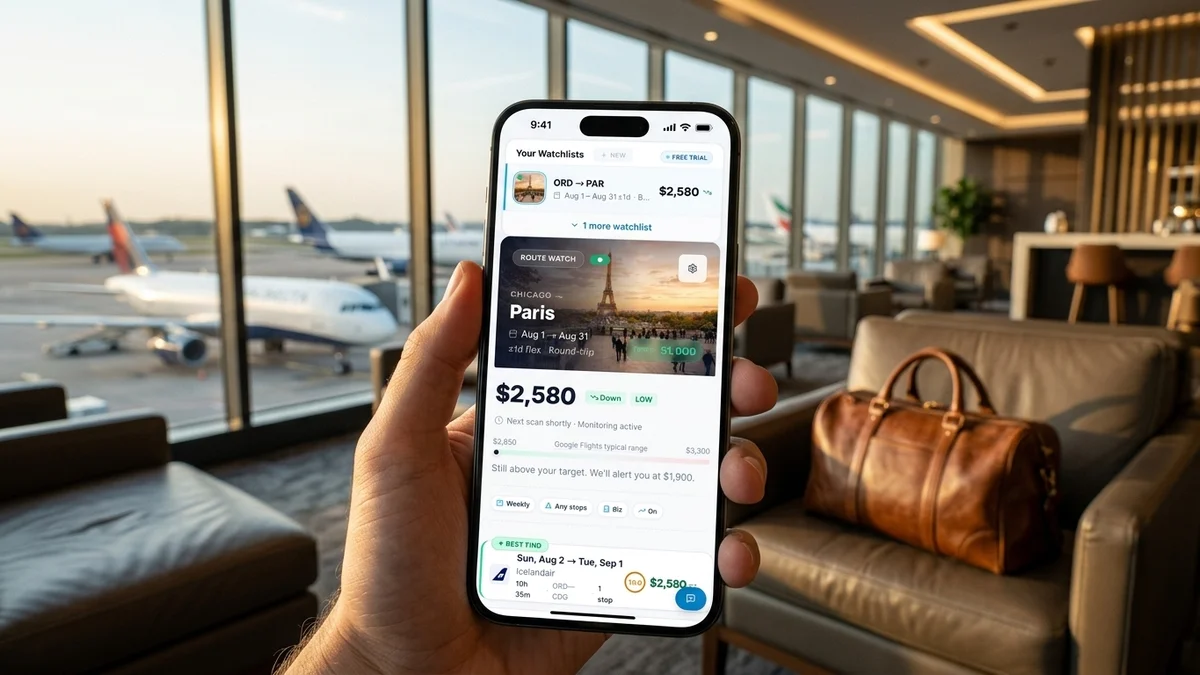
The frequency of these drops varies by route. On high-competition corridors — think New York to London, LA to Tokyo, Miami to São Paulo — you'll typically see meaningful price drops a few times a month. On thinner routes with fewer competing carriers, it might be once every six weeks. Either way, the monitoring has to be consistent. Checking once a week yourself is not consistent enough.

What generic flight alert tools get wrong
Google Flights has price tracking. Kayak has alerts. Hopper will send you a push notification. These are fine tools if you're flying economy and your main concern is saving $80 on a domestic flight. For business class fare monitoring, they fall short in a few important ways.
First, they're optimized for volume, not precision. A generic alert system doesn't know the difference between a $3,200 transatlantic business class fare that's genuinely exceptional and one that's just 8% below average. It might fire on both. Or neither. The calibration isn't there because the tool wasn't built with premium fares in mind.
Second, the scan frequency matters more than people realize. If a fare window opens at 6 AM and closes by 2 PM, a tool that checks prices every few hours might catch it — or might not. The faster the monitoring cycle, the better your chances of seeing the opportunity while there's still time to book.
Third — and this is the one that really gets me — generic tools don't give you context. They'll tell you a price dropped, but they won't tell you whether that price is actually good relative to historical norms for that specific route and season. That context is what turns a notification into a decision. Without it, you're just looking at a number.
There's also the issue of route coverage. Most generic tools work best when you already know your exact dates. Business class deal-hunting often works the other way: you have flexibility, and you want to know when any good fare appears on a route you care about, regardless of specific dates. That's a fundamentally different kind of monitoring.
How business class flight alerts work at BusinessClassSignal
I'll be direct here: I built BusinessClassSignal because I got tired of the gap between what generic tools offered and what serious premium fare hunters actually needed. The site started as a newsletter I was sending to about forty travel industry contacts. It's grown from there.
The way the system works: we scan Google Flights data multiple times per day across a library of routes, looking for meaningful price deviations from what we've established as the normal range for that route and time of year. When something crosses our threshold, it gets scored on a 1-10 scale based on how far below normal it is, how long similar fares have historically lasted, and a few other factors. Scores of 7 and above trigger immediate alerts to subscribers monitoring that route.
The scoring piece is what I care most about. A raw price number tells you almost nothing without context. $2,800 round-trip in business class from New York to London is genuinely excellent. The same $2,800 from New York to Paris is good but not exceptional. From New York to Dublin it's barely interesting. The score translates that context into something actionable.
There's a free tier that lets you monitor one route with standard alerts. The Core plan at $36/month covers unlimited route monitoring and includes our AI market briefings — a morning summary of what's moving across the routes in your watchlist and why. Pro at $78/month adds priority alerts (you get notified faster), extended historical data, and direct access to our deal analysis.
If you want to understand more about how the scanning and scoring actually functions, the how the monitoring system works page goes into considerably more detail than I will here.
Setting up alerts that actually catch deals
This section is practical. Whether you're using BusinessClassSignal or something else, the setup decisions you make will determine how useful your alerts are.
Be specific about the route, not the dates. The biggest mistake I see is people setting alerts for a specific outbound and return date combination. That's too narrow. Airlines don't drop prices on your preferred travel dates specifically. They drop prices based on their load factors, which might be on a Tuesday departure you hadn't considered. If you have any flexibility — even a week in either direction — monitor the route broadly and let the deal tell you when to fly.
Set a realistic target price. Know what "good" looks like before you start monitoring. For transatlantic routes in business class, anything below $2,500 round-trip is generally worth serious attention. Transpacific routes are tougher — $3,000 to $3,500 is the range where experienced fare hunters tend to get interested. Intra-European business class is a different animal entirely, since the cabins are often just economy with a blocked middle seat.
Don't set your threshold too low. If you're only willing to book at $1,800 round-trip on a route where the historical floor is $2,200, you'll monitor forever and never book anything. I've watched people do this. They're still waiting.
Act fast when an alert fires. This is the discipline that separates people who actually score deals from people who just collect alerts. When a high-scoring notification comes in, the right response is to open it immediately and decide within an hour or two. Not "I'll look at this tonight." Tonight it'll be gone. I've missed deals this way myself — it's painful every time.
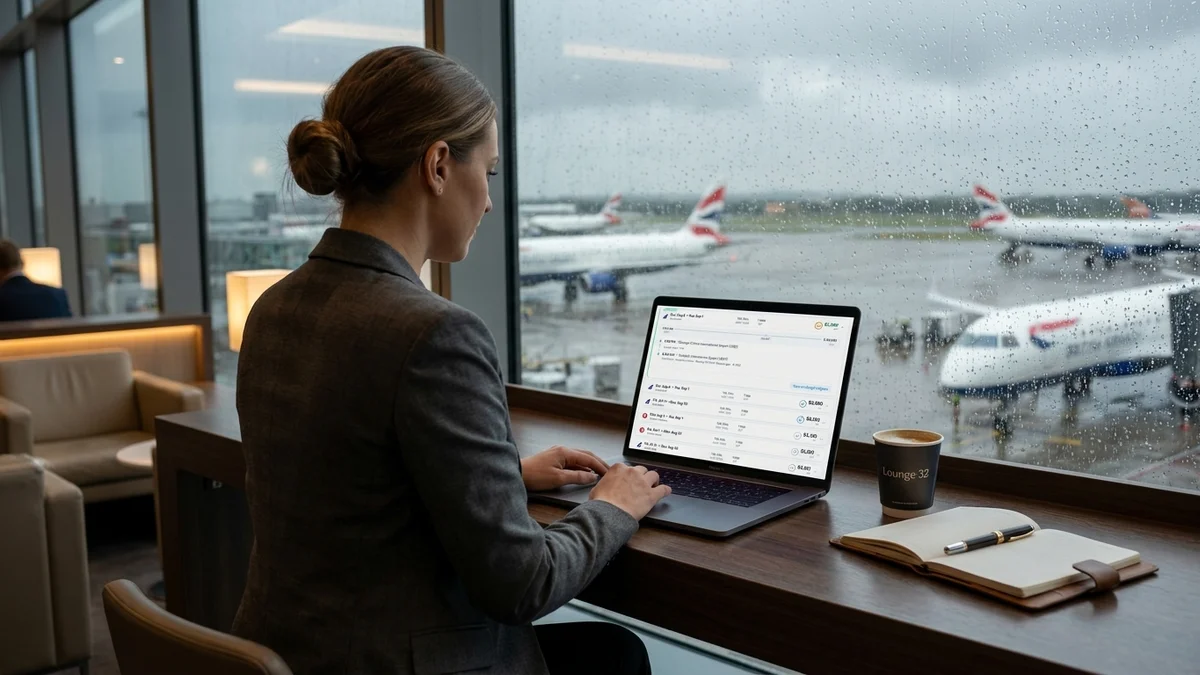
You should also browse all routes before you commit to monitoring a specific corridor. Some routes produce deals regularly. Others are dominated by one carrier with no real competition, and meaningful price drops are rare. Knowing which category your route falls into will set your expectations appropriately.
Which routes produce the best business class deals
Not all routes are created equal when it comes to fare volatility. A few patterns I've noticed over years of watching this:
- High-competition transatlantic routes — JFK to London, LAX to Paris, ORD to Frankfurt — tend to produce the most frequent deals because multiple carriers are fighting over the same passengers. When one drops, others often follow. These corridors can generate genuinely compelling fares several times a month.
- Routes with a dominant low-cost carrier nearby — When Norwegian was operating transatlantic routes, it pushed legacy carriers to drop premium fares to compete. Similar dynamics happen when carriers like Level or Play operate nearby. The competition doesn't have to be in business class to affect business class pricing.
- Transpacific routes out of West Coast hubs — SFO, LAX, and SEA to Tokyo, Seoul, Hong Kong, and Singapore produce excellent deals periodically, especially in shoulder seasons (think February through mid-April, or October). ANA and JAL in particular run competitive fare structures that occasionally produce remarkable windows.
- Routes with seasonal demand swings — Summer transatlantic business class is rarely cheap because demand is high and corporate travel fills cabins. But January and February? That's when carriers need to stimulate demand and you'll see prices that don't appear any other time of year.
Routes I'd watch closely right now: anything from US East Coast gateways to London, US West Coast to Tokyo, and New York to the Middle East hubs (particularly on carriers that connect onward to Africa and South Asia — those fares sometimes drop dramatically when onward demand is soft).
And honestly, some routes just don't produce good deals. Anything with limited competition or strong corporate demand tends to stay stubbornly priced. I've watched the New York to São Paulo corridor for years and the deals, when they come, are modest. It's worth knowing that going in.
Getting the most from business class flight alerts over time
There's a learning curve to this. The first few alerts you receive, you might not know whether to act. That uncertainty is normal and it diminishes over time as you build a sense of what normal pricing looks like on the routes you care about.
One thing I'd recommend: even if you're not planning a trip right now, start monitoring routes you fly regularly. The historical data you accumulate — even just by watching alerts come and go — gives you a calibration you won't get any other way. When you do have a trip to plan, you'll already know what "good" looks like. You won't be starting from zero.
The AI market briefings on our Core and Pro plans are useful here. They're not just a list of today's deals — they give you a read on whether prices are trending up or down on your routes, whether a current fare is likely to hold for a few days or disappear by tonight, and what's driving the movement. That context turns alert-watching from passive monitoring into something more like informed decision-making.
I'd also say: don't get so focused on finding the perfect deal that you never book anything. I've talked to readers who've been monitoring a route for eight months waiting for a sub-$2,000 fare that may simply not exist at the frequency they imagine. There's a real cost to not traveling, and a fare that's 35% below average is genuinely worth booking even if it's not the theoretical floor. The floor might be years away.
If you want to start monitoring this route, the free tier is a reasonable place to begin. One route, standard alerts, no commitment. If you find yourself actually acting on the alerts — which most people do, once the first good one comes through — upgrading to Core makes sense.
The tools exist. The deals exist. The only variable is whether you're watching when they show up.
Set the alert. Then actually book the thing.