Why Dubai keeps pulling people back into business class
I've done this route more times than I can easily count. New York to Dubai, LA to Dubai, once memorably from Chicago during a snowstorm that made the whole thing feel like an escape. And every time, the question is the same: which cabin, which airline, which routing?
The honest answer is that flying business class to Dubai is one of the better use cases for a premium cabin ticket from the US. It's a long haul — around 13 to 14 hours from the East Coast, closer to 16 from LA — so the lie-flat bed actually earns its keep. You're not paying for a 6-hour hop where you'd sleep through the meal service anyway. The distance justifies it.
But "business class to Dubai" isn't one thing. It's Emirates on a 777 with the best-in-class ICE entertainment system. It's Qatar via Doha with a stop that adds three hours but sometimes saves you $800. It's Lufthansa through Frankfurt if you're in the Midwest and want to break the trip up. Each version of this route has a different character, different tradeoffs, and wildly different pricing windows.
Let me walk you through what I actually know about this.
Emirates business class: the one everyone asks about
Yes, it lives up to most of the hype. Not all of it, but most.
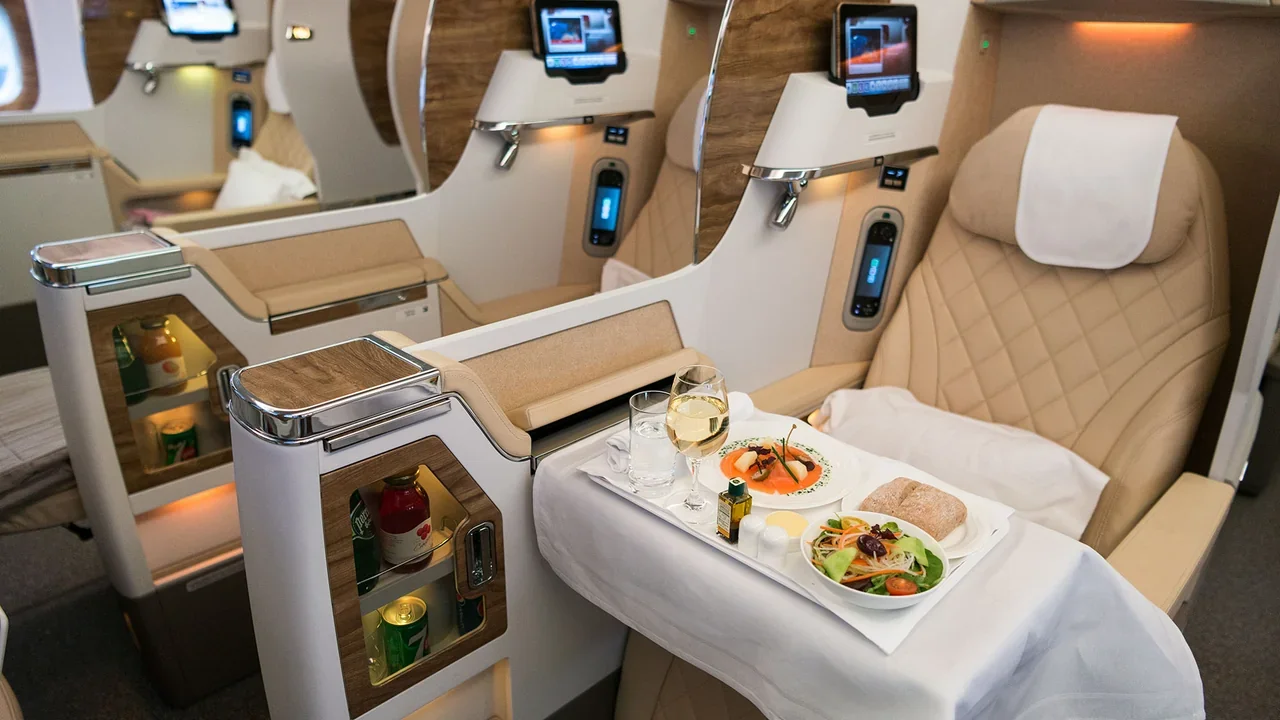
The Emirates business class product on the 777-300ER — which is what you'll get on most US routes — is a 2-3-2 configuration in a staggered layout. The window seats are genuinely private. The middle seats, particularly 14D and 14G, are fine for couples but feel exposed if you're traveling solo. I'd always pick a window seat, specifically something in rows 9 or 10 if I can get it, where the forward position gives you slightly faster deplaning at DXB.
The seat itself fully flat, 76 inches long, with a decent mattress pad that Emirates has improved over the years. It's not the 1-2-1 layout that Qantas or Virgin Atlantic use on some routes, so if direct aisle access from every seat is your baseline requirement, you'll find the window seats don't have it. You're stepping over the aisle seat if your neighbor is asleep. That's the real-world version of the product.
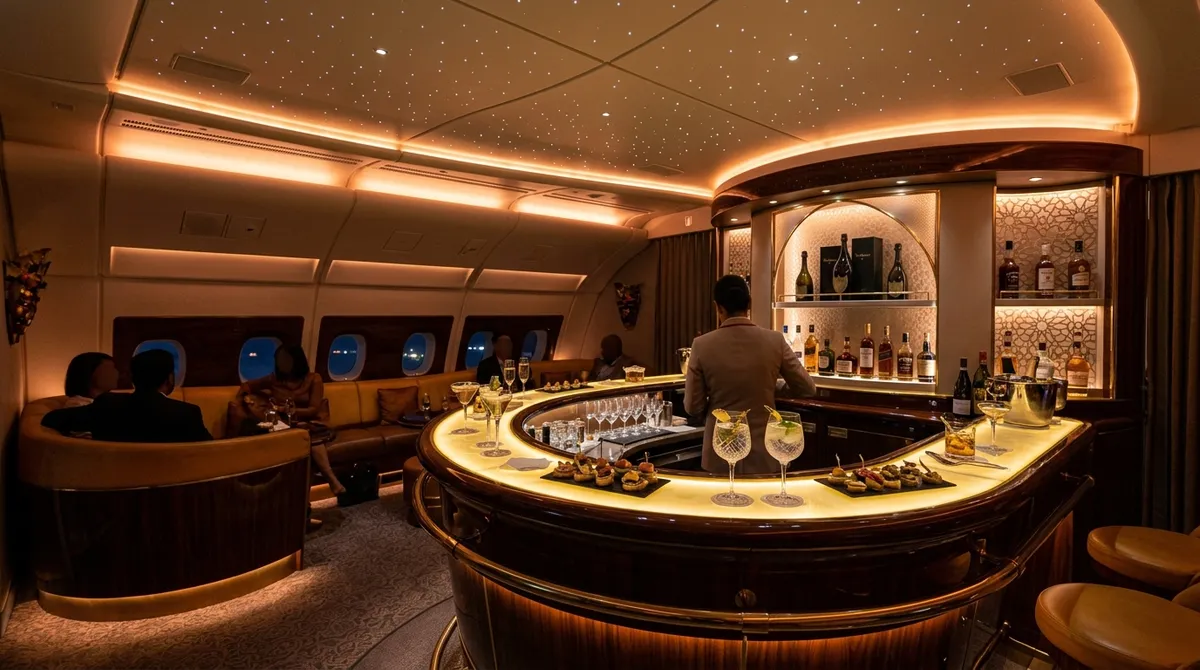
The bar — yes, there's a standing bar at the back of the cabin on the 777 — is genuinely one of the better touches in the sky. I've had conversations there at 2am over the Atlantic that I wouldn't trade. But it can also be crowded and loud, which isn't what you want if you're trying to sleep through the night. It's a feature that cuts both ways.
Food is solid. The mezze starter on the JFK-DXB route is usually the highlight — properly seasoned hummus, decent fattoush, warm bread that actually arrives warm. The mains are inconsistent in my experience. I've had a lamb dish at 39,000 feet that surprised me, and I've had a chicken option that tasted like it was assembled in a hurry. Order the Arabic coffee with the dates when they come around. That part is always right.
The entertainment system — Emirates' ICE — is legitimately the best in the sky on the hardware side. The screen is large, responsive, and the content library is deep enough that I've never exhausted it on a transatlantic leg. Noise-canceling headphones have improved; the older pairs were weak, the newer ones are fine.
First class vs. business class: is the upgrade worth it on this route?
This comes up constantly and the short answer is: it depends entirely on the price gap.
Emirates First Class on the 777 is one of the genuinely great products in commercial aviation. The private suite with closing doors, the onboard shower spa (yes, an actual shower), the dedicated lounge in the DXB terminal — it's all real and it's all remarkable. I've used the shower. It's a strange and wonderful thing to do at 35,000 feet.
But First Class on Emirates from the US routinely prices at $8,000 to $12,000 one-way at retail. Business class on the same flight — same departure, same destination — runs $3,000 to $5,000. That's a meaningful gap. For most people I talk to, the incremental experience in First doesn't justify $4,000 to $7,000 more per ticket. Business class on this route is genuinely comfortable and genuinely good. You'll sleep, you'll eat well, you'll arrive rested.
Where First starts to make sense is on award redemptions. If you've got Emirates Skywards miles or you're transferring from Amex Membership Rewards or Chase Ultimate Rewards, the First Class award rates are sometimes more achievable than you'd expect. That's a different calculation entirely.
If you're paying cash, stick with business. The gap isn't worth it.
Connecting options via European hubs
If you're not locked into flying Emirates nonstop, there are a few connecting routings worth knowing about.
Qatar Airways via Doha is the main competitor. The QSuite product — which is their business class on the 787 and A350 — is genuinely exceptional. Double beds, sliding doors, real privacy. I'd put it slightly ahead of Emirates business class on pure seat quality, though the ICE entertainment system gives Emirates the edge on screens. Qatar also sometimes prices lower, particularly out of secondary US cities like Dallas or Houston where they have good connections. If you see Qatar Airways pricing $400 to $600 below Emirates on a comparable routing, it's worth taking seriously.
The Doha stopover adds time — anywhere from 2 to 4 hours depending on the connection — but the Hamad International Airport transit experience is smooth and the Al Mourjan lounge is one of the better airport lounges in the world. Substantially better than what you'll find in most US departure airports, honestly.
Lufthansa via Frankfurt is the option that makes sense if you're departing from a Midwest city — Chicago, Detroit, Minneapolis — and you want to break the trip into two manageable segments. Lufthansa business class is fine, not exciting. The seat on the 747-8 upper deck is genuinely pleasant and the Frankfurt lounge in Terminal 1 has a decent hot buffet. But it adds considerable total travel time and I wouldn't choose it over a direct Emirates flight unless the price difference was substantial or the connections worked unusually well from your home city.
British Airways via London is an option I'd generally steer people away from. The Club Suite on newer BA aircraft is good, but the T5 Heathrow connection is genuinely stressful — security re-screening, long walks, frequent delays. And the BA catering in business class has been declining for years. The Club Kitchen self-serve snack bar concept they introduced is not what you want after paying $4,000 for a transatlantic business ticket. I've written about this at length and my position hasn't changed.
What the DXB airport experience is actually like
Dubai International is enormous and you need to understand it before you land there confused at 6pm local time.
Emirates operates primarily out of Terminal 3, which is dedicated to the airline. If you're arriving from the US in business class, you'll clear immigration through a separate fast-track queue — this genuinely saves 20 to 40 minutes compared to the general queue, especially during peak arrival windows. The baggage reclaim in T3 is reasonably fast by international standards.
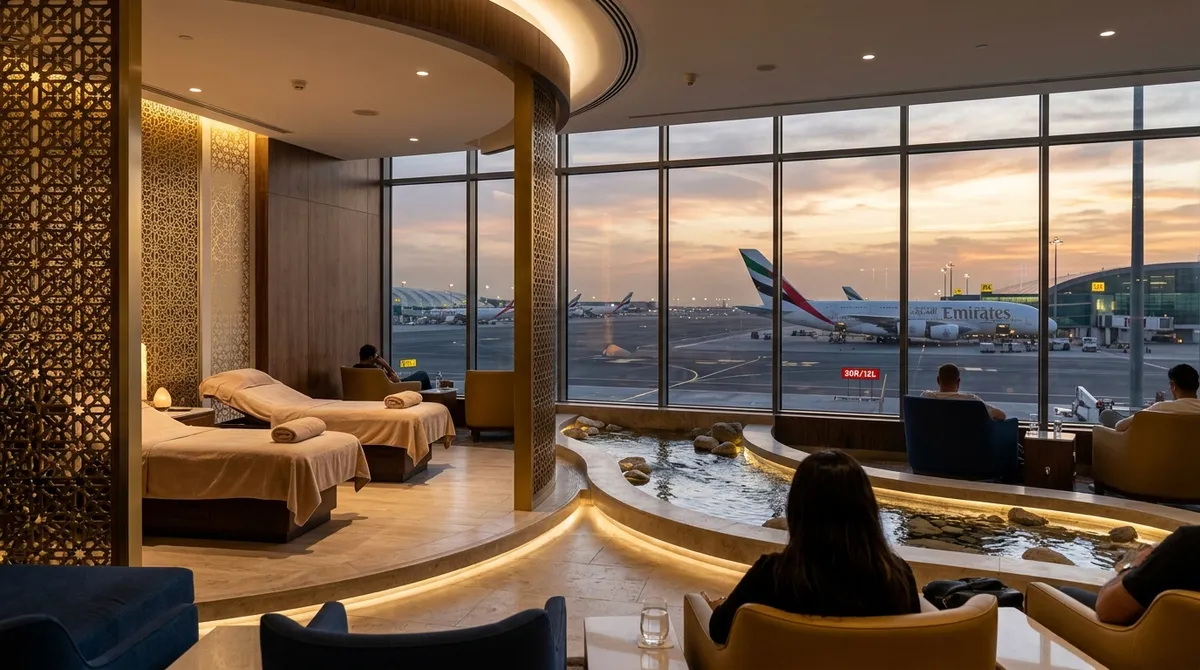
The Emirates lounge in T3 on departure is worth arriving early for. It's large, well-staffed, and the à la carte dining option (rather than the buffet) is available to business class passengers — the grilled hammour with herb butter is the move if it's on the menu. The spa offers complimentary treatments for First Class passengers but you can pay for a massage as a business class passenger, which is worth it on a long layover if you're connecting onward.
One thing that catches people off guard: the transit experience at DXB if you're connecting through is slower than you'd expect for such a large hub. Immigration and security can back up badly during certain arrival banks, particularly afternoon arrivals from Europe and South Asia. If you're transiting, don't book a connection under 90 minutes. I've seen people miss flights with 75-minute connections at DXB and it's not a fun situation.
The Dubai airport metro link is one of the better city-airport connections in the world. The Red Line runs directly to the city center — Union Square is the main interchange — and it's clean, fast, and genuinely easier than a taxi if you're not carrying excessive luggage. At AED 25 or so for a business class NOL card journey, it's almost insultingly cheap compared to what you just spent on the flight.
When to buy and what prices actually look like
Business class to Dubai from the US is one of those routes where the pricing swings are genuinely dramatic. I've seen JFK-DXB round-trips in business class at $2,100 during off-peak windows. I've also seen the same routing sitting at $7,400 two weeks before departure. That's not a small variance — it's a completely different purchase decision.
The sweet spot for this route tends to be the shoulder seasons: late August through September, and February through March. Peak pricing hits December through January (the Dubai winter is excellent and everyone knows it) and again in June when school holidays drive demand from the UK and Europe, which feeds into transatlantic pricing in ways that aren't always obvious.
The other pattern I've noticed is that Emirates specifically tends to release discounted business class inventory on Tuesday and Wednesday mornings, US Eastern time. Not always, not reliably enough to build a strategy around alone, but often enough that it's worth knowing. A fare that's $4,800 on Monday sometimes drops to $3,400 by Wednesday without any obvious reason. That's just how dynamic airline pricing works and it rewards people who are watching.
This is exactly what BusinessClassSignal was built for. The service monitors specific routes and sends you an alert the moment a price drops below your target threshold — you set the number, it watches the route. The 14-day free trial gives you full access to set up as many route alerts as you want, and you don't need to check anything manually. If you're planning this trip but not ready to buy yet, start monitoring this route now so you don't miss a drop when it happens. I've seen fares on the JFK-DXB route move $1,200 in a single day. Being notified in real time is the difference between catching it and reading about it afterward.
If you want to understand how the alerts are set up and what triggers them, the how the monitoring system works page explains it without the marketing fluff.
A few things nobody tells you before the trip
Dubai in July and August is genuinely brutal outside. Mid-40s Celsius, humidity that makes it feel worse. The city functions — everything is air-conditioned to an almost aggressive degree — but outdoor activities are largely off the table. If you're going for the beaches or the outdoor markets, go between November and April.
The alcohol situation: Dubai is more permissive than many people expect for a Muslim-majority city, but it's not unrestricted. You can drink at licensed hotels, restaurants, and bars. You can't drink in public spaces or unlicensed venues. On Emirates, business class has an open bar from shortly after takeoff and it's well-stocked. The Hennessy XO is available on most routes. Don't be that person who overindulges and then causes problems. Emirates is not forgiving about that and the UAE's entry rules give the airline significant discretion.
Business class passengers clear Dubai customs through a separate immigration hall in T3. Have your entry documentation ready — US passport holders get a visa on arrival for 30 days, no pre-registration required as of the last update, but this is the kind of thing that can change so verify before you travel.
And one thing I always tell people: the flight back from Dubai to the US is almost always harder than the inbound. You're flying against the jet stream, the eastbound journey adds an hour or more, and the departure time from DXB is often late night or early morning, which sounds good in theory but means you land in New York at 8am having not really slept. The flat bed matters more on the way home than the way out. Don't let anyone talk you into economy for the return leg.