Quick summary
Since the Strait of Hormuz closure in late February 2026, business class to the Middle East has become one of the most volatile premium fare markets I've ever tracked. Seat inventory is sharply down, prices are swinging wildly, and some airlines have pulled out entirely. Here's what's actually happening and what it means if you're trying to fly business class to the region this year.
The situation right now, in plain terms
I've been watching fare data on Middle East routes for over a decade. I've seen Gulf carrier price wars, the post-COVID capacity crunch, the brief window in late 2022 when you could get a QSuite round-trip from New York for under $2,800. I've seen a lot.
What's happening with business class to the Middle East right now is different. It's not a sale cycle. It's not a capacity adjustment. It's a market operating under genuine geopolitical stress, and if you're planning travel to Dubai, Doha, or anywhere in the broader Gulf region through the rest of 2026, you need to understand the mechanics of what's changed.
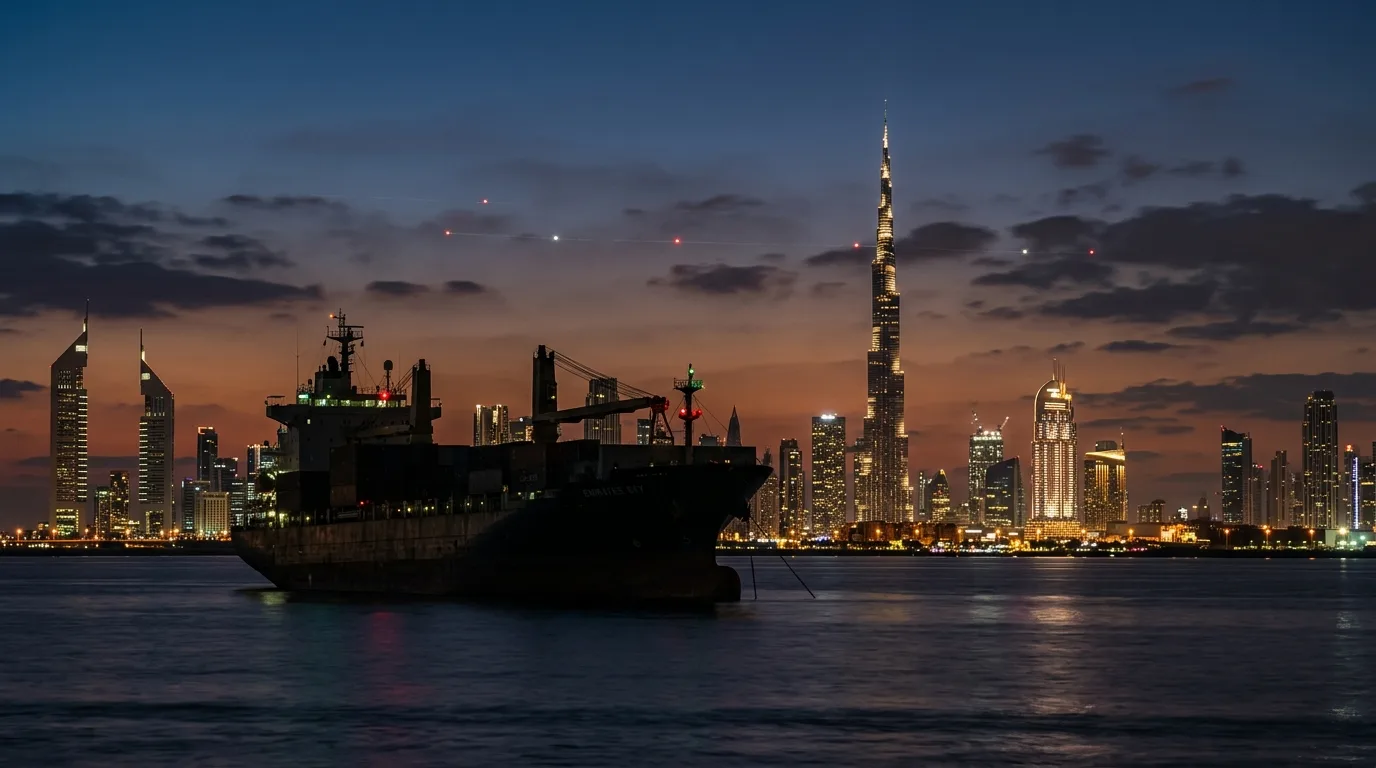
The Strait of Hormuz has been effectively closed since late February 2026. Iran declared the waterway under "strict management and control," citing the continued US naval blockade of its ports. There have been gunfire incidents on vessels attempting transit. The knock-on effects have moved well beyond shipping lanes into aviation routing, airport operations, and — critically for anyone reading this — premium cabin availability.
What the DXB restrictions actually mean for your seat
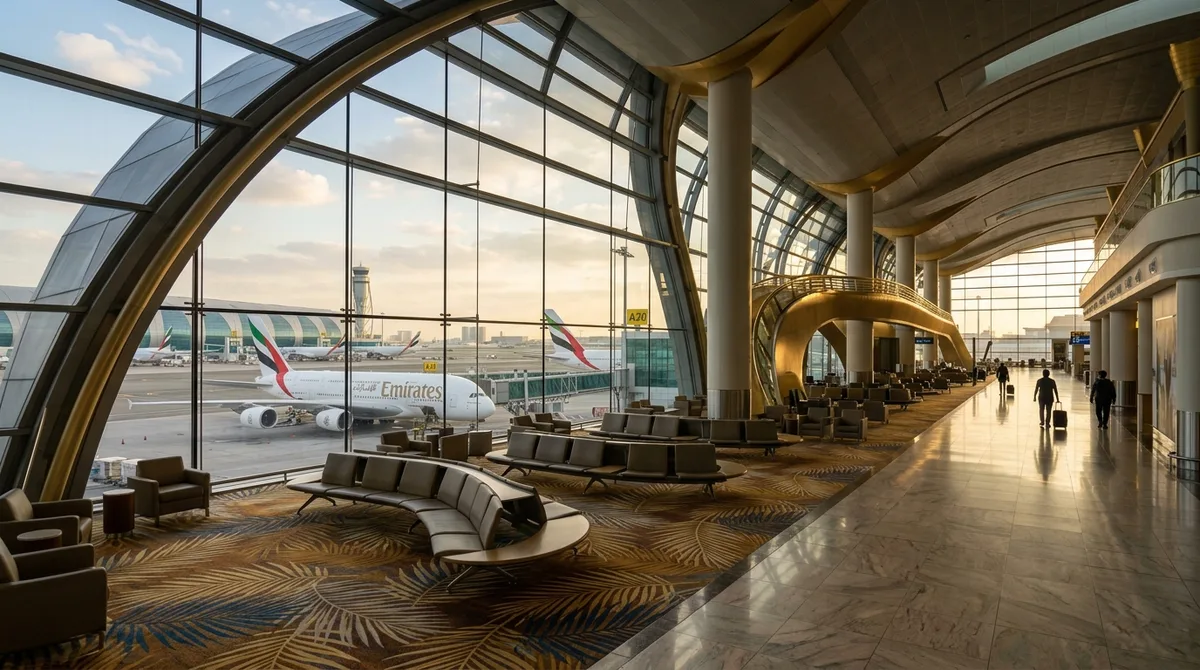
On April 20, 2026, Dubai International Airport implemented a cap that doesn't get enough attention in the mainstream travel press. All non-UAE airlines are now limited to one round-trip per day at DXB, with the same restriction applying at the secondary Dubai World Central airport. Emirates and flydubai are exempt.
Let that sink in for a second.
British Airways, Lufthansa, Singapore Airlines, Qatar Airways — every foreign carrier — is limited to a single daily rotation at most. The reason given is that military-managed airspace corridors have reduced the number of safe hourly aircraft movements the airport can process. These restrictions run through May 31, 2026, though there's no particular reason to assume they end cleanly on that date given everything else that's in flux.
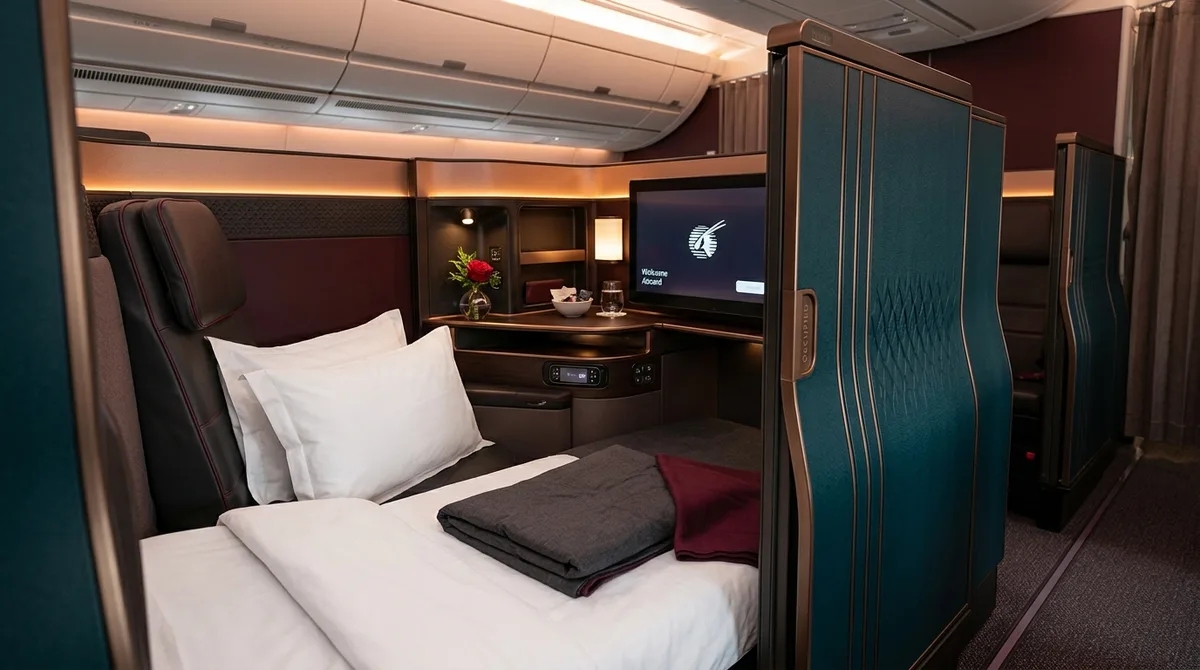
What this means practically: a British Airways 777 that might have operated twice daily now operates once. The business cabin on that one flight is carrying twice the demand. Qatar Airways' QSuite availability out of the US is, by multiple accounts I've seen in the data and heard from readers, extremely limited right now. Overbooked flights are being prioritized for the highest-fare demand, which means award redemptions and discounted business class fares are the first things to disappear.
Award availability warning
Premium award inventory on Gulf routes is essentially gone on most carriers right now. If you're counting on points and miles to cover a Middle East trip in 2026, you'll need either extreme flexibility on dates or a lot of patience waiting for sporadic releases.
The Lufthansa situation and what it signals
Lufthansa Group has gone further than most. They've suspended all flights to several Middle East destinations outright, with some suspensions extending through October 2026. That's not a short-term weather hold. That's a carrier making a multi-month business decision about risk.
I think it's worth paying attention to when a major European flag carrier pulls out of a market for seven months. Airlines don't do that lightly. The reputational cost, the lost revenue, the rebooking headaches — they're absorbing all of that because their safety assessment says it's the right call. Other European carriers haven't gone that far, but they're operating with tighter constraints.
The western section of Iranian airspace remains closed. The eastern section has partially reopened for transit as part of a phased four-stage plan, but that's "transit" — meaning aircraft can cross overhead, not that Iranian airspace is operationally normal. Six civilian airports in Iran are operating with limited 11-hour windows. The patchwork nature of all this means routing decisions are being made day by day, and that unpredictability flows directly into pricing.
Business class middle east 2026: what fares are actually doing
In normal times, I'd tell you to target Emirates JFK–DXB at around $2,800–$3,200 round-trip for a solid deal, and that patient monitoring through a tool like BusinessClassSignal would catch dips into the $2,400 range a few times a month. BusinessClassSignal is a fare monitoring service that tracks 800+ business class routes twice daily and sends alerts when prices drop below your target threshold.
Right now, those numbers don't apply. I've seen round-trip Emirates business class from New York to Dubai sitting north of $4,800 on peak dates, with limited availability even at those prices. The dips still happen — they just happen faster and at higher floors than before. A "deal" in this market might be $3,400 when the going rate is $4,600.
The fare volatility is real and it moves with little notice. A ceasefire announcement, a diplomatic development, a change in airspace status — any of these can shift prices within hours. I've watched a London–Dubai business class fare on BA drop by £600 and then recover within 36 hours during the past few weeks. If you're not monitoring daily, you're almost certainly missing the windows.
Why is business class to the Middle East so expensive right now?
The short answer: supply is down, demand hasn't dropped proportionally, and uncertainty is baked into every fare.
The longer answer involves a few overlapping factors. The one-rotation cap at DXB cuts available premium seats roughly in half for most non-UAE carriers. Airlines are also building in operational buffers — extra fuel for longer routing around closed airspace, crew rest contingencies for extended flight times, higher insurance premiums in conflict-adjacent zones. Those costs don't stay in the airline's P&L. They show up in your fare.
Emirates is in an unusual position. Exempt from the DXB cap, they're operating at higher frequencies than competitors. That makes them the most reliable option right now in terms of schedule, though they're still dealing with restricted airspace corridors that affect routing. Their First and Business Class prices have moved up sharply because they're absorbing demand from carriers that have cut back or pulled out.If you're set on flying into DXB, Emirates is currently your most reliable option for schedule consistency. But check Turkish Airlines via Istanbul for potentially better business class pricing — they've become a serious alternative routing for Middle East travel.
Is Turkish Airlines a viable alternative for Middle East travel right now?
Yes, and more so than most people realize.
Istanbul's hub position has become genuinely useful during this period. Turkish Airlines routes a huge portion of its Middle East traffic through IST, and their airspace situation is materially different from carriers routing through Gulf airspace or Iranian transit zones. Istanbul sits outside the most affected corridors, and Turkish has been quieter about disruptions than many of its Gulf competitors.
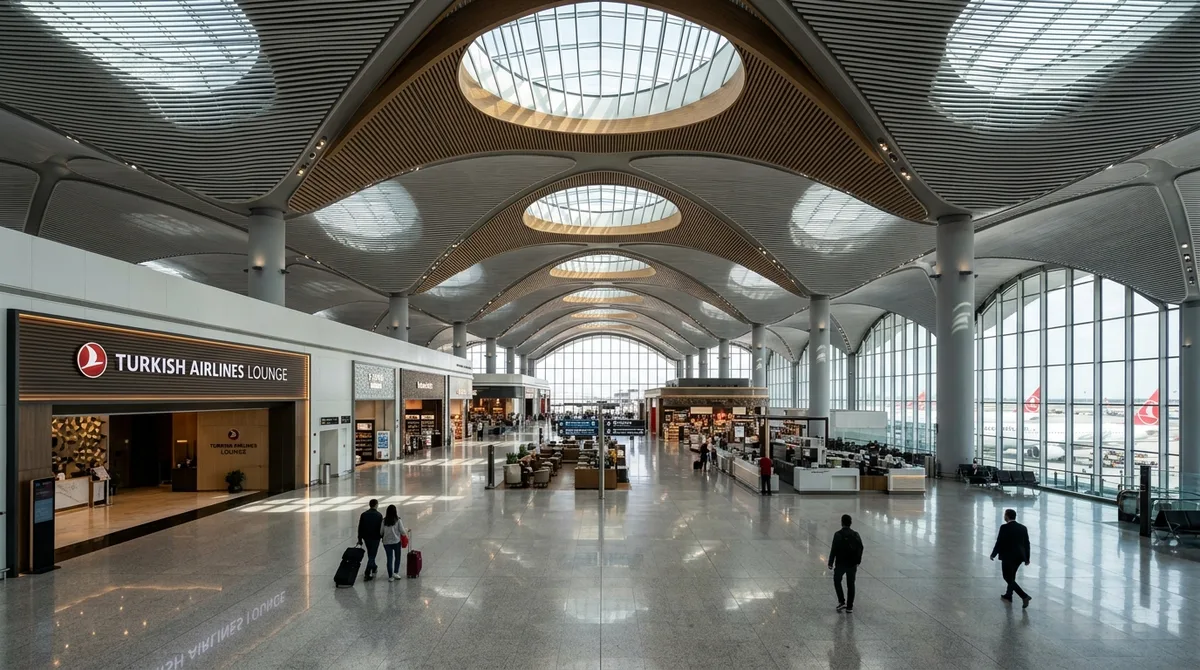
I've flown Turkish business class three times in the past two years. The seat on their 787 is good — a proper lie-flat with direct aisle access in the 1-2-1 configuration. The food is legitimately better than most carriers (their Istanbul catering operation is one of the better-kept secrets in business class), and their lounge at IST, the new CIP lounge in the international terminal, is large and well-stocked even if it gets crowded during peak hours.
The downside: the connection through Istanbul adds time. If you're going IST–DXB or IST–DOH, you're looking at a minimum connection time of around 90 minutes to be comfortable, and the airport is large enough that gates can be genuinely far apart. But if the alternative is paying a $1,500 premium on a direct flight with uncertain routing, the tradeoff starts to look reasonable.
Etihad and Abu Dhabi: the quieter story
Etihad doesn't get as much attention as Emirates or Qatar Airways in the business class conversation, but Abu Dhabi's situation is worth flagging separately. AUH faces similar regional constraints to DXB — the military-managed airspace corridors affect the broader UAE, not just Dubai. Etihad hasn't announced the same kind of dramatic operational changes as Lufthansa, but their schedule reliability has been more variable than usual.
I've always found Etihad's business class slightly underrated. The seat on their A350 is excellent, the lounge at AUH is genuinely good (the food options in the Al Maha lounge are better than what you'll find at most European hubs), and the airline tends to price more aggressively than Emirates on transatlantic routes. But right now, AUH is operating under the same constraints as the broader UAE aviation environment, and I'd want to see more schedule stability before I booked a tight connection through Abu Dhabi.
Practical advice for anyone booking business class middle east 2026 travel
Let me be direct about what I'd actually do if I were booking a Middle East trip for the second half of 2026.
First, I'd check the EASA and FAA Conflict Zone Information Bulletins before booking anything. These are updated regularly and represent the most current official assessment of airspace risk. EASA's CZIB for the Gulf region has been updated multiple times since February. The FAA's equivalent is a bit harder to parse but contains flight crew advisories that give you a sense of what commercial operators are actually dealing with. These aren't alarmist documents — they're operational references, and reading them gives you a more accurate picture than any travel news article.
Second, travel insurance. Make sure your policy explicitly covers geopolitical disruptions. Most standard policies don't. You want a policy that covers "change in government advice" or "civil unrest" as a cancellation trigger, not just natural disasters or illness. Read the exclusions carefully. I know that's tedious advice, but I've heard from readers who got burned on non-refundable business class tickets during earlier disruptions because their policy had a conflict zone exclusion buried in the fine print.
Insurance specifics matter
Look for policies that include "cancel for any reason" (CFAR) coverage, or at minimum cover "government travel advisory changes" as a trigger. Standard travel insurance often won't pay out on geopolitical grounds.
Third, flexibility. This is not a good moment to book a rigid itinerary with non-refundable connections and a single-day arrival window. Build in buffer days. Book refundable fares where the premium is reasonable. The ceasefire that was in effect expired April 22nd, and the situation has enough moving parts that a sharp change in conditions is plausible on short notice.
Fourth — and this is where monitoring becomes genuinely useful rather than just nice to have — watch the prices daily. Fare dips in volatile markets are real, but they're short-lived. A political development that briefly improves the outlook can send prices down for 12–24 hours before demand catches up. You won't catch those windows by checking once a week.
Set your target price threshold lower than you think is realistic right now. In volatile markets, brief dips can go surprisingly deep — but only for a few hours. You want the alert to fire fast.
Where deals are still appearing, and why
Despite everything I've described, business class middle east 2026 fares are not uniformly expensive across all routes and all dates. There are patterns worth knowing.
Shoulder-period dates in June and July — outside of Eid travel windows — have shown more price movement than peak dates. The logic is simple: demand is somewhat softer, and airlines are occasionally releasing inventory at lower prices to fill seats that would otherwise go empty. A fare that costs $4,800 in late April might show up at $3,100 for a mid-June departure. Not a steal, but a meaningful difference.
Routes from secondary European gateways have been more interesting than the major hubs. Manchester to Dubai, for example, has shown more price volatility than Heathrow to Dubai — in part because the single-rotation cap affects LHR more acutely given its higher baseline frequency. Similar dynamics apply to some secondary US gateways.
The Turkish Airlines angle I mentioned earlier deserves repeating. Their business class fares on JFK–IST–DOH routing have been some of the most competitive prices I've tracked in this market recently, and they're not subject to the same DXB cap dynamics. If your destination is Doha, that routing is worth pricing seriously.
Browse all currently monitored Middle East routes to see where the current floor prices are sitting across carriers.BusinessClassSignal has been tracking this market intensively since the Hormuz closure, and the pattern we're seeing is that dips are real but brief. The monitoring cadence — twice daily scans on 800+ routes — is set up precisely for markets like this one, where a fare that's $4,200 at 9am can be $3,100 at 2pm and back up by the following morning.
The honest outlook for the rest of 2026
I'm not going to pretend I know when the Strait of Hormuz situation resolves. Nobody does. What I can say is that the April 20 DXB restrictions running through May 31 are the most concrete near-term constraint, and there's no guarantee they don't extend. Lufthansa's suspensions running through October suggest at least one major carrier's risk assessment doesn't see a clean resolution before then.
If you're traveling to the Gulf region for business and don't have flexibility on timing, book the most refundable fare you can find, read the CZIB updates, and have a backup routing in mind. If you're traveling for leisure and do have flexibility, late 2026 — Q4 — is where I'd focus attention. Either the situation improves and prices come down meaningfully, or it doesn't and you've saved yourself a headache.
The market right now rewards people who are paying close attention and can act fast. That's not most travelers. But if you're serious about getting into a flat bed to Dubai or Doha without paying the absolute peak rate, the infrastructure exists to help you catch the windows when they open.
Monitor business class fares to Dubai, Doha, and across the Middle East — 7-day free trial
Try Free