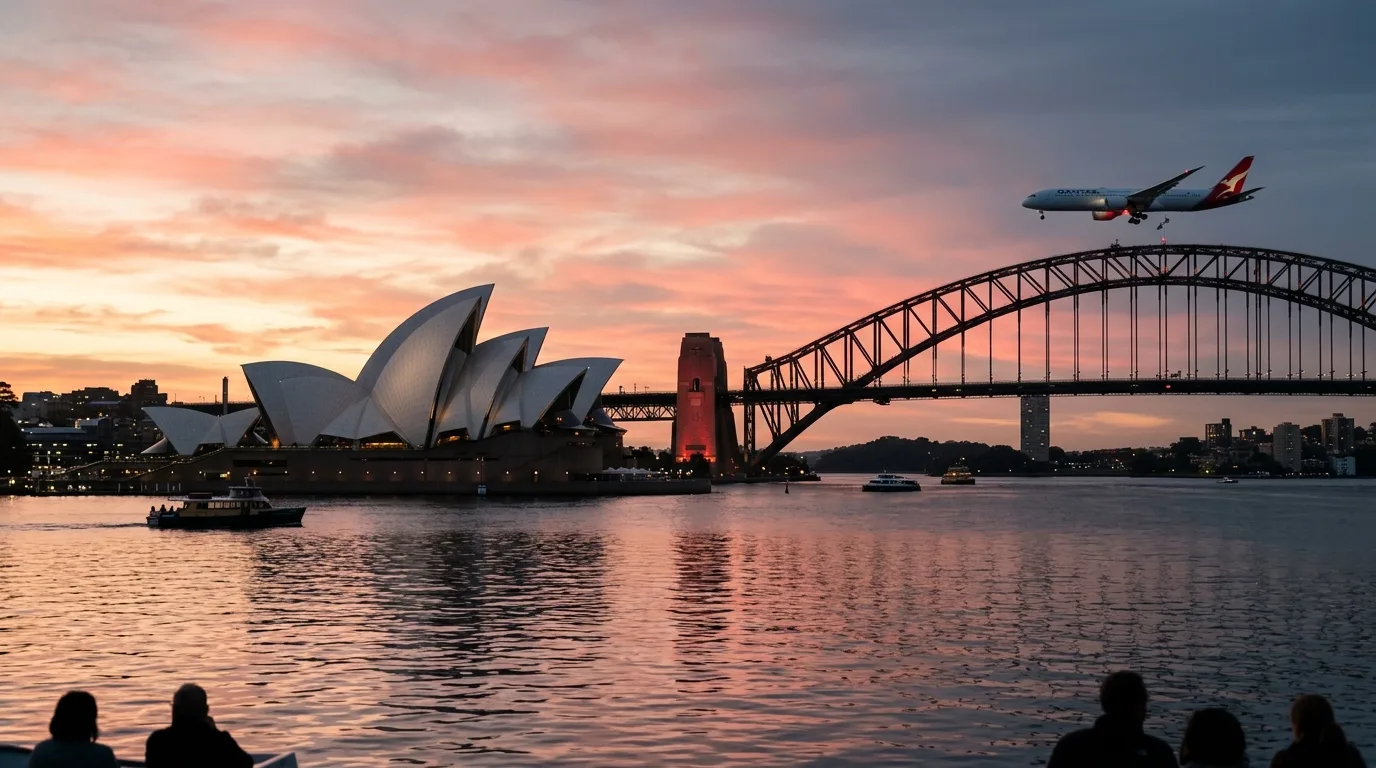
The honest state of business class to Sydney right now
Sydney is one of those routes where the options look better on paper than they sometimes feel in practice. You've got a handful of carriers worth considering, fares that occasionally drop into genuinely good territory, and one of the longest overwater flights in commercial aviation sitting between you and your destination. Getting this one right matters more than most routes, because a bad seat choice on a 15-hour-plus flight isn't something you sleep off. It follows you.
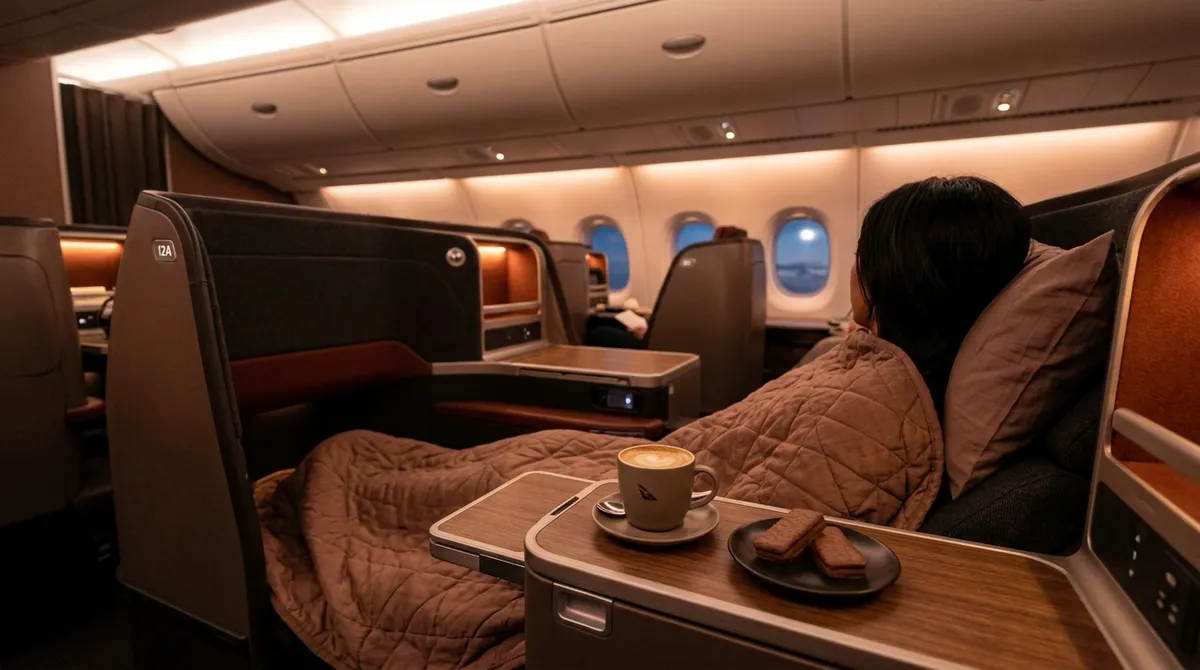
I've flown Sydney from the US six times in the last four years — twice on Qantas direct, once on United, and the rest connecting through Auckland or other points. Each had tradeoffs I didn't fully anticipate. This guide is the version I wish I'd had before a couple of those bookings.
Qantas direct LAX-SYD: still the benchmark for business class to Sydney
If you're originating from Los Angeles, the Qantas nonstop is the obvious first thing to price out. QF11 departs LAX in the evening — usually around 10:55 p.m. — and lands in Sydney roughly 15 hours later, arriving late morning local time. The timing is actually well-designed for jet lag management, assuming you can sleep on the plane. That's a big assumption, and I'll get to it.
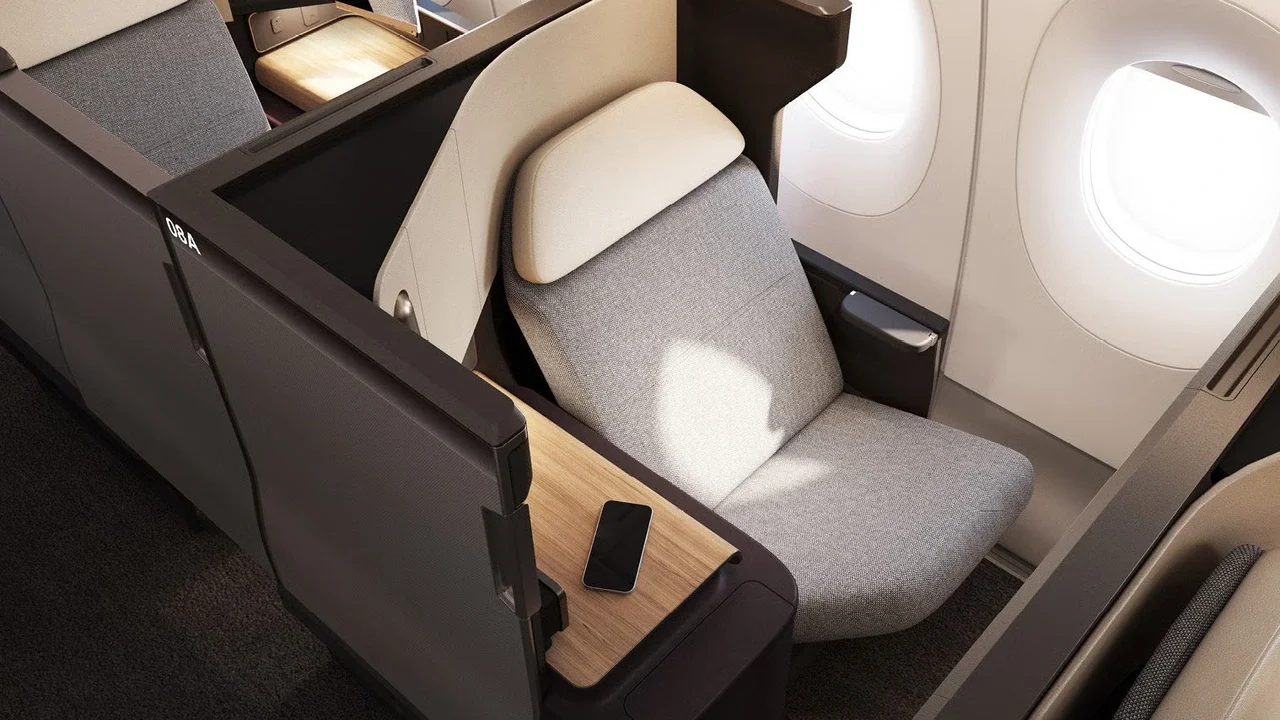
The aircraft is a Boeing 747-400 on some rotations and more recently the A380 on others. Get the A380. The 747 business cabin is dated — the seats don't fully recline to flat, there's less personal storage than you'd want, and the whole product feels like it's waiting for retirement. The A380 upper deck business cabin is a different experience entirely. You've got angled-flat or fully-flat seats (depending on the specific configuration), more cabin separation from economy, and generally better noise levels up top.
Qantas has been rolling out its "Business Suites" product on A380 routes, and the LAX-SYD flight has seen it on and off depending on the specific aircraft. The suite doors and the 1-2-1 layout make a real difference on a 15-hour flight. If you're booking and want to check which aircraft is assigned, use the Qantas seat map tool at booking — the Business Suites product shows a noticeably different layout than the older staggered configuration.
The food on Qantas long-haul has always been one of its genuine strengths. The "Rockpool Neil Perry" partnership has had its ups and downs over the years, but on the LAX-SYD route I've consistently had the barramundi hold up better than you'd expect from a reheated galley at 40,000 feet. The macadamia nut ice cream sundae is real and it's good. These are small things that add up across 15 hours.
Pricing on this route is variable in ways that can be maddening. I've seen it as low as $2,400 round-trip during off-peak windows (typically February and parts of June) and as high as $8,500 when you're booking close in. Award availability on Qantas itself is notoriously tight — they hold back a lot of their own J seats from the points market, especially on this route. Partner redemptions through American AAdvantage or Alaska can occasionally surface availability that Qantas.com won't show you.
The Qantas LAX lounge situation
One thing people don't talk about enough when booking the LAX departure: the Qantas International First Lounge at LAX is legitimately good. It's located in the Tom Bradley terminal, post-security, and the food offering is a proper sit-down a la carte menu rather than a buffet grab. The barista coffee is decent — better than most US airport lounges and considerably better than what you'll find in most oneworld partner spaces at LAX.
The shower suites require a bit of a wait during peak hours (the 9-11 p.m. window before the Sydney departure can back up), so get there early if that matters to you. The lounge is accessible for Qantas Business passengers, oneworld Emerald and Sapphire members, and certain partner cardholders.
The one complaint I'll register: the lounge gets crowded on busy departure nights, and the seating near the windows fills up fast. It's not the quiet sanctuary some people expect. Plan accordingly.
United's LAX-SYD option and what you're actually getting
United operates LAX-SYD on a Boeing 787-9, which is a more modern aircraft than some of Qantas's older metal on this route. The Polaris business class seat is a fully-flat 1-2-1 configuration, which is the right call for this distance. No middle seat nightmares, direct aisle access regardless of where you're sitting.
Here's my honest take on United Polaris: the seat itself is good. The bedding is genuinely above average for a US carrier — the Saks Fifth Avenue partnership produces a duvet that's actually warm. But the service inconsistency on United long-haul is real, and it's more pronounced on the Sydney route than on transatlantic flights in my experience. I've had one exceptional crew on a LAX-SYD Polaris flight and one that was perfunctory to the point of being forgettable. Your mileage will literally vary.
The dining is serviceable. Nothing that will stick with you. The pre-departure drinks are fine. The United app integration with the IFE system is one of those features that sounds better in the press release than it works in practice — the Bluetooth pairing drops, and the content library is smaller than Qantas's on this route.
Where United can win on this route is pricing and MileagePlus redemptions. United sometimes prices business class to Sydney more aggressively than Qantas during off-peak periods, and MileagePlus award space on their own metal is generally more available than Qantas's own program. If you're holding United miles and need to get to Sydney, this is a reasonable use of them.
One practical note: United's LAX-SYD typically departs from Terminal 7 or 8, not the Tom Bradley International Terminal. The United Polaris Lounge at LAX is in the B concourse area. It's a solid lounge — better than the old United Club product — but it doesn't quite match the Qantas lounge for the pre-departure experience.
Connecting through Auckland: slower but sometimes smarter
The Auckland connection doesn't get enough attention from US travelers pricing out business class to Sydney. Air New Zealand operates SFO-AKL and LAX-AKL, and from Auckland you've got a short 3-hour hop to Sydney on either Air New Zealand or Qantas codeshares. The total elapsed time is longer, obviously — you're looking at roughly 20-22 hours city-to-city versus 15 hours nonstop. But there are reasons to consider it.
Air New Zealand's Business Premier product on the widebody AKL flights is genuinely excellent. The lie-flat seat has a distinctive cradle design that some people love and some find slightly awkward — I'm in the love camp, for what it's worth. The food service is outstanding for a premium economy-adjacent carrier that punches well above its size. On the SFO-AKL segment, I've had lamb rack that was the best single thing I've eaten on an airplane in the last two years. I know that sounds like hyperbole. It isn't.
The Auckland connection also opens up Air New Zealand's Koru Lounge at AKL, which is worth a few hours of your time. The coffee is excellent, the food is better than most connecting lounges, and the whole terminal at AKL has a calm that feels almost impossible to find in LAX or SFO.
The fare math sometimes works in favor of the connection, particularly if you're booking through Air New Zealand's own site or finding itineraries that price the AKL-SYD segment cheaply. I've priced out SFO-AKL-SYD in Business Premier for $3,100 round-trip during promotional windows — that's competitive with the Qantas direct when Qantas isn't running a sale.
The downside is the transit. You're adding a connection, which means another boarding process, more time in airports, and the risk of a delay in Auckland cascading into a missed connection. AKL is a small enough airport that connections under 90 minutes can feel tight if your inbound is delayed. I'd always book at least two hours in Auckland if you're making this connection.
Ultra-long-haul realities that nobody mentions in the brochure
Fifteen-plus hours in any seat, no matter how good, is an endurance event. Anyone who tells you otherwise is trying to sell you something. Here's what I've actually learned from doing this route multiple times.
The overnight departure from LAX is a double-edged sword. You arrive in Sydney at a civilized hour, which is great for getting to your hotel and starting your trip without a wasted day. But it means you're boarding a plane at 11 p.m. after a full travel day, and the first few hours of the flight are the hardest for sleep because your body isn't ready yet. I've started taking melatonin on departure night rather than waiting until I'm on the plane — 30 minutes before boarding, not after. It makes a difference for me.
Hydration on this route is more important than on transatlantic flights simply because of the duration. The A380 cabin humidity is marginally better than the 787, but you're still losing water faster than you think. I bring a 1-liter bottle through security and ask the crew to refill it during the flight. Most will. The crew on Qantas particularly have always been accommodating about this.
The seat you pick matters enormously. On the Qantas A380 Business Suites configuration, I prefer rows 11 or 12 on the upper deck — far enough from the galley noise at the front, close enough to the forward lavatory that you're not walking the length of the cabin at 3 a.m. On United's 787-9 Polaris, the window seats in the 1-2-1 configuration (seats A and K) give you the wall storage and more privacy. Avoid the seats in the bulkhead row if you're tall — the footwell can feel constrained even in lie-flat mode.
One thing that catches people off guard: the return flight from Sydney to LAX is even longer than the outbound. You're flying against the winds, and QF12 can run 17+ hours depending on the routing. Pack accordingly. More sleep aids, more entertainment downloaded offline, more patience.
Project Sunrise and what it means for this route eventually
Qantas has been working toward direct flights from Sydney to New York and London — what they've branded Project Sunrise — using the Airbus A350-1000ULR. This isn't the same as the existing LAX-SYD route, but it's worth knowing about if you're planning travel more than a year out.
The commercial launch has been pushed back more than once and is currently targeting late 2025 or 2026 for the SYD-JFK and SYD-LHR routes. The cabin product being developed for these flights is reportedly a significant step up from current Qantas business class — dedicated sleep suites, a wellness zone, a redesigned food program. Qantas has invested heavily in the pitch because they need people to voluntarily sit in an aluminum tube for 20 hours.
The LAX-SYD nonstop isn't directly affected — that route will likely continue with A380 and eventually newer aircraft as the fleet evolves. But Project Sunrise matters to US travelers because it opens up a nonstop East Coast-to-Sydney option that doesn't currently exist. If you're flying from New York or Boston, the routing today involves either a transcon to LAX first or a connection somewhere in the Pacific. A JFK-SYD nonstop changes that math entirely.
I wouldn't delay travel plans waiting for it. But if you're thinking about a Sydney trip in 2026, it's worth watching what Qantas releases on that product before you commit to a routing.
Finding the fare drops before they disappear
Business class fares on this route move fast when they move. The LAX-SYD nonstop on Qantas doesn't go on sale often, and when it does, the window is sometimes measured in hours. I've seen $2,200 round-trip fares appear on a Tuesday afternoon and vanish by Wednesday morning. The same pattern holds for Air New Zealand's promotional fares on the Pacific crossing.
This is the part where I'll mention that BusinessClassSignal exists specifically to catch these drops. You set up a route alert for something like LAX to SYD, and the system monitors fares around the clock and sends you a notification when something worth acting on appears. It checks across multiple carriers — so if Air New Zealand drops a fare while Qantas is holding firm, you'll see it. The free 14-day trial gives you enough time to understand how the monitoring system works and whether it fits how you actually book travel. No credit card required to start. I'm obviously not unbiased here, but the honest pitch is: this route specifically is one where the monitoring pays for itself quickly if you're flexible on dates.
You can also start monitoring this route directly if you know LAX-SYD or SFO-SYD is what you're targeting. Takes about two minutes to set up.
The best fares I've personally seen on this route have come in late January and mid-June — after the holiday peak and before the Australian school holiday rush respectively. If you have any flexibility to target those windows, it's worth building your trip around them rather than the other way around.
Sydney is worth the effort to get right. It's a long way to go in a bad seat.