Quick summary
Getting upgraded to business class in 2026 is harder than it was five years ago, but it still happens — if you know which levers to pull. This guide covers the four main paths: elite status, bidding programs, paid upgrades, and operational upgrades. I'll be straight with you about the odds, because most advice on this topic is embarrassingly optimistic.
The honest state of upgrades right now
Let me start with something most travel blogs won't tell you: complimentary upgrades to business class are largely a relic. The days of checking in, smiling at the agent, and getting bumped up to a flat-bed seat are mostly gone. Airlines figured out that giving away their most profitable inventory for free was, shockingly, bad for business.
Business class load factors have climbed steadily since 2022. On routes like JFK–LHR and LAX–NRT, many carriers are running their cabins at 80–90% capacity on peak departures. There's simply less slack in the system.
That said, upgrades still happen. I've received them. I know people who get them regularly. But the mechanism matters enormously — and understanding which path you're actually on is the difference between a realistic strategy and wishful thinking.
Elite status: still the most reliable path
If you fly frequently enough to hold top-tier status with one airline (United 1K, AA Executive Platinum, Delta Diamond, BA Gold), complimentary upgrades are still part of the deal. But even here, the mechanics have changed.
Delta has been the most aggressive in pulling back. Diamond Medallion members used to get complimentary upgrades on domestic routes fairly reliably. Now, Delta has shifted heavily toward a system where Medallion Upgrade Certificates are the currency, and even those don't always clear. On transatlantic flights, complimentary upgrades for status holders are essentially gone — Delta pushes everyone toward the upgrade bidding program instead.
United is somewhat more generous to 1K members on domestic routes, but international complimentary upgrades are rare. American's Executive Platinum members probably get the best deal of the US carriers on domestic — the upgrade clearing rate is higher, and the window opens earlier.
Status upgrade timing
Most US carriers open the upgrade waitlist 100 hours before departure for top-tier members. Set a reminder and check your waitlist position around that window — if you're number one on a half-empty flight, you'll usually clear.
British Airways works differently. As a Gold member, you get upgrade vouchers (called Avios upgrades or Companion Vouchers depending on the context), but spontaneous complimentary upgrades at the gate are uncommon. BA's system is more transactional — you either use the voucher or you don't.
The honest truth about status: it helps, but you need to be flying the right routes at the right times. A 1K member on a sold-out Friday evening departure to London is not getting upgraded. That same member on a Tuesday morning departure in January? Much better odds.
How often do elite members actually get upgraded?
Nobody publishes clean data on this, which is convenient for the airlines. Based on what I've seen across forums, data shared in frequent flyer communities, and my own experience: top-tier domestic upgrade rates for US carriers hover somewhere between 40–65% depending on the route and season. On international flights, it drops to single digits for most carriers — maybe 5–15% for the very top tier on quieter routes.
Mid-tier status (Gold, Platinum, 50K) gets upgraded far less often than people expect. The waitlist is longer and the inventory is tighter. If you're sitting at mid-tier and banking on upgrades to business class as part of your travel strategy, I'd recalibrate.
Upgrade bidding programs: worth it or not?
Almost every major carrier now runs some version of an upgrade bid auction — United's PlusPoints, Lufthansa's Upgrade program, Qatar's bid system, Emirates Bid to Upgrade, and so on. You submit a bid within a set range, and if the airline accepts it (usually 24–72 hours before departure), your card gets charged and you're moved up.
I have genuinely mixed feelings about these programs.
On the positive side: they're one of the few ways a regular traveler without status can legitimately get upgraded to business class at a price below the full fare. I've seen people land transatlantic business class for an additional $400–600 on top of their economy ticket through bidding. That's a real deal.
The frustrating part is the opacity. You don't know your odds. You don't know what other people are bidding. The airline has complete pricing power and zero obligation to tell you anything useful. You bid, you wait, and you either get a congratulations email or you don't.
Don't bid your maximum too early
Some programs show you a "recommended" bid range. That range is set by the airline to maximize revenue. Start lower — around 30–40% above the minimum bid — and see if it clears. If your flight is in low season and the route isn't busy, modest bids often work.
The best programs, in my experience, are Lufthansa's and Qatar's — both have reasonably transparent minimum bids and a decent hit rate on less-popular routes. The worst are the ones where the minimum bid is already 70% of what a paid upgrade would cost, which makes the whole exercise feel like theater.
Bid on Tuesday or Wednesday departures in January, February, or September. Upgrade inventory is highest when leisure demand is lowest. A $350 bid on a Frankfurt–New York departure in February will go much further than the same bid in July.
Can you get upgraded to business class by just paying for it?
Yes — and this is the path I'd actually recommend for most people who want a business class seat but don't have status.
Paid upgrades come in a few forms. The most straightforward is buying up at the time of booking: you're looking at economy, you notice the business class fare is $800 more, and you decide it's worth it. Simple. But there's a subtler version that's more interesting: last-minute paid upgrades at the gate or check-in.
Airlines will often offer discounted paid upgrades in the 24–48 hours before departure when business class hasn't filled. These show up in the app, at the kiosk, or when you check in online. I've seen transatlantic upgrades offered for $400–700 this way on routes that would normally cost $3,000+ in business class.
The catch is that you can't count on it. It depends entirely on how full the cabin is, and if demand was strong, there's nothing to offer. But if you're flexible and you check your app at T-24, you might get lucky.
The other option — and this is where I'd point people who want a smarter long-term approach — is monitoring for business class fares that have already dropped to competitive prices. Sometimes the "upgrade" isn't upgrading at all; it's just booking business class outright because the fare has temporarily come down to something reasonable.
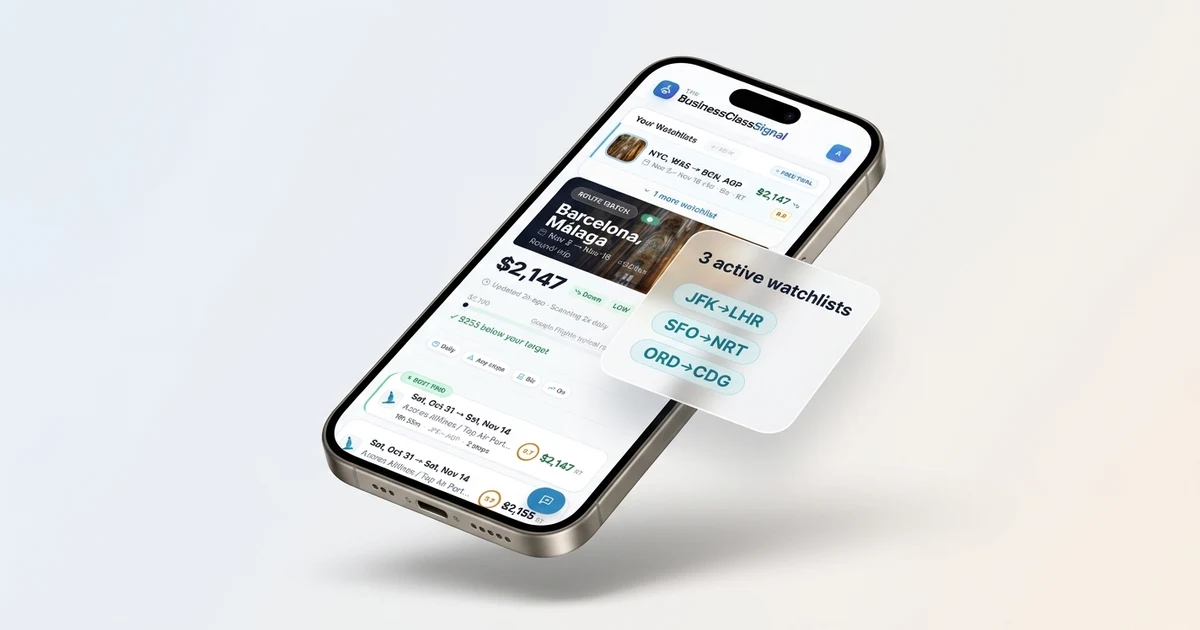
That's exactly what BusinessClassSignal is built for. It scans 800+ routes twice daily and sends you an alert when a business class fare drops below your target price. I built it because I was tired of manually checking 12 tabs every morning. A lot of people find that a $1,800 round-trip business class fare to Europe, when it surfaces, is more useful to them than chasing a 10% bid upgrade.
Operational upgrades: the rarest of the bunch
An operational upgrade is when the airline moves you up involuntarily — usually because economy is oversold, there's a weight-and-balance issue, or your original seat has a mechanical problem. You didn't ask for it. They just do it.
These are real. I've received two in 200+ business class segments, both on domestic US flights. One was because the economy cabin was oversold and I had top-tier status. One was because a seat in economy had a broken IFE system and there was exactly one open seat in first class.
The odds of getting an operational upgrade to international business class are low enough that you shouldn't factor them into your planning. Airlines will rebook you, give you a voucher, or put you in a slightly better economy seat before they'll bump you to business class internationally. The math doesn't work for them otherwise.
If you're hoping an operational upgrade happens: hold top-tier status, check in as late as possible (not always advisable, but statistically interesting), and be flexible. None of that guarantees anything. It's mostly luck.
Does asking at the gate still work?
Rarely. But let's be honest about when it might.
If you're at a gate with a visible empty business cabin and a stressed gate agent dealing with an oversell situation, politely mentioning that you're flexible can occasionally work. It's not a charm offensive — don't bring cookies, don't wear a suit, don't tell them it's your anniversary. Just be calm, be pleasant, and if the moment arises, ask quietly whether any upgrades are available.
The key word is "quietly." Asking loudly in front of a queue of other passengers is embarrassing for everyone and will get you nowhere.
I've had exactly one gate agent tell me "let me see what I can do" and follow through with a seat change. Once. In twelve years. So yes, it's technically possible. Just don't build a travel strategy around it.
The airport lounge angle
Some people think hanging out in a business class lounge increases upgrade odds. It doesn't. Lounge access and upgrade inventory are completely separate systems. Being in the lounge doesn't flag you to the gate agent.
Using miles and points to upgrade
This deserves its own section because it's technically an upgrade — you're moving from an economy ticket to a business class seat using frequent flyer miles — but the mechanics are specific enough that conflating it with the other methods causes confusion.
Mileage upgrades work best when you've booked an upgradeable fare class in economy (usually full-fare or one tier below). Discount economy fares (the ones you buy when you're trying to save money) are often not upgradeable with miles at all, or require a disproportionate number of miles to do so.
United's PlusPoints system, American's mileage upgrade system, and British Airways Avios upgrades all have different rules, different availability windows, and different fee structures. Worth reading the fine print before you assume your miles will get you to business class.The programs I find most useful for actual upgrades (as opposed to outright award bookings):
- American AAdvantage — Systemwide Upgrades (SWUs) for Executive Platinum members are genuinely valuable on domestic and some international routes
- British Airways Avios — upgrading a cash ticket with Avios is sometimes reasonable, especially on short-haul routes within Europe where the Avios cost is manageable
- Air Canada Aeroplan — one of the better programs for international upgrades if you have status and the right fare class
What I'd avoid: trying to upgrade a heavily discounted ticket with miles at the last minute. The math rarely works out, and you'll burn miles that could go toward an outright award booking in business class.
If you're going to use miles, use them to book business class outright rather than upgrade from economy. Award availability in business class — especially on partner airlines — is often better than upgrade availability, and you get the full experience without the fare class restrictions.
Mixed-cabin strategies and when economy is the right call
Sometimes the smartest move isn't chasing an upgrade to business class at all.
If you're traveling with family, or positioning to a hub to catch a long-haul business class flight, paying business class prices for every segment is genuinely wasteful. I fly economy on short hops constantly. A 90-minute domestic segment in economy costs me nothing — I'm not sleeping, I'm not eating, I just need to get somewhere.
For those segments, and for trips where business class isn't in the budget but you still want fare monitoring, the team behind BusinessClassSignal also runs FlightKitten — an economy fare tracker that monitors prices across 220+ airlines and alerts you when they drop below your target. It starts at $4.99/month and it's useful for exactly the kind of positioning flights and family-in-economy situations where you don't need business class but you don't want to overpay either.
The mixed-cabin approach — economy to the hub, business class on the long-haul — is something I do regularly and recommend without hesitation. You save real money on the short leg and still arrive in decent shape for the important part.
What actually improves your odds of getting upgraded to business class
Let me pull this together practically, because I've seen too many articles that spend 2,000 words explaining upgrade mechanics and then end with "just be friendly and dress nicely." That's not advice.
Here's what actually moves the needle:
- Hold top-tier status with the airline you fly most. This is the biggest single factor, and there's no shortcut around it.
- Book upgradeable fare classes in economy if you plan to use miles or certificates. Check the fare rules before you buy.
- Use bidding programs on off-peak departures. Set a calendar reminder to bid 72 hours out, start modest.
- Check your app at T-24 for paid upgrade offers. Airlines push these when they have unsold inventory.
- Monitor for business class fares that have dropped to reasonable prices — sometimes the "upgrade" is just buying the right ticket at the right time. Here's how the monitoring system works if you want to understand the mechanics.
- Be flexible on travel dates. Tuesday and Wednesday departures, January through March, mid-September — these are your friends.
- Avoid peak routes on peak dates. A JFK–LHR flight the Friday before Christmas will not upgrade you. Stop hoping.
The single best upgrade strategy for non-status travelers
Bid on the auction program + monitor for cheap business class fares simultaneously. If the bid doesn't clear, you might catch a fare drop that makes booking business class outright worth it anyway. Having both running costs almost nothing and covers both scenarios.
One more thing: if you're serious about flying business class more than once a year, it's worth picking one airline and actually working toward status rather than spreading your flights across carriers. The upgrade benefits compound significantly at the top tier. Mid-tier status at three airlines is worth less than top-tier status at one.
BusinessClassSignal monitors over 800 business class routes twice daily and sends you an alert the moment a fare drops below your target price. If you're flying transatlantic or transpacific in the next six months, it's worth having running in the background. The 7-day free trial costs nothing and takes about two minutes to set up.
Monitor business class fares on your route — 7-day free trial, no card required
Try Free