Why this Emirates business class review is different from the ones you've already read
Most Emirates business class reviews are written by people who either flew once on a press trip or scraped their content from other reviews. You'll recognize them: lots of adjectives, zero opinions, a photo of the minibar, and a score of 9.2 out of 10. Great, thanks for nothing.
I've flown Emirates business class eleven times across both the A380 and the 777. I've done it on full fares, on mistake fares, and on deals that BusinessClassSignal caught at 2 a.m. before the airline fixed the pricing. I've done JFK–Dubai, LAX–Dubai, ORD–Dubai, and onward legs to places like Mumbai and Nairobi. I have opinions. Some of them are not flattering.
What I'm going to give you here is a real account of what you're buying, what it's worth, what the pricing looks like from major US cities right now, and — critically — how to not pay full fare. Because full fare on Emirates business class is genuinely painful, and there are better ways to do this.
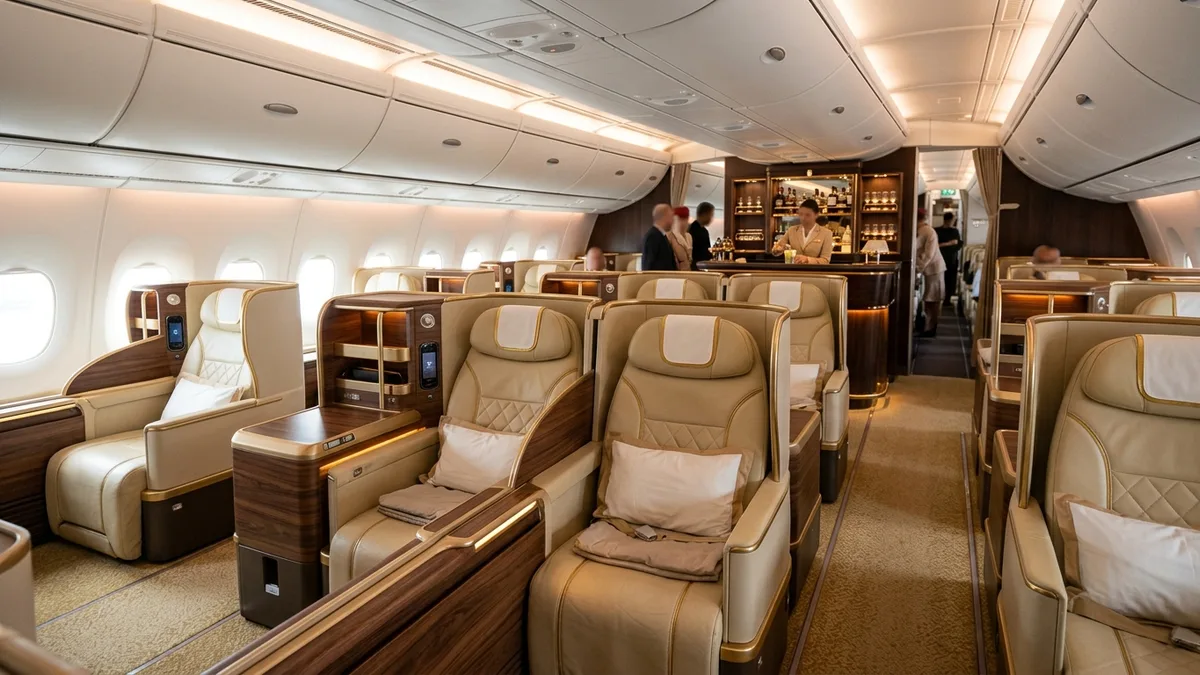
The A380 vs the 777: they are not the same product
This is the thing most reviews gloss over, and it matters enormously depending on which aircraft you end up on.
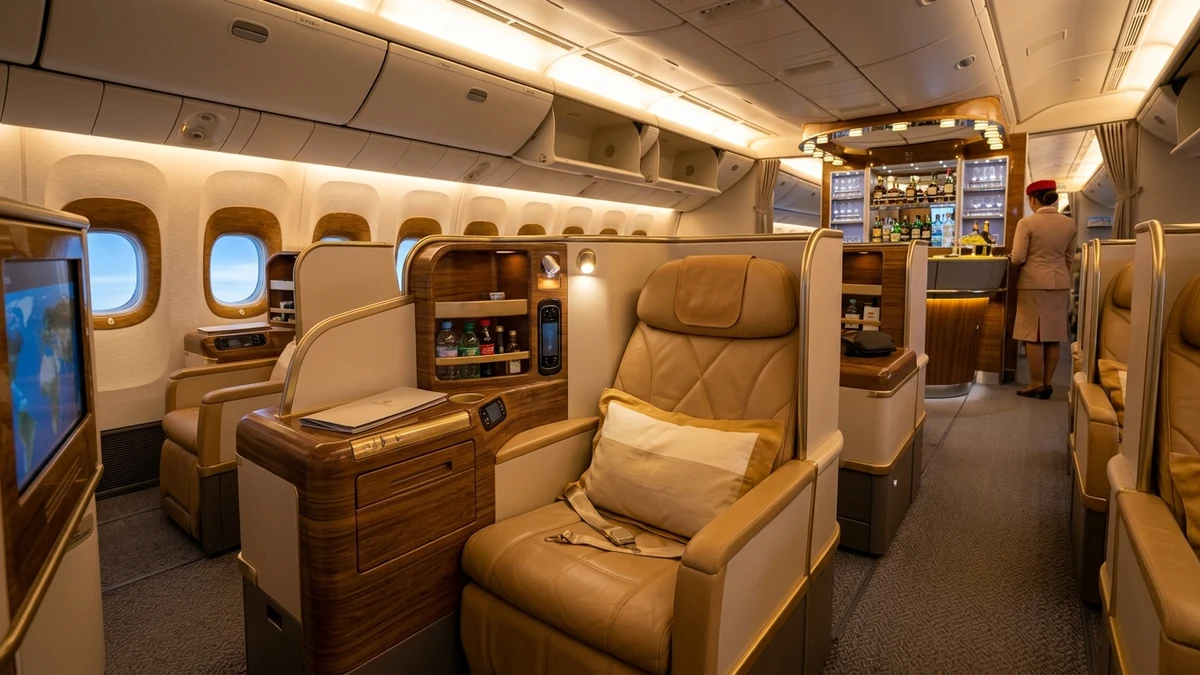
The A380 is the one you want. Emirates operates a two-cabin Business Class on the upper deck of its A380s — 76 seats in a 1-2-1 configuration, which means every single seat has direct aisle access. The seats are wide, the cabin is quiet in a way that double-deck aircraft tend to be, and the whole thing has a slightly hushed, premium feel that I don't get on most business class products. There's also the bar. More on that in a moment.
The 777 is a different conversation. Emirates runs a 2-2-2 configuration on many of its 777 business class cabins, which means window seats require climbing over your neighbor if you want to get up at 3 a.m. That's a dealbreaker for me on a long-haul flight. Some of the 777 fleet has been updated with a newer 1-2-1 layout, but you need to actually check which aircraft and which configuration you're booking before you commit. The Emirates website will show you the aircraft type. Cross-reference it with SeatGuru or just look at the seat map carefully — if you see pairs of seats in the middle, that's your warning.
I flew the 777 from ORD to Dubai last spring and sat in a middle seat because I booked late and didn't check. Ten hours. I don't recommend it.
For most nonstop US routes, Emirates uses the A380 on its flagship JFK–Dubai and LAX–Dubai runs. Chicago, Houston, and some other gateways get a mix, so always verify before booking.

The seat itself: genuinely good, with caveats
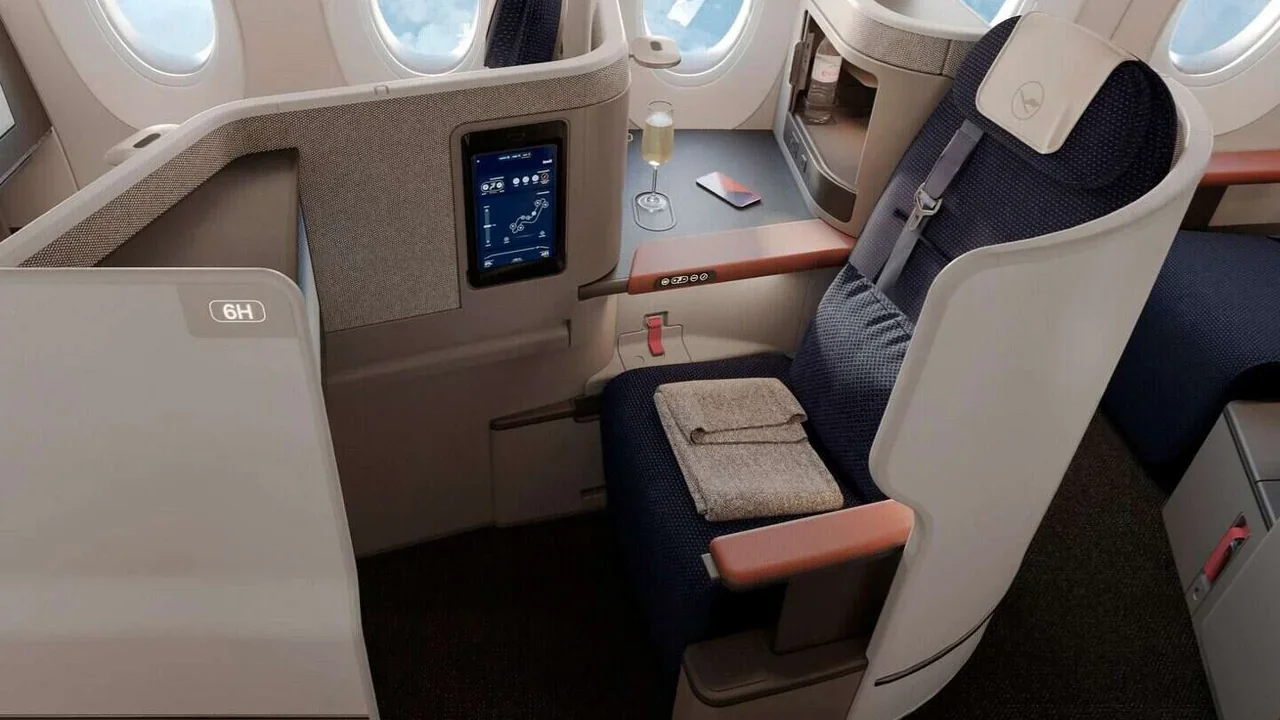
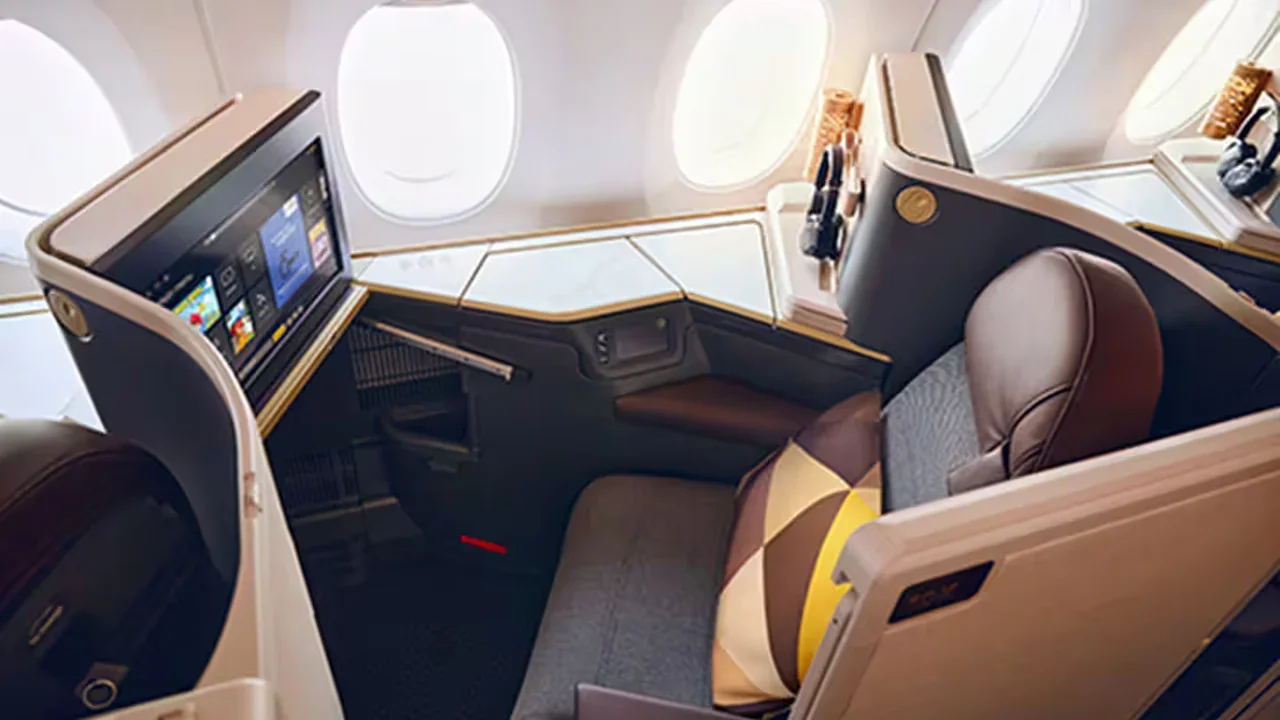
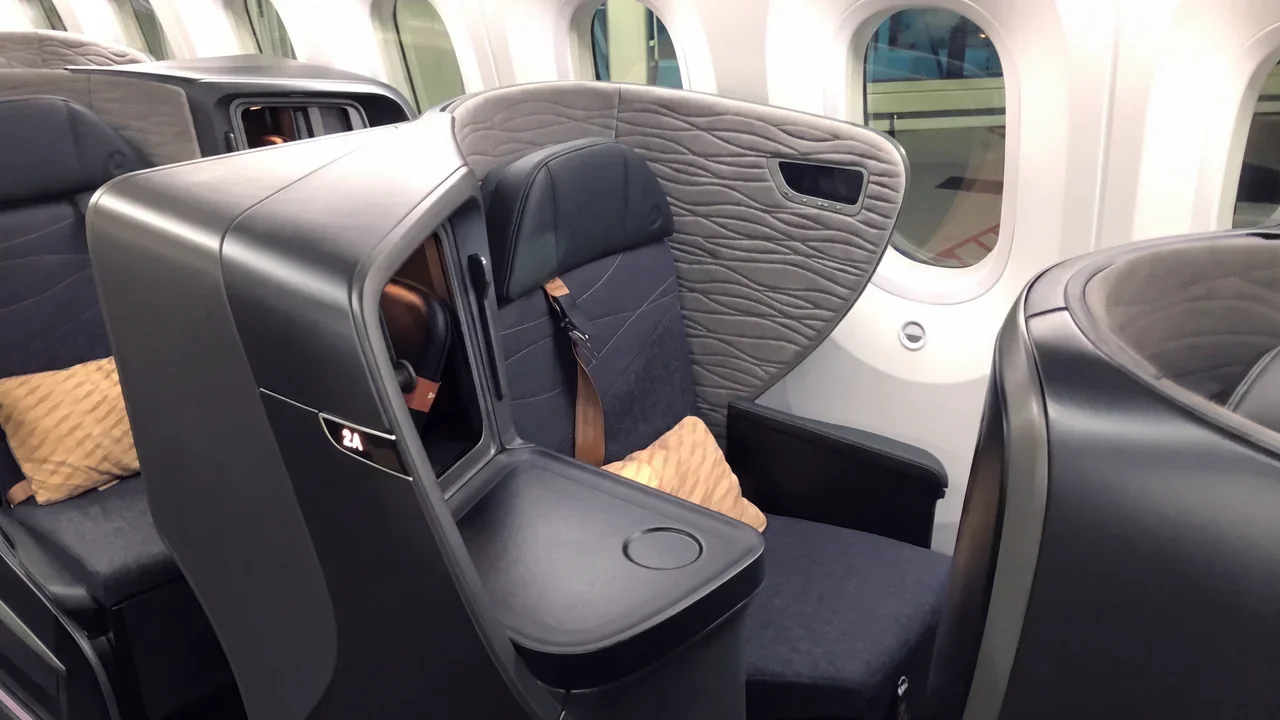
Emirates uses its own proprietary flat-bed seat on the A380 upper deck, and it's one of the better products in the sky right now. Fully flat, about 6'10" in length when reclined, and reasonably wide. The shell design gives you privacy from the aisle without being the full enclosed suite you'll find on Qatar's Qsuites or Singapore's newer business product. There's a partition between seats in the center pair, which raises and lowers — useful if you're traveling with someone, less useful if you're not and end up next to a talker.
The seat controls are intuitive, the reading light is properly positioned, and there's a decent amount of surface space for a water bottle and your phone. The mattress pad they offer after takeoff is legitimately good — thicker than most airlines bother with.
But here's what nobody tells you: the window seats on the A380 upper deck are slightly angled away from the windows. Not dramatically, but enough that you're not really "by the window" in the way you might imagine. If you want to look outside, you have to lean. Seats in the A and K positions are your window seats; C, D, G, H are center. I default to A or K and lean when I feel like looking at clouds.
Storage is adequate. There's a small compartment near the ottoman for shoes, a spot for your laptop, and a side shelf. It won't fit a large backpack without some shuffling, so keep your personal item manageable.
The onboard bar: the thing that actually sets Emirates apart
This is real. It's not marketing. There is a bar at the back of the A380 upper deck business class cabin, and it is a genuinely enjoyable place to spend an hour at 38,000 feet.
The bar stocks a rotating selection of wines, spirits, and soft drinks. On my last JFK–Dubai flight, they had Veuve Clicquot Yellow Label, a decent Scotch selection including Johnnie Walker Platinum (not just the standard Black), and what they were calling a "signature cocktail" that was, essentially, a gin sling with a twist. I've had worse at actual bars. The bartender on that flight — and yes, there's someone stationed there — was happy to make simple cocktails off-menu if you asked nicely.
The bar also has some snacks. Typically nuts, olives, small bites that change based on the route. Nothing that replaces a meal, but enough to make you feel like you're somewhere other than a pressurized aluminum tube.
It's become something of a social spot on longer flights, which either appeals to you or it doesn't. I've had good conversations there. I've also had to politely extract myself from a man who wanted to tell me about his cryptocurrency portfolio for forty minutes. Your mileage will vary.
One honest note: the bar is only on the A380. If you're on a 777, there's no bar. This is, for me, one of the top reasons to specifically seek out the A380 when booking.
Food and service: the highs and the inconsistency
Emirates has a genuinely strong catering program on paper. The business class menu typically offers four or five main course options, a proper appetizer course, cheese, and dessert. On longer flights, there's also a lighter second meal or a "snack on demand" service where you can order off a condensed menu at any hour.
The food quality, in my experience, ranges from quite good to forgettable. The Arabic mezze appetizer plate that appears on most Middle East-routing flights is consistently excellent — decent hummus, proper tabbouleh, some decent olives. The lamb dishes tend to be overcooked by the time they reach you. The fish is occasionally good, occasionally not. The ice cream sundae at the end of the meal is, inexplicably, always a highlight. They do this tableside with actual toppings, and it's the kind of thing that makes you feel slightly ridiculous for being happy about ice cream at 35,000 feet.
Service quality is where Emirates is genuinely inconsistent. I've had cabin crews that were attentive, warm, and proactively refilled drinks without being asked. I've had crews that were perfectly polite but clearly going through the motions. It's not a systemically bad product — but it's not as reliably excellent as, say, Singapore Airlines or ANA in business class, where the service consistency is more of a hallmark. Emirates crew come from over 130 countries, which gives the airline a genuinely international feel, but the training outcomes vary more than you'd expect at this price point.

Chauffeur service: it's included, and it's actually useful
Emirates includes a complimentary chauffeur service for business class passengers in most markets — including the US. This means a car picks you up from your home or hotel and takes you to the airport, and another car meets you on arrival. In theory.
In practice, the service works well in some cities and is more variable in others. In New York, the cars are typically Lincoln Town Cars or similar sedans, and the pickup is generally punctual. I've used it four times from my apartment in Brooklyn and had exactly one hiccup — the driver was 20 minutes late, which they acknowledged and which Emirates was apologetic about. For a free car service, that's a pretty good track record.
The catch: you need to book it in advance through the Emirates website, and there are distance limits from the airport (typically around 70 km, though this varies by city). If you live outside that radius, you may get a voucher for a taxi or a shorter transfer instead. Worth reading the fine print before you assume it covers your specific situation.
On the Dubai end, the chauffeur service to your hotel is similarly solid. Dubai traffic is its own adventure, but the cars are clean, drivers are professional, and there's no surge pricing drama. Coming from a 14-hour flight, having a car waiting is genuinely one of those small things that feels worth more than it costs.
Emirates business class pricing from US cities: what you'll actually pay
Let's talk money, because this is where most reviews go vague and I find that useless.
Full-fare Emirates business class from the US to Dubai runs roughly $6,500–$9,000 round-trip depending on your departure city, travel dates, and how far in advance you're booking. New York and Los Angeles tend to be on the lower end of that range because they're hub routes with more competition. Chicago, Houston, and Seattle are often higher because the routing involves a connection or a less competitive market.
Those are the prices you pay if you just go to Emirates.com and book without thinking about it. I don't recommend paying those prices.
The deals that actually make Emirates business class worth buying tend to land in the $2,800–$3,800 round-trip range from East Coast cities, and occasionally lower. These come up several times a year — sometimes around major sale events, sometimes randomly when Emirates is trying to fill seats on specific dates. They're typically available for 12–48 hours before the airline adjusts the pricing back up. That's the window you're trying to catch.
From LAX, I've seen deals as low as $2,400 round-trip to Dubai, though those are rarer. More commonly you're looking at $3,000–$3,500. From Chicago, the sweet spot tends to be $3,200–$4,200 when deals surface. These numbers aren't guaranteed — they're based on what I've seen over the past 18 months of actively watching this route.
This is exactly what start monitoring this route is designed for. BusinessClassSignal scans Google Flights data multiple times a day, scores each deal on a 1–10 scale based on how good it is relative to historical pricing on that route, and sends you an alert before the window closes. The free tier lets you watch one route. If you're serious about JFK–Dubai or LAX–Dubai, that's the one to use your free slot on.
For anyone who flies internationally more than a couple of times a year, the Core plan at $36/month pays for itself the first time you catch a deal. The Pro tier at $78/month adds AI market briefings that give you a read on whether prices on a given route are trending up or down — useful if you have flexibility on when you travel.
You can see how the monitoring system works in more detail, but the short version is: it does the watching so you don't have to refresh Google Flights at midnight hoping something changed.
Who Emirates business class is actually right for
It's a good product. Not the best in the sky, but good — and on the A380 with the bar and the right crew, it can be genuinely excellent.
If you're flying from the US to Dubai, the Maldives, East Africa, or South Asia, Emirates is often the most direct routing and one of the better products on those corridors. The connectivity through Dubai is strong, and the onward legs in business class are generally consistent with what you get on the main haul.
Where I'd push back: if you're going to Europe, Emirates isn't always the obvious choice. Routing through Dubai adds time, and you can often get competitive business class products on European carriers with more direct routes. The bar is great, but not "fly east to go west" great.
If you specifically want the most private, enclosed suite experience in business class, Qatar's Qsuites on the right aircraft beats Emirates. Full stop. The door-closed privacy is something Emirates simply doesn't offer in its current business class product. Emirates does have its own private suite product — but that's First Class, which is a different price category entirely.
For most people flying from the US to the Gulf or beyond, though, Emirates business class at the right price is a genuinely strong choice. The key phrase there is "at the right price." At full fare? I'd look around. At $3,000 round-trip from JFK? Book it without a second thought.
You can read more about Emirates deals and route monitoring on our airline page, or check current pricing trends for Dubai if that's your destination.
And if you want to see what else is out there before committing to Emirates specifically, browse all routes we're currently monitoring — there are some genuinely interesting alternatives on certain corridors that don't get enough attention.
The ICE entertainment system and connectivity
Emirates' in-flight entertainment system, branded as ICE, is one of the better ones out there. A large touchscreen (typically 23 inches in business class on the A380), a genuinely massive content library, and responsive controls. I've rarely found myself unable to find something worth watching. The noise-canceling headphones they provide are decent — not Bose or Sony-level, but functional enough that I don't feel the need to bring my own, though I usually do anyway out of habit.
Wi-Fi is available and priced by data package. It works. It's not fast enough for large file transfers or video calls in most cases, but for email and messaging it does the job. This is about average for long-haul business class connectivity — nobody's cracked truly fast in-flight Wi-Fi yet at a price that isn't extortionate.
One small thing I appreciate: the system remembers where you were in a film if you fall asleep and the screen times out. Sounds minor. It's the kind of thing you only notice when other airlines don't do it.
Dubai layovers and the Emirates lounge at DXB
If you're connecting through Dubai rather than it being your final destination, you'll have access to the Emirates First and Business Class Lounge at Dubai International. Terminal 3, Concourse B is where most Emirates international flights operate from. The lounge is large — genuinely large, not just airline-marketing large — and has a proper hot food buffet, a la carte dining in a separate section, showers, and a quiet area that's actually quiet.
The food in the lounge is better than most airport lounges I've visited. There's a Middle Eastern station with dishes that change throughout the day, a Western options section, and a decent dessert spread. I once had a very good lamb kofta at 6 a.m. Dubai time after a red-eye from New York, which is either a sign of good catering or the kind of judgment lapse that comes from sleep deprivation. Possibly both.
The showers are clean and usually available without a long wait outside peak hours. Towels and basic toiletries are provided. If you have a long connection — Emirates sometimes routes passengers through Dubai with layovers of two to four hours — the lounge makes it tolerable.