Quick summary
Japan Airlines business class on the A350 — marketed as Sky Suite III — is one of the better long-haul business class products flying today, full stop. Every seat gets direct aisle access, the food is genuinely good, and the Japanese service philosophy makes a real difference on a 14-hour flight. Fares are high at retail, but they drop, and when they do, this is one of the first routes worth jumping on.
What Sky Suite III actually is
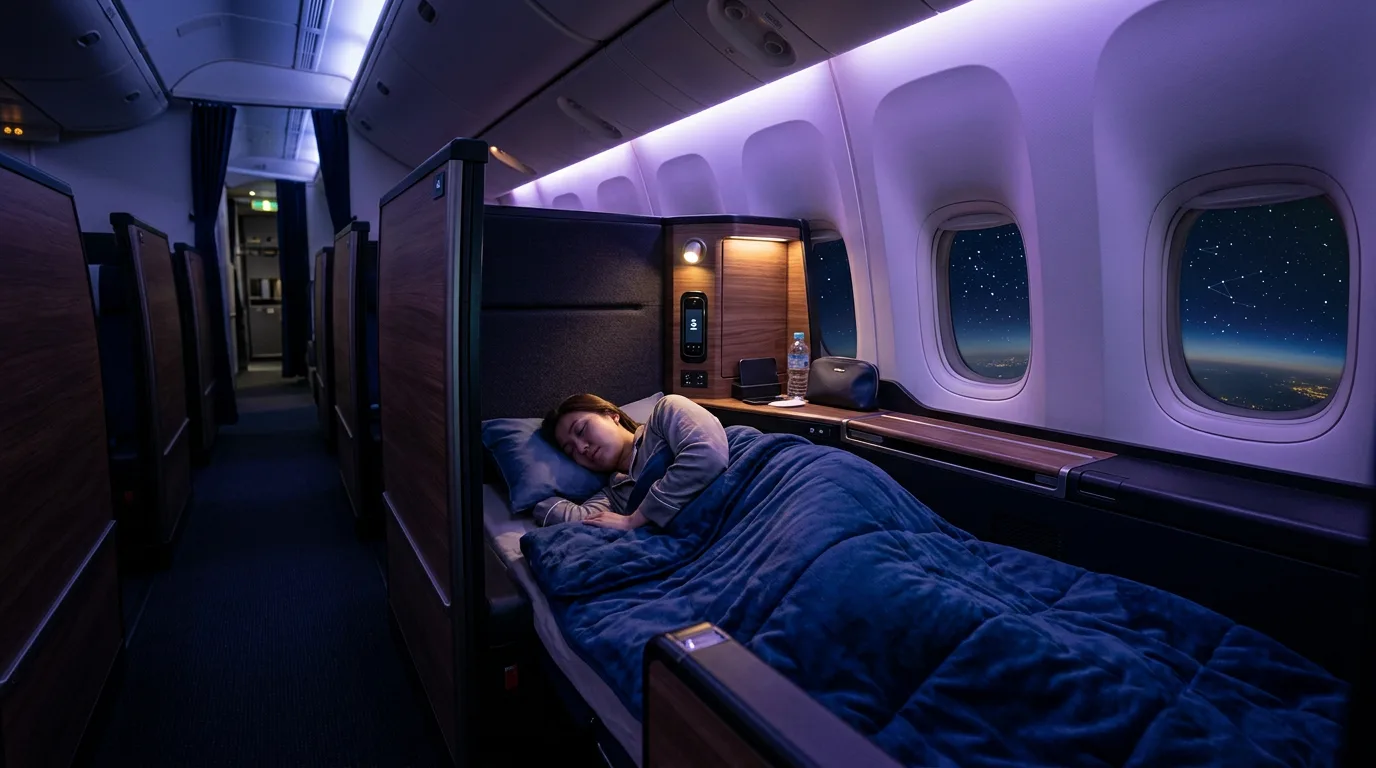
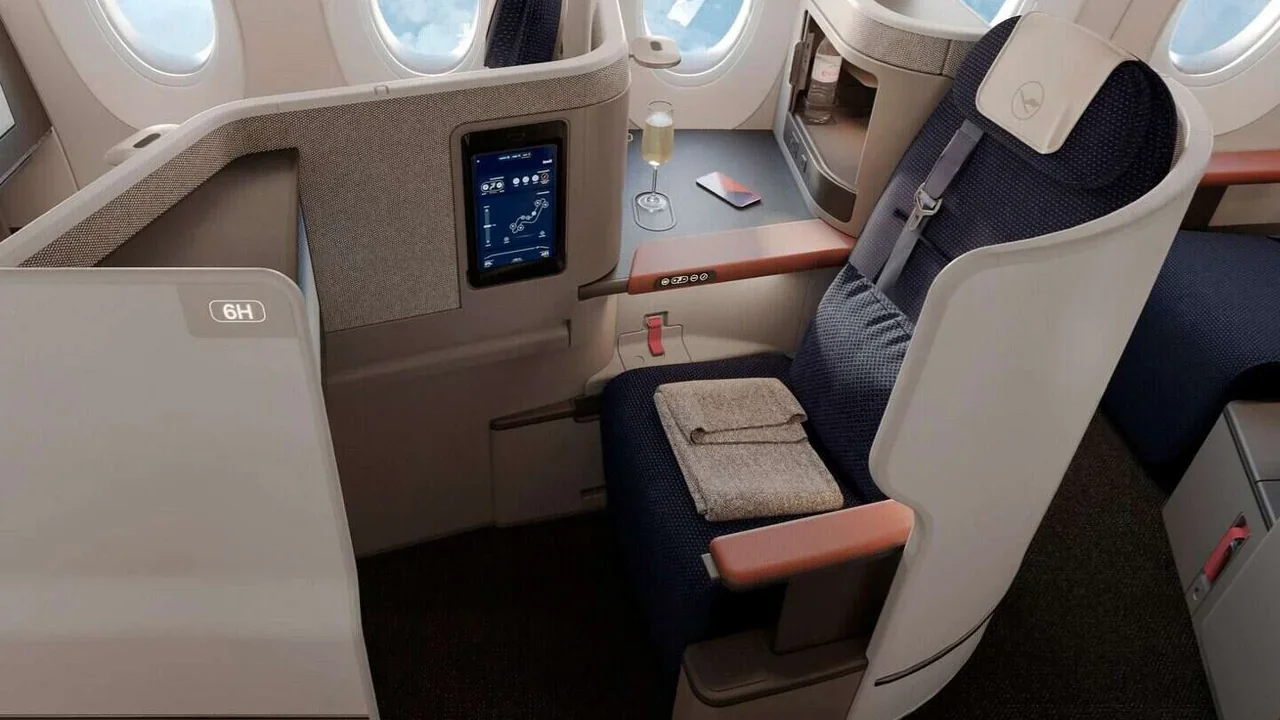
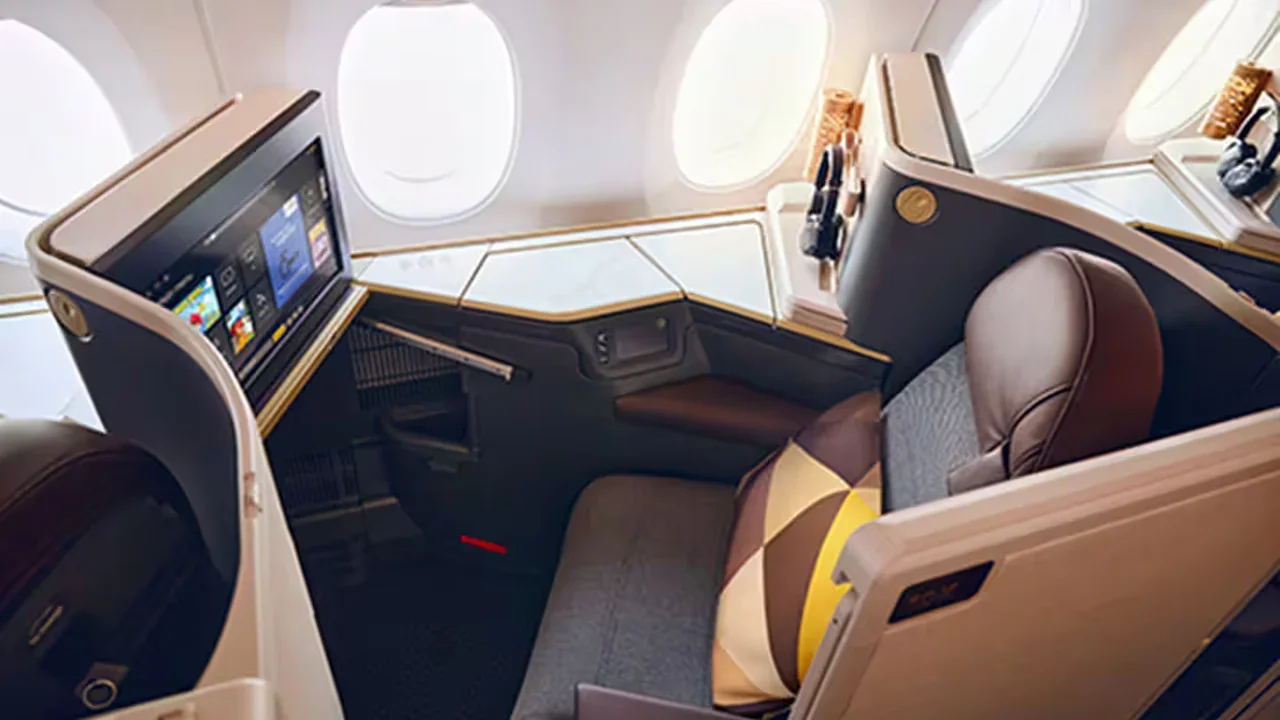
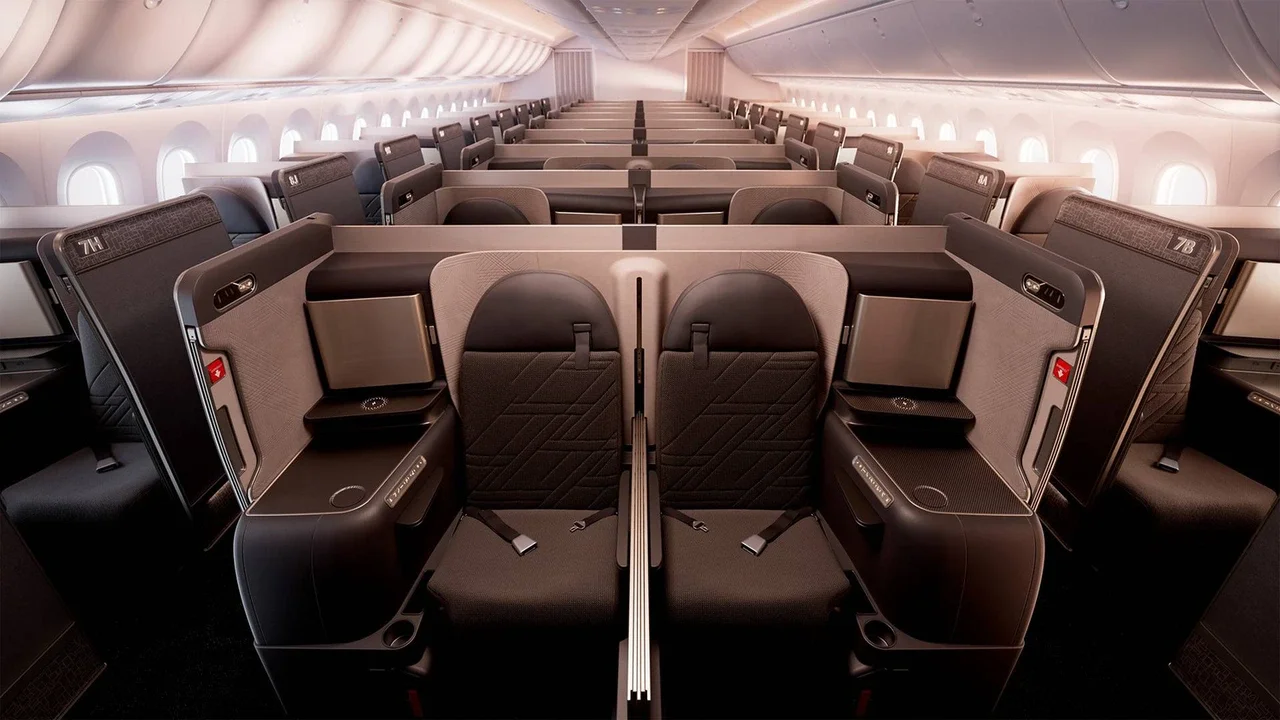
Japan Airlines calls it Sky Suite III, and unlike a lot of airline branding, the name isn't doing too much heavy lifting. The product flies on JAL's Airbus A350-900, which JAL has deployed on key international routes including Tokyo Haneda to New York JFK, London Heathrow, Chicago, and a handful of other long-haul destinations. The cabin has 54 seats in a 1-2-1 configuration, which means the middle pairs share a small divider but every single seat has direct aisle access. No climbing over your neighbor at 3am. No awkward shuffle. You just get up and go.
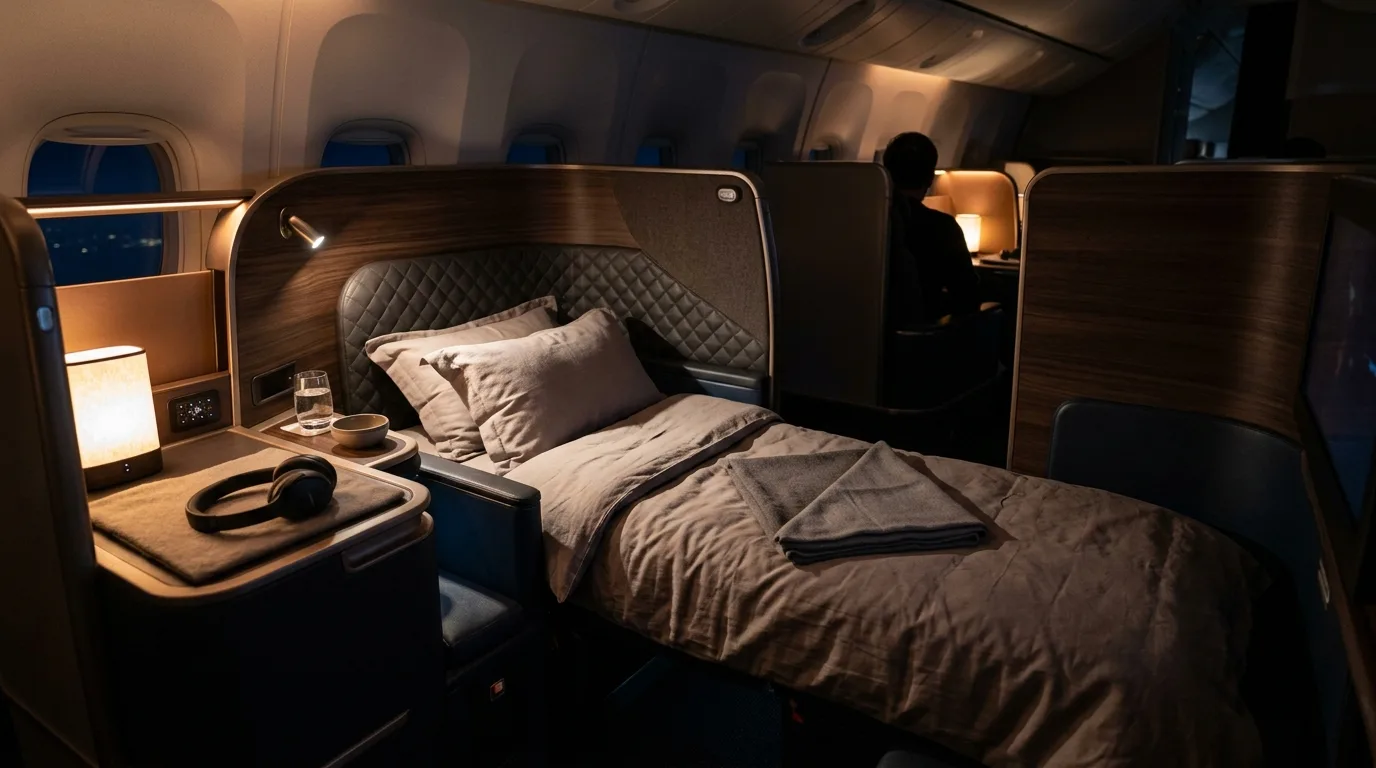
The seats themselves run about 78 inches fully flat, which is standard enough in this class, but the shell design is what sets them apart a little. JAL went with a staggered offset layout that gives the window seats a genuine sense of privacy — you're slightly angled away from the aisle, and a fixed shell wraps around your shoulder. It's not a full suite in the Qatar QSuite sense. There's no closing door. But it's a proper cocoon, and I've slept better in it than in products that cost more per mile.
The in-flight entertainment screen is 18 inches, which is bigger than it sounds when it's right in front of you. The content library leans predictably toward Japanese cinema and anime, but the Hollywood selection is solid and the system is fast and responsive — a small thing that matters over 13 hours. There's a universal power outlet and USB-A port at every seat. No USB-C, which is annoying in 2026, so bring your adapter.
The seat configuration: who gets the better deal
Here's where it gets worth thinking about before you book. The A350 layout puts window seats in two varieties: the true window seats (A and K) and the middle pair seats (D and G). If you're traveling solo, you want A or K. The window seats are angled toward the window wall, which means more visual privacy and a slightly better sleeping position for most people. The shell curves around your left shoulder if you're in an A seat, right if you're in K, and it genuinely cuts out ambient light from the aisle.
The D and G seats — the middle pairs — are fine for couples. The shared space between them is generous enough that you can have a conversation without raising your voice, and there's a small storage nook between the seats that works well for shared items. But if you're flying solo and you end up in a D or G seat, you're going to feel slightly more exposed. Not terrible, just not the move if you have a choice.
On the JAL A350, seats 11A and 11K are in the last row of the forward cabin and offer extra privacy since no one is seated directly behind you. Good for light sleepers.
Row 1 is bulkhead, which some people love for the extra legroom on takeoff and landing, but the tray table folds out of the armrest rather than from the seat in front — which means it's marginally less stable. I'd skip it unless you specifically need bulkhead space.
The food, honestly
This is where JAL earns its reputation. I've eaten in a lot of business class cabins over 12 years and a lot of segments, and JAL's food is among the handful I'd actually look forward to rather than just eat because it's there.
The signature offering is the "BEDD" meal service (Business class Experience on Demand Dining), which JAL introduced a few years back. You can eat whenever you want, and the crew won't push a full service at you the moment the seatbelt sign goes off. On a flight departing Tokyo Haneda at 11pm, this matters enormously — being allowed to go straight to sleep instead of sitting through a 90-minute meal service is a genuine quality-of-life improvement.
Order the Japanese option
The Western menu is fine, but the Japanese kaiseki-style meal is the reason to fly JAL. The bento presentation on outbound flights from Tokyo often includes seasonal elements — I had a chawanmushi (savory egg custard) on one flight that I still think about. Order it before you even look at the Western options.
The meal itself on a Tokyo to New York sector typically involves an appetizer course, a main (your choice from usually four options, split between Japanese and Western), and a dessert. The Japanese main on my most recent JFK flight was a braised black cod with dashi broth and pickled vegetables, served with rice and miso soup. It was actually good. The Western alternative was a chicken breast that was fine but nothing you'd mention to anyone.
Drinks selection is strong. The sake list is curated rather than just slapped together, and there are usually two or three options at different price points if you were paying retail. The champagne for many years has been Nicolas Feuillatte, which is perfectly decent but not the prestige pour that Emirates or Singapore put in front of you. The Japanese whisky selection, though — usually a Nikka and a Suntory — is where I'd spend my attention.
Breakfast service before landing is lighter: a choice of Japanese or Western, typically a rice porridge (okayu) or eggs, plus fruit and bread. The okayu is worth trying if you've never had it at altitude. It's gentle, warm, and exactly what your stomach wants after a long flight.
Japan Airlines business class review: the service itself
There's a specific thing that happens on JAL flights that I haven't found easy to replicate on other carriers, including ones with higher overall ratings. The crew pays attention without hovering. They notice when your water glass is getting low. They don't interrupt you mid-movie to ask if you need anything, but somehow when you look up, someone is nearby. It's attentive without being performative.
Part of this is staffing ratios — JAL typically runs a 1:6 or better crew-to-passenger ratio in business, which gives the crew actual capacity to be attentive rather than just trying to keep up. Part of it is training, which is famously rigorous. And part of it is the underlying service philosophy, called omotenashi, which roughly translates to anticipating needs before they're expressed. It's a real thing, not just marketing language.
I've flown the JFK-HND route four times in Sky Suite III and once in the older Sky Suite product on the 777. On every single flight, the crew remembered my drink preference after the first ask without me repeating it. On one flight, a crew member noticed I was working and brought a small snack without being asked. Small things. But over 13 hours, small things add up.
The pajamas are provided on long-haul international flights — a two-piece set in a light grey that's more comfortable than average, with a drawstring waist and real pockets. The amenity kit is Etro branded on some routes, and contains the basics: lip balm, eye mask, earplugs, moisturizer. The eye mask is actually good. The earplugs are foam cylinders that will fall out by hour two, so bring your own.
The JAL Sakura Lounge at Haneda
Is the Sakura Lounge worth your time before departure?
If you're departing from Tokyo Haneda (HND), yes. The Sakura Lounge in Terminal 3 is a proper flagship lounge — large, quiet, well-staffed, and with food that embarrasses most airport lounges globally. The ramen counter alone would be worth showing up early for. It's a self-serve bowl of tonkotsu or shoyu ramen that they make to order, and it's exactly what you want before a long overnight flight or exactly what you want after landing, depending on the direction.
The lounge also has private shower rooms that are clean, well-stocked, and bookable in advance through the JAL app — which I'd recommend doing the moment you check in, because they fill up fast on busy evenings. There's a sake and whisky bar in the corner that's self-serve after around 5pm, and the seating splits between a quieter reading area and a livelier dining section. The Wi-Fi is fast by airport lounge standards.
The Narita (NRT) Sakura Lounge is smaller and noticeably less impressive. If you have a choice of airports for your Tokyo departure, Haneda is better for the lounge experience, and also for the fact that it's considerably closer to central Tokyo.
Lounge access at outstations
Outside of Japan, JAL often uses partner lounges rather than its own. At JFK, JAL business class passengers use partner lounges in Terminal 1 — it's fine, clean, and has decent food, but it's not a Sakura. Don't book an early airport arrival expecting a JAL lounge experience in New York.
How does the Haneda lounge compare to Narita?
It's not close. Haneda Terminal 3's Sakura Lounge had a significant renovation completed in 2023, and it shows. The design is quieter and more considered — a lot of natural wood, indirect lighting, and enough space that even on a busy evening you can usually find a seat with some breathing room. Narita's lounge is older, more crowded, and the food selection is limited to light snacks and a small hot food section that often runs low during peak hours.
If you're transiting through Japan on your way somewhere else and you have a choice of connections, Haneda is the better layover airport for JAL business class passengers by a meaningful margin.
Routes and fares: what you'll actually pay
Retail fares on JAL's transpacific routes are expensive. A round-trip JFK to HND in business class at full Y or C fare is often north of $8,000. That's not unusual for the route, but it's not the price you want to be paying. The sweet spot is the discounted business class fare classes — typically I or D class on JAL — which can bring the round trip down to the $4,500 to $5,500 range. And a few times a year, JAL runs flash sales or error-adjacent fares that bring transpacific business class into the $2,000 to $2,500 range for round trips.
Those low fares don't last long. We're talking hours, sometimes less. Which is exactly why Japan Airlines is one of the routes we monitor most closely at BusinessClassSignal — the drops are real, they happen, and if you're not watching the route actively, you'll miss them.
Browse all monitored routes to see whether your specific origin is covered. JAL has a surprisingly wide outstations network for a carrier that's not always top of mind for US travelers, including Chicago O'Hare, Dallas/Fort Worth, Boston, and San Diego in addition to the main JFK and LAX hubs.JAL's fare drops often happen on Tuesday or Wednesday evenings US Eastern time, which aligns with mid-week pricing adjustments in Tokyo. Set your alert, then don't check obsessively — let the system do it.
How Sky Suite III compares to the competition
The honest answer is: it depends what you're prioritizing. If privacy and enclosure are your thing, Qatar QSuite has a door and a genuinely more private feel. If food and wine are the main event, Singapore Airlines Suites (on the A380) is in a different category entirely, though you're also paying for it. ANA's The Room, also on the 777-300ER, is a close competitor to Sky Suite III and probably edges it slightly on seat width and the feel of the enclosure.
But here's where JAL holds its own: the consistency. I've flown QSuite three times and had one excellent experience and two that were fine but not special. JAL's service consistency across multiple flights has been higher than almost anything else I've flown at this price point. The food doesn't vary wildly depending on which crew you get. The seat doesn't feel different depending on which aircraft they've swapped in. What you see in the spec sheet is roughly what you get in the air.
The A350 itself is also a genuinely comfortable long-haul aircraft. The cabin pressure is set lower than older planes (6,000 feet equivalent versus 8,000 on older widebodies), the humidity is slightly higher, and the windows are larger and electronically dimmable. You arrive feeling less wrecked than you do off a 777. That's not nothing on a 13-hour flight.
Award bookings
JAL miles (JAL Mileage Bank) are notoriously hard to accumulate for non-Japan residents, but American AAdvantage miles can be used to book JAL business class at decent rates — typically 60,000 miles one-way for JFK-HND. The availability is limited but it does open up. Worth checking if you're sitting on AAdvantage miles.
The things that are genuinely annoying
No USB-C. I mentioned it above and I'll mention it again because it's 2026 and my laptop charges via USB-C and I had to dig out an adapter at 35,000 feet.
The IFE remote is mounted in an awkward position on the seat arm, and on two of my four flights I accidentally triggered it while shifting position and woke myself up with the screen brightness suddenly at full. Small thing. Still annoying.
The Wi-Fi is available but not cheap. JAL charges for in-flight connectivity, and the pricing is per-hour or per-flight, neither of which is particularly reasonable for what you get. Download your shows before you board. The connection speed is also inconsistent over the Pacific — fine over Japan and the US coasts, spottier in the middle.
And the lounge situation outside Japan remains genuinely patchy. If you're a frequent JAL business class flyer who connects through a lot of US cities, you'll spend time in some fairly undistinguished partner spaces. It's the gap between the onboard experience and the ground experience that I'd most want JAL to close.
None of this is a dealbreaker. But a Japan Airlines business class review that doesn't mention the USB-C situation and the variable lounge access isn't giving you the full picture.
Is it worth booking at current fares?
At full retail, you're paying a premium for a product that's excellent but not categorically better than ANA or Singapore at similar prices. The case for paying full Y class fare is weak unless you're on a corporate card and don't care.
At discounted business class fares in the $4,000 to $5,000 round-trip range for transpacific, it's genuinely competitive. You're getting a flat bed, direct aisle access, some of the best airline food in the sky, and service that actually makes a 13-hour flight feel manageable. That's the value proposition.
At the flash sale prices that show up a few times a year — $2,000 to $3,000 round-trip — it's not a question. Book it immediately and figure out the dates later.
BusinessClassSignal monitors JAL's key routes twice daily and sends an alert the moment fares drop below your target price. The monitoring system works by scanning published fares across booking channels and flagging anything that falls below the threshold you set when you sign up. You tell it what you'd pay for JFK to HND in business class, and it tells you when JAL hits that number. That's it.
Monitor JAL business class fares — get alerted the moment prices drop
Start free trialThe 7-day free trial gives you full access to all monitored routes, including JAL's transpacific and Tokyo routes. No commitment, no card required to start. If you've been waiting for the right moment to book Sky Suite III, setting an alert is the actual way to catch it — not refreshing Google Flights at random intervals hoping something turns up.