Quick summary
New Year's 2027 business class deals do exist, but the window to catch them is narrow and the timing is counterintuitive. Fares to the most popular NYE destinations — Dubai, Sydney, Tokyo, New York — spike hard from mid-December, but there's a reliable dip in late October and early November where award and revenue fares both soften. This article breaks down where those deals show up, which routes to watch, and how to avoid paying full fare for what is, historically, one of the most expensive travel periods of the year.
Why New Year's is both the worst and the best time to book business class
Let me be honest with you upfront: New Year's Eve is not a forgiving travel period. Airlines know exactly what they have. They've been selling seats on December 28–31 departures since the day they opened the schedule, and for the most in-demand routes — think JFK to Dubai, LAX to Sydney, London to Tokyo — the published fares are brutal. We're talking $8,000+ round-trip in business class on routes that might sit at $3,200 in March.
And yet, every year without fail, we see genuine New Year's business class deals slip through. Not because airlines are feeling generous. Because inventory management isn't perfect, because corporate blocks get released, because someone built a fare rule in June that looks insane by December.
The trick is knowing when and where to look.
The deals that matter — the ones worth setting an alert for — tend to cluster in a few specific places. Certain routes that aren't on most people's NYE shortlist. Certain departure dates that are just adjacent to the peak window. And certain airlines that are more likely to drop their guard on pricing than others.
I've been tracking this stuff for over a decade. Here's what I've actually seen work.
The booking window for New Year's 2027
When do New Year's business class fares actually drop?
The answer is earlier than most people think, and then again later than most people expect.
The first dip happens in late October to mid-November 2026. This is when a lot of the initial "aspirational" pricing starts to crack. Airlines have had the schedule open for months, early bookers have filled some of the premium inventory, and the carriers are starting to get a read on how full their cabins are going to be. If they're looking at a December 29 departure that's still 40% empty in business class, they'll quietly drop the fare to stimulate demand. It won't last. But it shows up.
The October window
The period between October 20 and November 15, 2026 is historically the best time to find softness in New Year's business class pricing. Set your alerts now, not in December when everyone else is panicking.
The second window is more chaotic: the last two weeks of November, after Thanksgiving bookings resolve. Some airlines reprice aggressively in early December as they reassess their load factors. You might catch something. But I wouldn't count on it the way I'd count on the October window.
What you should absolutely avoid is the assumption that prices will drop in December because "it's getting close." That logic works for some travel periods. It does not work for NYE. The closer you get to December 28, the more desperate you are, and the airlines know it. I've watched fares on London to Singapore go from $4,800 to $6,200 in the final three weeks before New Year's. They don't need to discount. The seats fill anyway.
How far out should I book business class for New Year's?
For revenue (cash) fares, I'd say 10–14 months out if you want the best shot at something reasonable, or the October 2026 window if you're reading this closer to the date. For award space, it's a different story — some programs release partner award space in the 24–30 day window as the cabin firms up, so there's occasionally a late-breaking opportunity there. But that's speculative. If you're counting on it, you're gambling.
Book the return flight first. Return fares on January 2–5 are dramatically cheaper than the outbound leg. If you can lock in a cheap return early, you've de-risked the trip even if the outbound costs more than you wanted.
The other thing worth knowing: New Year's 2027 falls on a Thursday. That's actually a slightly better situation than a weekend NYE for business class pricing, because the corporate travel logic that normally depresses Thursday fares doesn't apply over a holiday week. But it does mean the December 26 Saturday and December 27 Sunday departures will be absolutely packed. If you're flying transatlantic or transpacific, December 28 (Monday) or December 29 (Tuesday) might be your best shot at a seat that isn't fully priced.
The destinations where New Year's business class deals actually show up
Not all NYE destinations are created equal when it comes to fare behavior. Some routes are so oversubscribed that there's basically no deal to be had unless you're booking 14 months out at opening inventory prices. Others have more nuanced pricing because the demand is softer or the competition between carriers is higher.
Here's where I'd focus my attention.
Dubai (DXB) is perennially popular for NYE — the fireworks at Burj Khalifa have turned it into a legitimate bucket-list destination — but it's also one of the most competitive routes in the world. Emirates, Etihad, British Airways, Virgin Atlantic, and Qatar Airways all fly it from major hubs. That competition creates real pricing tension. I've seen JFK–DXB round-trip business class dip to $2,800 in the October window before NYE. Not common, but it happens.Airlines worth watching — and one to be careful about
Fare behavior varies significantly by carrier, and if you're going to set up alerts for New Year's business class deals, it helps to know which airlines are most likely to be the source of a genuine drop.
Qatar Airways tends to be aggressive on pricing when they're trying to fill inventory. Their QSuites product is genuinely excellent — one of the few business class products I'd pay a premium for — and they're not shy about dropping fares when a departure date looks soft. Watch them on routes from the US East Coast to the Gulf, Southeast Asia, and beyond. ANA is the one I always tell people to watch for transpacific. Their business class seat, the ANA Business Staggered on the 777-300ER, is solid. Not Qatar-level, but solid. And their pricing on the US–Tokyo route has historically shown more volatility than JAL's, which tends to be stickier. Virgin Atlantic is worth watching on the transatlantic. Their Upper Class product has improved considerably, and they have a habit of releasing sale fares on routes where they're competing with BA and AA that can look genuinely good in the October window.One carrier to be careful about: British Airways on routes where they know they have a near-monopoly. The JFK–LHR route in business class over NYE is not where BA feels compelled to compete on price. Their Club Suite product has gotten better (the new T5 gates with proper jet bridges make a difference), but the fare itself on that specific route over that specific period is almost always full price. If you're flying BA business class to London for NYE, you're probably paying $4,000+ round-trip unless you got in very early.
Watch the connection trap
Some of the cheapest-looking business class fares to popular NYE destinations route through hubs with tight connections. A $2,400 fare to Bangkok that connects through Frankfurt with 55 minutes on December 30 is not a deal — it's a stress test. Build in at least 2 hours for European connections, more if you're checking bags.
How to actually find New Year's business class deals before they disappear

This is where I have to be direct about the mechanics, because the window on these fares is short. We're talking hours to a day or two in most cases. The October softness I mentioned earlier doesn't mean fares stay low — it means there are brief moments where pricing logic creates an opening.
Checking Google Flights once a week isn't going to cut it. I've watched a $2,900 round-trip JFK–DXB fare in business class last about 14 hours before it repriced to $5,200. The people who caught it were either refreshing obsessively or had some kind of automated alert running.
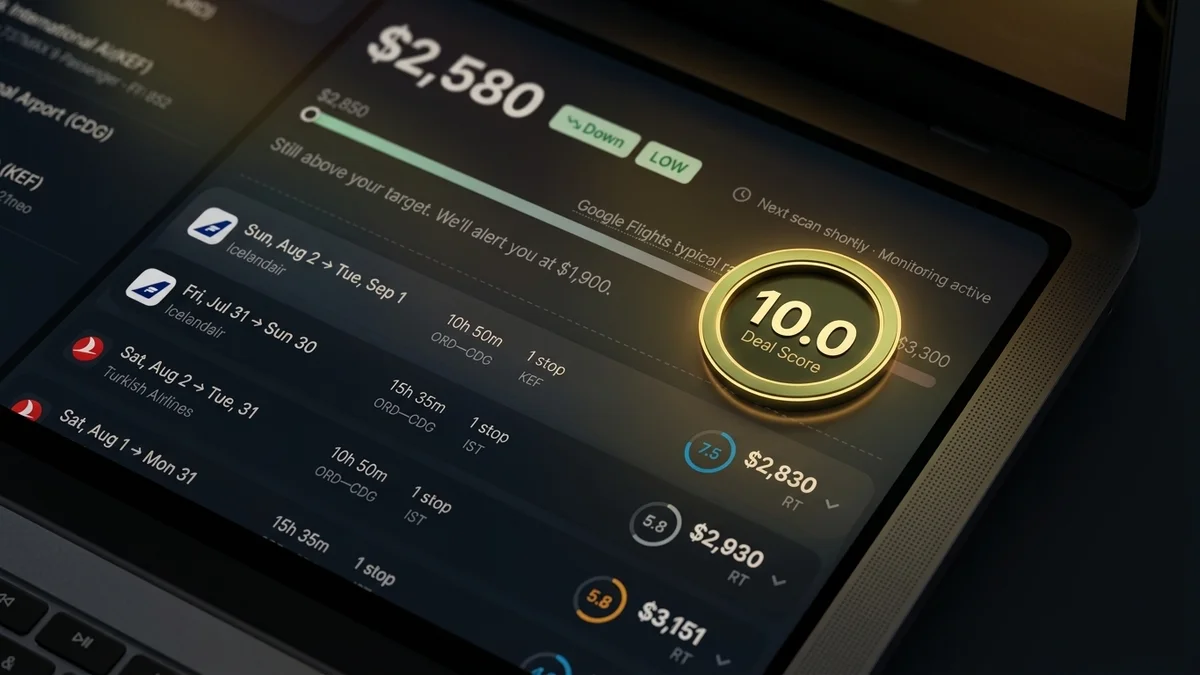
The way BusinessClassSignal works is pretty straightforward: you tell it the route you're watching and the price threshold you care about (say, JFK to Dubai, alert me if round-trip business class drops below $3,200), and it scans the route twice daily and emails you the moment something hits. We cover 800+ business class routes globally. For NYE specifically, I'd set alerts 15–20% below the current published fare — that's usually enough to catch a genuine dip without missing everything because your threshold was too aggressive.The other thing that helps: knowing what a "normal" fare looks like on your target route. If you've never checked JFK–DXB in business class before and you see $3,800, you don't know if that's good or terrible. (It's borderline, for what it's worth — I'd want to see sub-$3,200 before I felt good about it over NYE.) Spend some time now, in the months before you need to book, just looking at the route. Get a feel for the baseline. That context is what lets you move fast when something genuinely good shows up.
Set your BusinessClassSignal alert about 20% below the current fare you see today. That's usually the sweet spot — low enough to catch a real drop, not so low that nothing ever triggers.
The award mile angle — is it worth it for NYE?
I get asked this a lot, and the honest answer is: it depends on which program you're in and how flexible you can be on dates.
For most major US programs, peak pricing on award space is now a thing. American AAdvantage, Delta SkyMiles, and United MileagePlus all have some form of dynamic or peak award pricing. A business class award to Sydney over New Year's that might cost 70,000 miles in March could easily run 120,000–150,000 miles for December 29–31. Delta is the most aggressive about this — I've seen SkyMiles awards to Sydney in business class priced at 200,000 miles round-trip over NYE. That's not a deal, that's a hostage situation.
The programs that tend to behave better for peak periods are the fixed-rate or partner-focused ones. ANA Mileage Club prices partner awards on a fixed chart, which means a business class round-trip from North America to Europe on a partner carrier is 88,000 miles regardless of when you fly. If you have ANA miles and can find partner award space, NYE doesn't change the price. Same logic applies to Air Canada Aeroplan, which has been more consistent on partner pricing than the US carriers.
The catch is availability. Finding business class award space on a partner carrier for December 29–31 is genuinely hard. It exists, but you're competing with a lot of other savvy travelers who know the same trick.
One award space pattern worth knowing
Some airlines release unsold premium cabin seats as partner awards in the 21–30 day window before departure. This is more common on transpacific routes than transatlantic. If you're watching a specific flight on a specific date, check the award space about three to four weeks out — you might find something that wasn't there in October.
Positioning flights and the overlooked money-saver
Here's something I don't see talked about enough in the context of NYE travel: the positioning flight.
If you're based in a secondary US city and you're trying to get to, say, Tokyo for New Year's, the fare from your home airport (say, Memphis or Kansas City) is going to be punishing. You're at the mercy of whatever hub airline serves your market. But if you're willing to fly economy or even premium economy to a major hub a day or two early, you can often book a much better business class fare from that hub.
Memphis to Tokyo via Dallas in business class over NYE might be $9,000. But a separate $180 positioning flight from Memphis to LAX, plus a $3,400 business class fare from LAX to NRT? That's $3,580 total, you get to spend a day in LA, and you're on ANA's long-haul product instead of a cramped AA domestic connection into a transpacific flight. The math often works. It requires more planning, but it's real money.
The same logic applies internationally. Positioning to London from a regional European city, then flying transatlantic in business class from Heathrow, can be cheaper than flying business class all the way through. BA and Virgin both tend to have better pricing on longhaul fares ex-LHR than on connecting itineraries originating elsewhere in Europe.
What to actually do right now if New Year's 2027 is on your radar
If you're reading this and NYE 2027 is something you're genuinely planning, here's the sequence I'd follow.
First, decide on the destination. This sounds obvious, but a lot of people spend too long keeping their options open and miss the October window because they haven't committed to a route. Pick a destination. Lock in the route you're watching.
Second, check the current published fare on that route today, even if you're months out. Write it down. That's your baseline. You need to know what "normal" looks like before you can recognize a deal.
Third, set up monitoring so you don't have to check manually. If you want to start monitoring this route through BusinessClassSignal, the free trial covers 14 days and you can set as many route alerts as you want during that period. I'd set one for the outbound (your home airport to destination, December 28–30 departures) and a separate one for the return (January 2–5).
Fourth, when an alert fires, act within a few hours. Have your payment details ready. Know your seat preference in advance (window vs. aisle, which side of the cabin). The decision-making overhead is what kills people — they get the alert, they spend two hours researching the airline's seat map, and the fare is gone.
And if nothing hits in October at a price you're happy with? Reassess in late November. But mentally prepare for the possibility that NYE 2027 might just be an expensive trip, because sometimes it is. The deals exist. They're real. But they're not guaranteed.
Monitor New Year's 2027 business class fares — set your alert and we'll tell you when the price drops
Start Free Trial