The route itself, and why it's not simple
New York to Singapore is a long haul in the truest sense. We're talking about one of the longest possible city pairs on the planet, and depending on how you route it, you're looking at anywhere from 18 to 22+ hours of travel time. That's not a number to brush past. It means the seat you're in, the bed you sleep in, the food you eat — all of it matters more than on a transatlantic hop where you can survive almost anything for seven hours.
There are basically two ways to fly NYC to Singapore in business class: you take Singapore Airlines nonstop from JFK, or you connect somewhere — Frankfurt, Tokyo Narita, Hong Kong, Doha. Each has real tradeoffs. The nonstop is obviously tempting, but the connecting routes sometimes open up pricing that makes the decision less obvious than it sounds.
I've flown this route four times in the last six years. Twice nonstop on Singapore Airlines, once via Frankfurt on Lufthansa, once via Narita on ANA. They were genuinely different experiences, and I'll tell you what I actually thought.
Singapore Airlines nonstop: what you're actually signing up for
SQ Flight 22 — JFK to Singapore Changi — is currently the world's longest commercial flight by distance. Around 9,537 miles, roughly 18 hours and 40 minutes westbound, slightly longer eastbound depending on winds. It operates on an Airbus A350-900ULR, which stands for Ultra Long Range, and that designation isn't marketing — the aircraft is genuinely configured differently from a standard A350 to handle that kind of duration.
Singapore Airlines runs this flight daily out of JFK Terminal 4. Departure is typically in the early evening, which means you board around 10pm, eat, sleep (hopefully), and land in Singapore mid-evening local time the following day. On paper, the schedule is as civilized as an 18-hour flight can be.
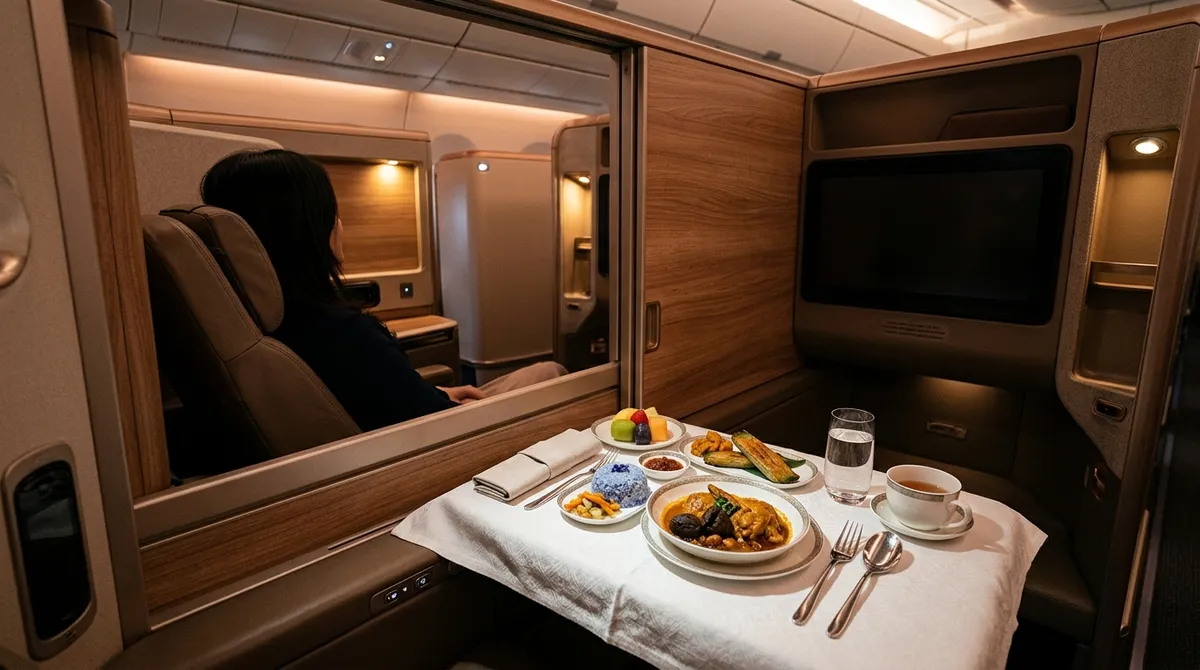
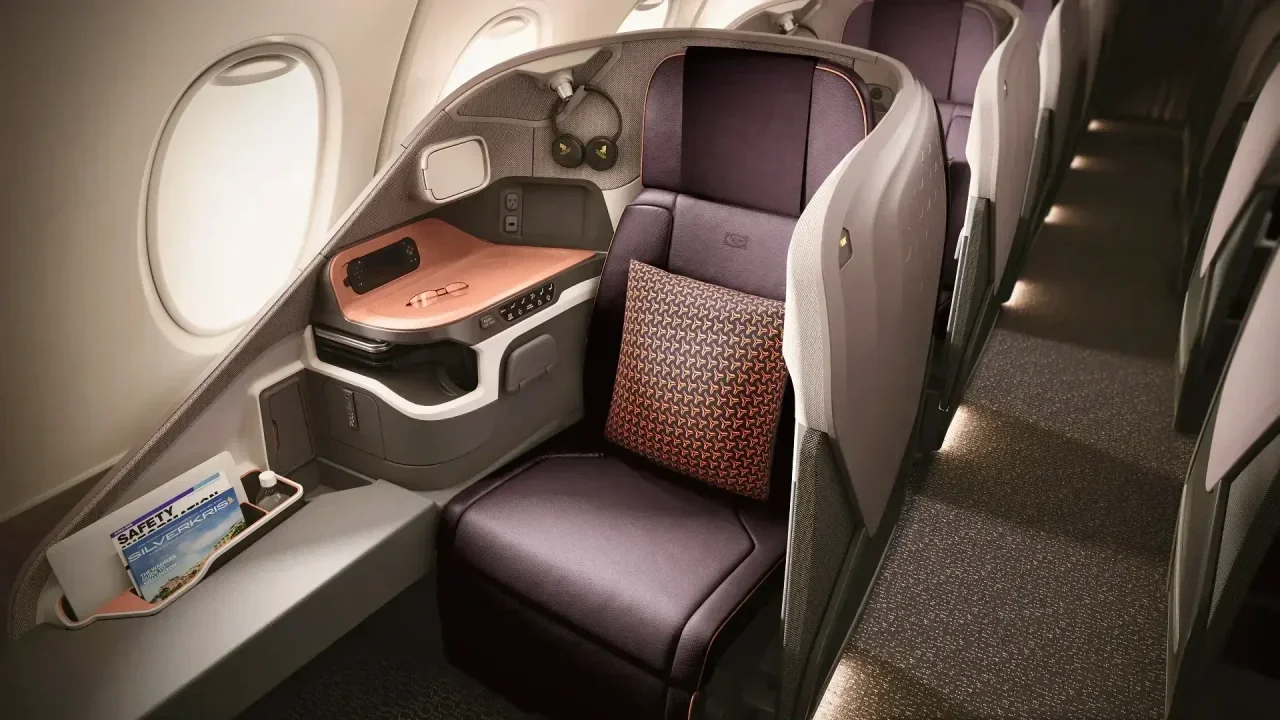
Business class on the A350-900ULR is a 1-2-1 configuration, 42 seats total, with every seat having direct aisle access. The seat itself — Singapore's "Book the Cook" long-haul product — converts to a full flat bed at 78 inches. I'm 6'1" and I fit. That's not always a given on Asian carriers' older widebody products, but the A350 cabin feels generous.
The window seats are worth knowing about specifically. Seats in the A and K columns have a privacy shell that curves around the head end, which does a reasonable job blocking ambient light from the aisle. The middle seats (D and G) are the ones couples book, and they're genuinely good for that — they sit close together with a shared surface between them. Solo travelers should avoid D and G unless you don't mind being right next to a stranger at roughly arm's length.
Food is where Singapore Airlines earns most of its reputation. Book the Cook is a pre-order service where you select your meal up to 24 hours before departure, and the options are genuinely better than what gets loaded as standard. I've had the chili crab with steamed rice on the SIN-JFK return that was, honestly, one of the better meals I've had at 40,000 feet. The satay appetizer shows up on almost every SQ long-haul and people love it. Rightly so.
But 18 hours is 18 hours. Even on a good seat with good food, you will hit a wall somewhere around hour 12. The cabin gets stuffy. The A350's cabin altitude is lower than older aircraft (around 6,000 feet versus 8,000), which genuinely helps with fatigue, but it doesn't eliminate it. Bring noise-canceling headphones. Drink less alcohol than you think you should. And if you're prone to back issues, the firmness of the mattress topper is something to know about — it's thin, and after six hours some people feel it.
Connecting via Frankfurt or Tokyo: when it's actually worth it
The Frankfurt routing — typically on Lufthansa with a connection at FRA — adds three to five hours to your total travel time depending on the layover. That sounds like a penalty. Sometimes it is. But there are two situations where it makes sense.

First, pricing. Connecting itineraries on this route can come in $800 to $1,500 below the nonstop, especially on partner bookings through Miles & More or United MileagePlus. I've seen JFK-FRA-SIN in Lufthansa business class price out around $2,800 round-trip during off-peak windows when the SQ nonstop was sitting at $4,200. That's real money.
Second, the Frankfurt Airport Senator Lounge in the B concourse is legitimately good, and a three-hour layover there isn't unpleasant. Hot food, proper showers, a quiet room. It's one of the better hub layovers in Europe for business class passengers. I wouldn't engineer a connection just for it, but if you're routing through FRA anyway, it softens the blow.
The Narita routing on ANA is a different animal. ANA's business class product — "The Room" on their 777-9 and 787 aircraft — is excellent. Proper suite doors, good bedding, strong Japanese food service. The connection at NRT is smooth if you've got two hours or more. The total travel time from JFK via NRT to SIN runs around 20-22 hours, which is longer than the nonstop, but if you can book ANA business through Virgin Atlantic Flying Club miles at a reasonable rate, the value math can work.
One honest note on connections: clearing customs and immigration in Singapore after 20+ hours of travel, with a connection in your past, is more grinding than it sounds in the planning phase. Changi Airport is excellent — probably the best airport in the world for processing arrivals — but you're still tired. Factor that in.
Finding NYC to Singapore business class fares that don't require a second mortgage
Published business class fares on this route are not cheap. You'll see rack rates from $5,000 to $8,000 round-trip on Singapore Airlines during peak season. That's not a typo, and I'm not going to tell you it's a bargain.
What actually moves the needle is timing and monitoring. The JFK to Singapore route does drop — SQ releases discounted fares, usually for travel 3-6 months out, and they don't announce it with a press release. You see a fare sitting at $6,200 for weeks, and then one Tuesday morning it's $2,800, and by Thursday it's gone. That's the window.
There are a few patterns worth knowing. January through March departures (avoiding Chinese New Year) tend to produce the best fare drops. September and October can also yield decent pricing. Summer and December are expensive without exception, and the nonstop specifically tends to hold price better than connecting options because demand for it is high year-round.
Award availability on the nonstop is a separate headache. Singapore Airlines releases very little KrisFlyer saver space on SQ22, especially in business. You'll have better luck searching partner availability — United MileagePlus, Air Canada Aeroplan, and Virgin Atlantic Flying Club all have access to SQ award space at varying rates. Aeroplan is currently pricing SQ business class at 85,000 points one-way from North America to Southeast Asia, which is steep but competitive against cash fares.
The honest answer is that this route rewards patience and flexibility more than almost any other premium route I track. If you can say "I'll fly anytime in February," you're in a different position than someone locked into a specific week. That's not a revelation, but it's the actual truth of how people get these fares.
If you want an alert system that catches these drops without you having to check manually every few days, that's exactly what BusinessClassSignal monitors for you — you set the route, set your price threshold, and it pings you when something hits. The 14-day free trial is worth using just for a route like this, where the fare windows are short and the savings are large enough to matter.
The Changi arrival experience, and why it changes the calculus
I want to say something about landing in Singapore specifically, because it's one of the few destinations where the arrival experience is good enough to factor into your choice of routing.
Changi Terminal 3, where most Singapore Airlines international arrivals land, is organized in a way that makes immigration and bag claim feel almost frictionless. I've cleared immigration at Changi in under 12 minutes after a full long-haul flight. That's not typical for a major Asian hub. If you have a Singapore arrival card filled out via the MyICA app in advance, the e-gates are fast. Bag claim is close. Taxis and the MRT are directly accessible from the arrivals hall.
Why does this matter for business class specifically? Because when you've been flying for 18 hours and you're deciding between the nonstop and a connection, the knowledge that the arrival end is efficient removes one anxiety from the equation. You're not going to land exhausted and then spend 90 minutes in an immigration queue. It's probably the smoothest international arrival I've experienced anywhere.
The SilverKris Lounge at Changi is worth a mention for the return leg. Business class passengers on SQ get access, and the Terminal 3 version is the best of the bunch — a proper buffet, noodle bar, private bathrooms with showers that are actually clean. The wine list is not exceptional, but the local food options are good enough that I usually eat there instead of waiting for the meal on the plane.
What I'd actually book, and when
If money isn't the constraint, the Singapore Airlines nonstop is the right call. The A350-900ULR is purpose-built for this flight, the product is among the best in the sky, and landing in Singapore without a connection is just cleaner. You know what you're getting.
If you're working with miles, I'd start with Aeroplan and check SQ partner availability well in advance — 11 months out if you can manage it. The nonstop saver space does appear, just not often.
If you're paying cash and the nonstop fare is above $3,500 one-way, I'd genuinely consider the Lufthansa connection via Frankfurt or an ANA routing via Tokyo, depending on which product you prefer and what the award math looks like on your points. Both are good business class products. Neither is a compromise you'll regret.
The one routing I'd skip is anything that connects in the Middle East and adds a third long segment. QR and EK both fly JFK-DOH/DXB-SIN, and while the products are fine, the total travel time starts pushing 24 hours with connections, and at that point you're just grinding through it.
You can browse all the routes we monitor to see what other long-haul business class fares are doing right now. This route isn't the only one that drops — it's just one of the more dramatic ones when it does.
One last thing: if you're flying into Singapore for the first time and haven't booked a hotel near the Botanic Gardens, consider it. Nothing to do with the flight. Just good advice.