Quick summary
Three airlines fly SFO to Seoul in business class: Korean Air, Asiana, and United. Korean Air's Prestige Suite is the standout product on this route — direct aisle access, a proper door, and a bed that actually works. Asiana's business class is solid but showing its age. United is the budget option and it shows. Prices for all three typically run $2,800–$4,500 round-trip at retail, but errors and sales can push that down to $1,800–$2,400 if you're watching closely.
The SFO to Seoul business class market, honestly
San Francisco to Seoul Incheon is one of those routes that looks competitive on paper — three carriers, daily departures, and enough seat options to make your head spin. In practice, though, the gap between the best and worst product here is bigger than on almost any other transpacific route I cover. You've got a genuinely excellent hard product at the top end, a decent-but-dated middle option, and one that I'd only book if the price was low enough to make me forget I'd booked it.
The flight is roughly 11 hours westbound, 10 hours eastbound. Long enough that the seat matters a lot. At this distance, you're not going to sleep through the whole thing on a recliner-style seat without waking up stiff and miserable. So the lie-flat question isn't academic.
Let me walk through each carrier. I've flown this route on Korean Air and United personally. My Asiana notes come from a colleague who covered it last year and whose opinions I trust, plus the seat specs I've verified myself.
Korean Air Prestige Suite: the one to target
Korean Air operates the SFO–ICN route with their 787-9, and on that aircraft you'll find the Prestige Suite — which is the seat that actually made me sit up and pay attention when I first flew it out of JFK a few years ago. I've since had it on the transpacific twice, and it holds up.The layout is 1-2-1 in a staggered herringbone configuration. Every seat has direct aisle access. The "Suite" designation isn't just marketing padding — there's a sliding privacy door that gives you a genuine sense of enclosure. It's not a full floor-to-ceiling door like you'd get on Singapore Suites or Emirates First, but it's a proper panel that blocks your sightline from the aisle and muffles the noise when the cabin crew are working.
The bed length is around 6'1" — I'm 5'11" and I fit comfortably, which is more than I can say for the United product on this route. The mattress pad they provide is legitimately good. I've had worse beds in three-star hotels in Seoul.
Which seats to pick on Korean Air's 787-9
On the Prestige cabin, the window seats in rows 11 and 12 (11A, 11K, 12A, 12K) give you slightly more privacy because of how the stagger works — you're further from the aisle and the shell blocks more of the cabin. Avoid row 16 if you can; it's adjacent to the galley and the noise picks up on the long overnight leg.
The food is where Korean Air really separates itself. They take the Korean meal option seriously in a way that some carriers don't. The bibimbap is a genuine dish, not a sad airline approximation. On my last flight, the banchan spread at dinner included three proper side dishes. The Western option was fine — a beef tenderloin that was cooked correctly, which is all I ask for at 35,000 feet. The wine list is respectable without being remarkable.
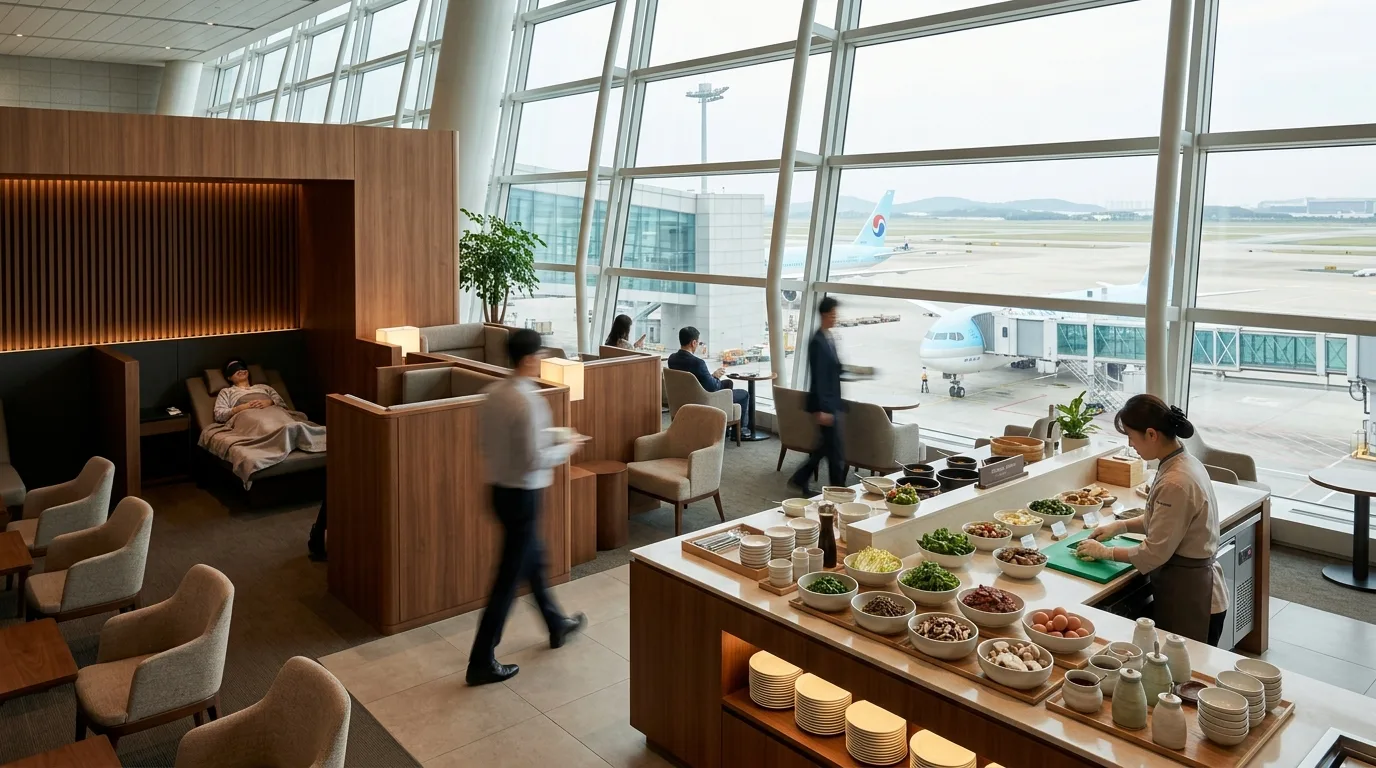
The lounge situation at SFO is worth knowing before you get there. Korean Air uses the Korean Air Lounge in the International Terminal, which is their own space. It's functional and clean but not luxurious. The food is better than average for an airport lounge — the noodle bar is usually worth a visit — but it's not going to compete with the Qantas First Lounge in Sydney or anything like that. Go in with calibrated expectations.
How much does Korean Air business class actually cost?
At full retail, Korean Air's Prestige class on this route runs roughly $3,200–$4,800 round-trip depending on the season. The shoulder months — late January through mid-March, and October — tend to be where the more reasonable fares appear. I've seen legitimate sale prices hit $2,200–$2,600 round-trip a few times a year, usually tied to Korean Air's own promotions or the occasional fare filing error. Those don't last. We've caught a few of them on BusinessClassSignal and they typically close within 12–18 hours of appearing.
If you're using miles, Korean Air's own SkyPass program prices this at 80,000 miles round-trip in Prestige class. That's reasonable by current standards. The transfer partners are decent — you can move points from Chase Ultimate Rewards, which makes it accessible.
Asiana business class: still good, but you should know what you're getting
Asiana flies SFO–ICN on their A350-900, and their business class — called Business Smartium — is a 1-2-1 configuration with lie-flat seats. Full aisle access throughout. The seats are angled slightly, not fully flat when you look at the geometry, but in practice the sleeping surface is comfortable enough that most people don't notice.
The cabin feels a bit older than Korean Air's Prestige Suite. The seat itself was designed around 2014 and while it's been refreshed cosmetically, it doesn't have the privacy door or the same enclosed feeling. If you're a light sleeper who gets bothered by aisle activity, that's worth factoring in.
Where Asiana competes is on service quality and food. The crew on this route consistently gets strong reviews, and the Korean meal options are on par with Korean Air — sometimes better, depending on who's doing the catering that week. The cold noodle dish (naengmyeon) they serve on some departures is genuinely one of the better things I've eaten in a business class cabin, even if it sounds like an odd choice at altitude.
The Asiana lounge at SFO is the Star Alliance lounge in the International Terminal. It's shared, it's adequate, and the food selection is better than you'd expect from a shared facility. Nothing worth rushing to the airport early for, but you won't be standing around looking for somewhere to sit.
Pricing on Asiana runs close to Korean Air — $3,000–$4,500 retail round-trip, with sales appearing a few times a year. They're not quite as aggressive with promotions as Korean Air, in my experience, but when they do drop prices the fares hold for a bit longer. I've seen $2,400 round-trip on this route twice in the past 18 months.
Asiana's future product
Asiana has been rolling out a new business class product (called OZ Business) on some routes, with a proper privacy door and a more modern shell. As of now, it hasn't appeared on the SFO–ICN route — you'll still get the Smartium seat. Worth checking seatmaps before you book if this matters to you.
United: the fallback option
I'll be straight with you. United's Polaris business class on paper sounds competitive — fully flat seat, direct aisle access, the whole pitch. And on some aircraft, like the 777-300ER, it actually is a good product.
On the SFO–ICN route, United operates the 787-9, and the Polaris seat on that aircraft is... fine. The seat itself is the same shell across United's Polaris fleet, but the 787-9 has a tighter cabin than the 777. The seat width feels narrower than what you get on Korean Air or Asiana. The bed length tops out around 6'0" and the angle of recline means your feet end up slightly elevated in a way that bugs some people on long overnight flights.
The food has improved since United revamped their catering in 2022, and I'll give them credit for that. The starter and main are now more consistently good than they were for a while. But you're not getting the Korean meal options, and the wine list is the same one they run on their domestic routes with a few additions.
When does it make sense to book United on this route?
Honestly? When the price is significantly lower and you're not planning to sleep much. United Polaris fares on this route frequently dip to $1,900–$2,400 round-trip, and I've seen them go as low as $1,600 during off-peak windows. If you're flying eastbound (Seoul to SFO) and arriving in the morning with a full day ahead of you, the sleeping quality matters less and United's lower price point starts making more sense.
The other scenario is if you need the flexibility that comes with United's fare rules, or if you're using MileagePlus miles and can get good redemption value. At 70,000 miles round-trip in Polaris (when saver availability opens up), it's a reasonable use of points if you have them sitting around.
United Polaris saver awards on transpacific routes release closer to departure than you might expect — I've seen good availability open up 14–21 days out when seats don't sell at retail. Worth checking back if you struck out earlier.
United's Polaris Lounge at SFO is in Terminal 3, and it's one of the better Polaris Lounges in the network. The food is genuinely good — the short rib is a real dish — and the bar is stocked properly. If you're flying United on this route, get there early enough to eat in the lounge rather than on the plane.
What the ICN arrival experience looks like
All three airlines arrive at Incheon's Terminal 1, which handles most international carriers. Korean Air uses Terminal 2, which is their home terminal and a noticeably more pleasant experience — shorter immigration queues, better signage, a more modern facility overall. If that matters to you (and after 10+ hours in the air, it does), Korean Air has a structural advantage just by virtue of where they land.
Asiana and United both arrive at Terminal 1. The immigration process there is efficient by global standards — South Korea's automated passport control for eligible passport holders is fast and well-run. I've cleared immigration at ICN T1 in under 12 minutes including the walk from the gate. On a good day. On a bad day with a full 380 ahead of you, it can stretch to 45 minutes.
The Arex express train runs from both terminals to Seoul Station and Gimpo Airport. It's 43 minutes to Seoul Station from T1, 51 minutes from T2 with the additional stop. The express (non-stop) option costs about 9,500 KRW from T1 — around $7 at current exchange rates. Take it. The taxi queue after a full international flight is not where you want to be.
T-Money card on arrival
Pick up a T-Money transit card at one of the CU or GS25 convenience stores in the arrivals hall before you head to the Arex platform. You can load it with cash and use it on the train, Seoul metro, and most taxis. Saves you fumbling with cash or cards every time you transit.
SFO to Seoul business class: how to find a fare that's actually worth paying
The retail prices I've quoted throughout this piece are real, but they're not what you should be paying if you have any flexibility. This route has a reasonably active sale cycle, and all three carriers discount it several times a year.
Korean Air tends to run promotions in January (for spring travel), late August (for fall), and occasionally around Korean holidays when they're trying to fill seats going in the opposite direction. Asiana follows a similar pattern. United is less predictable but drops prices more frequently in smaller increments.
The thing about these fares is that they don't stay live for long. A Korean Air sale fare at $2,200 round-trip might be bookable for 36 hours. A misfiled United fare at $1,600 can disappear in under two hours. I've watched this route for years and the window on the genuinely good deals is short.
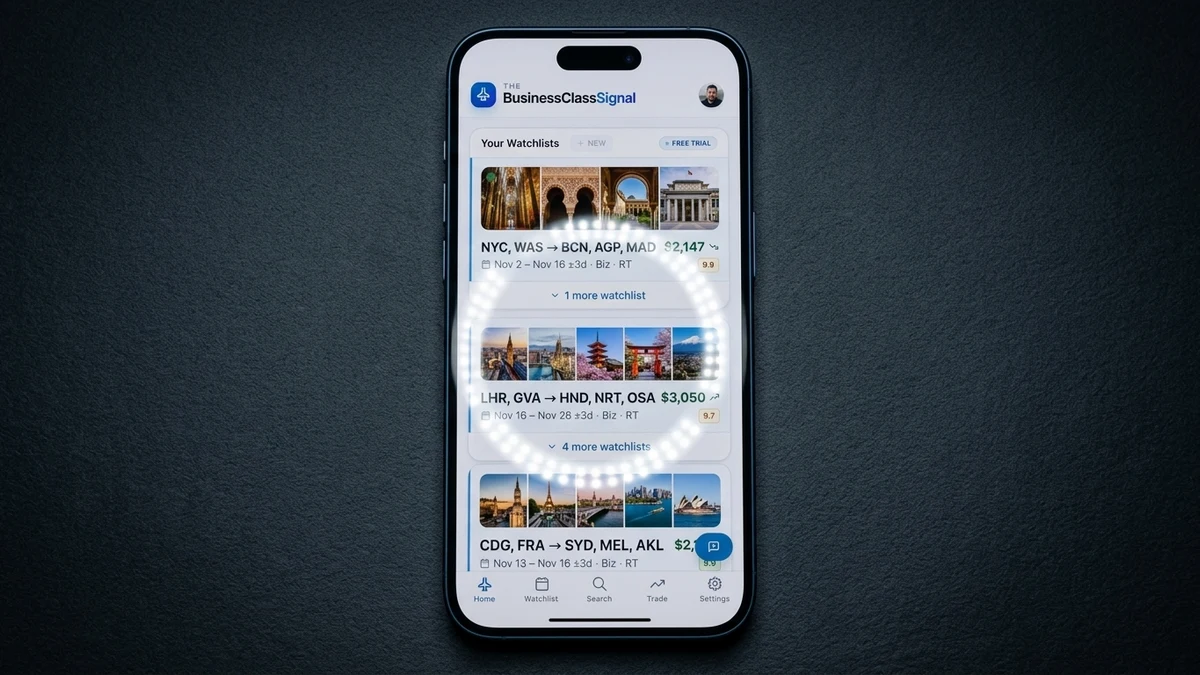
That's exactly why we built the monitoring system the way we did. BusinessClassSignal scans this route twice daily and alerts you when the price drops below whatever threshold you set. You tell it "alert me when SFO to Seoul business class goes under $2,400 round-trip" and it watches it for you. You get the alert, you book it, you move on. The alternative is checking manually every few days and probably missing the good windows.
We cover over 800 routes across the transpacific and beyond, and SFO–ICN is one of the more active ones in terms of price movement. It's worth having eyes on it.
Book Korean Air and Asiana fares directly through their own websites when possible — third-party OTAs sometimes add service fees and their change/refund policies on discounted fares can be more restrictive than the airline's own terms.
The honest verdict on which airline to pick
If I'm booking this route for myself and the price difference is $400 or less, I'm on Korean Air every time. The Prestige Suite is a genuinely good seat, the food is better, Terminal 2 at Incheon is a nicer arrival experience, and the service has been consistently strong across every flight I've taken with them. It's not a perfect product — the lounge at SFO is underwhelming and the IFE library could be bigger — but the core of what matters on a 10-hour overnight flight is done well.
Asiana is a reasonable second choice, especially if you can get a meaningful price difference. The seat is older but the service reputation is real. If you're flying during daylight hours when the lie-flat quality matters less, the gap between Asiana and Korean Air narrows considerably.
United is for when the price is right. And sometimes the price is right. A $600 gap between United and Korean Air on this route is a genuine decision point, especially if you're a MileagePlus member and can take advantage of the status benefits. I don't dismiss it out of hand. I've just had better flights on this route with the Korean carriers.
The best version of booking any of these is catching a sale fare on your preferred carrier rather than paying full retail on a lesser product. Set an alert, be ready to book when it fires, and don't overthink it.
Monitor SFO to Seoul business class fares — get alerted when prices drop. 14-day free trial, no credit card needed.
Start Monitoring