
Quick summary
Spring break 2027 business class fares will start appearing in late summer 2026, with the best prices typically surfacing 8–11 months out before collapsing again as March and April fill up. Caribbean and Mexico routes are the easiest wins for families. Transatlantic is doable but requires patience and a monitoring setup that catches the brief windows when prices drop.
Why spring break is a terrible time to buy business class — and how to do it anyway
Let me be honest with you upfront. Spring break is probably the worst time of year to find cheap business class fares. Airlines know exactly when American families travel. They've been running yield management systems since before most of us had email. The weeks around late March and early April are circled in red on every revenue manager's calendar, and fares reflect that.
And yet, people fly business class over spring break every year at prices that don't make you want to lie down in a dark room. The trick isn't finding some magical loophole. It's understanding when prices dip, which routes have more slack than others, and having something watching the fares so you're ready to book within hours of a drop.
I've personally covered spring break travel patterns for about six years running at this point. What I've noticed is that 2027 is shaping up to be an interesting year — capacity on transatlantic routes is up, a few carriers have added Caribbean service, and the post-pandemic premium travel surge is finally showing signs of softening slightly. That doesn't mean fares will be cheap. But it means there are more opportunities than there were in 2024 or 2025.
The booking timeline for spring break business class 2027
This is the part most people get wrong. They assume that because spring break is months away, there's no urgency. There is.
The best fares for spring break 2027 will surface in two windows. The first is August through October 2026, when airlines load their schedules and set initial prices. These early fares are sometimes surprisingly reasonable — not because airlines are being generous, but because they're testing demand. A route that goes on sale in September with a $1,800 round-trip business class fare to Cancún can be $3,400 by December once bookings fill in.
The second window is shorter and harder to predict: January 2027. Some airlines run flash sales in January to fill remaining premium inventory before the holiday travel hangover fully clears. These sales last 48–72 hours. If you're not watching, you'll miss them entirely.
After February 1st, 2027, I'd expect most spring break business class fares on popular routes to be at or near their peak. You can still find deals on less obvious routing — connecting through secondary hubs, flying on the actual holiday rather than the day before, or going to destinations that aren't Cancún or Nassau — but the easy wins are gone.
The Thursday departure trick
If your dates have any flexibility at all, look at Thursday evening departures rather than Friday. Airlines tend to price Thursday night lower than Friday morning because the leisure crowd wants Friday and the business crowd is already home. On some Caribbean routes I've tracked, the Thursday evening departure runs $200–$400 cheaper in business class than the same flight a day later.
How far out should you actually book?
For spring break 2027, the sweet spot is 8–11 months out from your travel dates. If you're targeting late March, that means booking between April and July 2026. If you're targeting early April, aim for May through August 2026.
I know that feels absurdly early. But business class seats are a finite resource, and on wide-body aircraft to the Caribbean — we're talking 767s, A330s, sometimes A350s — there might be 30–40 flat beds total. The best window and aisle configurations go first. By the time you're booking 3 months out, you're often looking at middle seats in a 2-3-2 layout or whatever's left after the frequent flyer upgrades clear.
The other argument for booking early: most airlines now allow free changes on paid business class fares. So if you book in June 2026 and a better fare appears in October, you can often rebook without penalty. Worth reading the fare rules carefully, but this flexibility has made early booking much less risky than it used to be.
Caribbean and Mexico routes: where the real value is
If you're traveling with family, Caribbean and Mexico routes are where I'd focus first. The flights are short enough that business class is genuinely about the lounge access and the lie-flat seat on arrival rather than 8 hours of comfort. But with kids who need to get off a plane in a decent mood, that still matters.
American's service to Cancún from JFK is one I've tracked closely. Fares have been hitting the $1,800–$2,100 round-trip range during off-peak windows, which for a 3.5-hour flight in a lie-flat seat is actually reasonable. The problem is that American's 737 MAX on this route doesn't have lie-flat business class — it's a recliner product. If lie-flat matters to you (and on a daytime Caribbean flight, it might not), you need to look at the widebody options.
United's service from EWR to Cancún uses a mix of aircraft. When they operate a 767, you get Polaris business class, which is genuinely good. The seat is the same one I flew IAD-LHR last October — private, lie-flat, decent bedding. When they operate a 737, you get a domestic first-class product dressed up as international business. Not the same thing. Always check the equipment before booking.
Nassau from Miami is almost too short to justify business class on pure comfort grounds — it's 50 minutes in the air. But the MIA Admirals Club is decent, and if you're connecting through Miami anyway, upgrading the last segment for the lounge access and priority boarding with kids in tow isn't a crazy call. Fares on this short hop can be under $1,200 round-trip when they drop, which is actually competitive with some transatlantic options.
Watch the equipment swap
Airlines change aircraft on Caribbean routes more than almost any other market. A flight listed as a 767 in August can quietly become a 737 by the time you're flying in March. Set a calendar reminder to recheck your equipment 60 days before departure. If it's been downgraded, you may have recourse to rebook or get a partial refund depending on the fare rules.
Mexico City deserves a mention that it rarely gets in spring break coverage. It's not a beach destination, but it's a genuinely great city to visit with older kids or teenagers, and business class fares from the US are often softer than to the resort markets because the route is more business-traveler-dependent. Aeromexico's Club Premier cabin on the 787 is underrated — I had a solid meal and a real flat bed on a daytime flight last year. Worth considering if your family is up for something different.
Spring break business class to Europe: possible, but here's what you're dealing with
Transatlantic in spring break season is a different animal. The fares are higher, the competition for seats is intense, and you're dealing with 7–9 hour flights where the product quality actually matters in a way it doesn't on a 3-hour Caribbean hop.
That range is wide because it really does vary that much. London is consistently the most expensive transatlantic market during spring break — partly because it's the most popular, partly because British Airways has pricing power on that route that's frankly annoying. Paris and Amsterdam tend to run a few hundred dollars cheaper. Southern Europe (Lisbon, Madrid, Rome) can be significantly cheaper, sometimes by $1,000 or more round-trip.
TAP's business class to Lisbon is not the most glamorous option. The seat is fine — lie-flat, reasonable pitch — but the service is inconsistent and the lounge at LIS is mediocre. That said, $2,800 round-trip from JFK to Lisbon in spring break season is a number that's hard to argue with if you're planning to continue to other European cities by train. I've seen these fares drop to that level during brief windows in fall 2025, and I'd expect similar patterns for 2027.
If you're set on London, British Airways Club World is the dominant option from North America, and it's... fine. The seat configuration is the thing that frustrates me most — the alternating forward/backward layout in the older 777 cabin means some window seats face the aisle rather than the window. The Club Suite on the newer A350 and some 777-300s is significantly better, with a proper door and forward-facing seat. Always check which aircraft and cabin configuration you're getting before booking BA.
For families flying to London, the T5 Galleries lounge at Heathrow is honestly not as impressive as the reputation suggests. The food is adequate. The coffee is mediocre. The children's area is small. Virgin Atlantic's Clubhouse at T3 is a noticeably better experience if you're on a Virgin ticket — better food, more space, a proper bar. I've spent too many hours in both to pretend they're equivalent.
When do transatlantic spring break fares actually drop?
The honest answer is unpredictably, and briefly. Airlines will occasionally release discounted business class inventory on transatlantic routes during what they call "tactical sale" periods — usually when advance bookings are tracking below forecast. For spring break 2027, the most likely windows are September–October 2026 and a short window in January 2027.
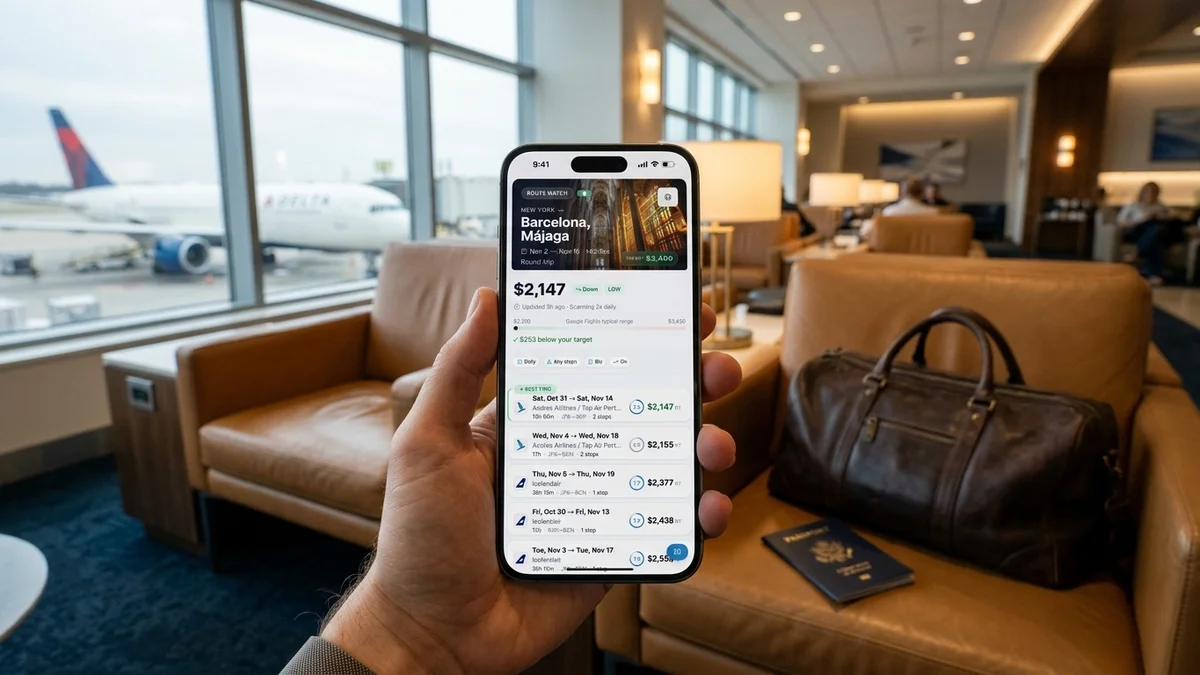
These sales are rarely advertised. They appear in the GDS, get picked up by fare monitoring services, and disappear within 24–72 hours. This is exactly the pattern that BusinessClassSignal's monitoring system is built to catch — it scans 800+ business class routes twice daily and sends an alert when a fare on your specific route drops below whatever threshold you've set. I built the monitoring logic around this exact problem: you can't manually check fares twice a day for six months. Nobody does that.
Set your alert threshold 20–25% below the current published fare, not at the absolute floor price you're hoping for. Fares rarely drop to fantasy levels, but a 20–25% dip is achievable on most transatlantic routes during tactical sale windows. That's still $800–$1,200 off a round-trip to Europe.
Flying with kids in business class: what's actually different
I get asked about this constantly. The short answer: some airlines are better about it than others, and the physical product matters more than the service attitude.

On routes where you're getting true lie-flat business class, the main practical difference with kids is seat configuration. If you have two kids and two adults, you want seats that are adjacent or at least across an aisle from each other. On a 2-2-2 layout (like many 767 and A330 cabins), you can get four seats together — two on each side of the aisle. On a 1-2-1 layout, the middle pair of seats works fine for two kids sitting next to each other while parents are in the window seats across the aisle.
What doesn't work well: putting a young child in a fully separate pod with no adjacent adult. Some newer business class products are so private that a 6-year-old can't see or easily communicate with the parent next to them. I've seen this cause real stress on overnight flights. Check the seat map before you book and think through the geometry.
Airlines vary on how they handle children in business class. Singapore and Emirates are notably good — attentive without being intrusive, good kids' meal options, crew who actually seem to enjoy having families aboard. Some US carriers are more indifferent. I won't name names, but if you've flown domestic first class with kids on a legacy carrier recently, you know the energy I'm describing.
Bassinet seats for infants
If you're traveling with an infant and want a bassinet, you need to book a bulkhead seat in business class specifically. These seats are limited — usually 2–4 per aircraft — and they go fast. Book as early as possible and call the airline to confirm the bassinet reservation separately from the seat selection. Don't assume checking the box online is sufficient.
Mixed-cabin strategies: business for the long haul, economy for the rest
Not every leg of a spring break trip needs to be in business class. A lot of families I talk to are doing something like: business class on the transatlantic or transpacific segment, economy on the short domestic connector or the island hop at the end.
This is smart travel, and it's worth planning deliberately rather than just booking whatever the airline bundles. The segments where business class actually changes the experience are the long ones — 6+ hours where a flat bed and a proper meal make a real difference. On a 90-minute domestic connection, business class is just a wider seat and a free drink.
If you're building an itinerary that mixes cabins, it's worth monitoring both markets separately. For the economy legs, FlightKitten does exactly what we do for business class but focused on economy fares — scans 220+ airlines and sends you an alert when prices drop on your specific route. It runs about $4.99 a month and is worth having alongside a BusinessClassSignal subscription if you're piecing together a multi-leg trip.
The routes worth setting alerts on right now for spring break business class
Here's where I'd put my monitoring energy for spring break 2027, based on historical fare patterns and current capacity trends.
JFK–CUN (New York to Cancún): Fares have been hitting the $1,800–$2,200 range during tactical windows. Watch for United 767 service specifically if lie-flat is important. Set up an alert on this route now and put your threshold at $2,000 round-trip.
MIA–LIS (Miami to Lisbon): TAP and Iberia both serve this route. Softer pricing than the northern transatlantic. Good entry point to Europe for families based in Florida or the Southeast.
LAX–LHR: Virgin Atlantic's Upper Class is genuinely one of the better transatlantic business products right now. The Clubhouse at LAX (which they share with Delta) is solid. Fares from the West Coast to London run higher than East Coast equivalents, but $3,400 is achievable during sale windows — I've seen it happen on this route twice in the past 18 months.
ORD–CDG (Chicago to Paris): United Polaris on this route is consistent, and CDG has decent lounge options if you're continuing by train to other French cities. Paris is expensive in spring, but the flight itself is often softer in pricing than London.
All four of these are routes you can browse and monitor through BusinessClassSignal. The system will flag you when fares drop below your target, which is the only realistic way to catch the windows I've been describing.
BusinessClassSignal monitors 800+ business class routes twice daily. You set a price target, and it emails you when a fare on your specific route drops below that number. The 14-day free trial is genuinely free — no card required until you decide to keep it. I'd set up alerts on at least two or three of the routes above and then just forget about it until the email arrives.
Monitor spring break business class fares — 14-day free trial, no card required
Start Free TrialOne last thing worth saying: spring break 2027 is far enough out that the best fares haven't appeared yet. The airlines haven't finished loading their schedules. Prices will shift. Some routes that look expensive now will soften; some that look reasonable will spike. The families who end up in flat beds over spring break aren't the ones who got lucky — they're the ones who started watching early and moved fast when something dropped. That's really the whole strategy.