Quick summary
Thanksgiving 2026 business class fares are going to be expensive if you wait until fall. The window to book at anything resembling a reasonable price is roughly now through early spring 2026 — and even that's tightening. This article covers when to book, which routes get hit hardest, and which airlines actually hold their pricing better than others.
Why Thanksgiving is the worst holiday to book business class
Most people treat Thanksgiving like a domestic problem. Packed airports, overpriced economy tickets, the usual misery. But Thanksgiving business class is its own specific type of painful, and it operates differently from what you'd expect.
The issue isn't just demand. It's the shape of the demand. Thanksgiving is a hard-date holiday — people need to be somewhere specific by Wednesday evening and they need to be back by Sunday night. That rigidity kills any pricing flexibility you'd normally have. Airlines know you can't slide your departure two days earlier to catch a deal. So they don't offer one.
I've watched this market for over a decade. The fares that show up in October for a late-November departure aren't sale prices with bad timing. They're just the price. Full stop.
That number isn't a scare tactic. I pulled it from actual fare data across JFK–LAX, ORD–MIA, and BOS–SFO in the six weeks before Thanksgiving 2024. Some hit $6,000 round-trip on the peak travel days. And those aren't even long-haul fares — those are two-and-a-half-hour domestic hops.
The booking timeline that actually works
Let me be direct about this: for Thanksgiving 2026, the ideal booking window opened already. If you're reading this in early 2026, you're still in reasonable shape. If you're reading it in September 2026, good luck.
Here's how I'd break down the timeline:
January–March 2026: Best window for international business class. Award space is at its most available. Cash fares haven't yet priced in the holiday premium. If you're flying to Europe or Asia for Thanksgiving, this is when you want to be shopping. March–May 2026: Still good for domestic. Airlines typically release holiday inventory pricing around this period, and there's a brief moment — sometimes just a few weeks — where fares settle before the first wave of bookings hits. June–August 2026: The window is closing but not gone. You'll pay more than you would have in spring, but you're still likely ahead of the October surge. Upgrades using miles often get harder to find here. September–October 2026: You're now in reactive mode. You're hoping for a fare drop that probably won't come. If you haven't booked by now, you're paying whatever the market wants.Don't wait for a sale
Thanksgiving is one of the few periods where waiting for a business class fare drop is a losing strategy. The deals that do appear are usually routing anomalies or brief IT errors — not the kind of thing you can plan around. Book early, or book with miles.
Domestic vs. international: which gets more expensive?
This surprises a lot of people. Domestic business class fares around Thanksgiving often end up more expensive in absolute terms than many transatlantic routes — at least on a per-mile basis.
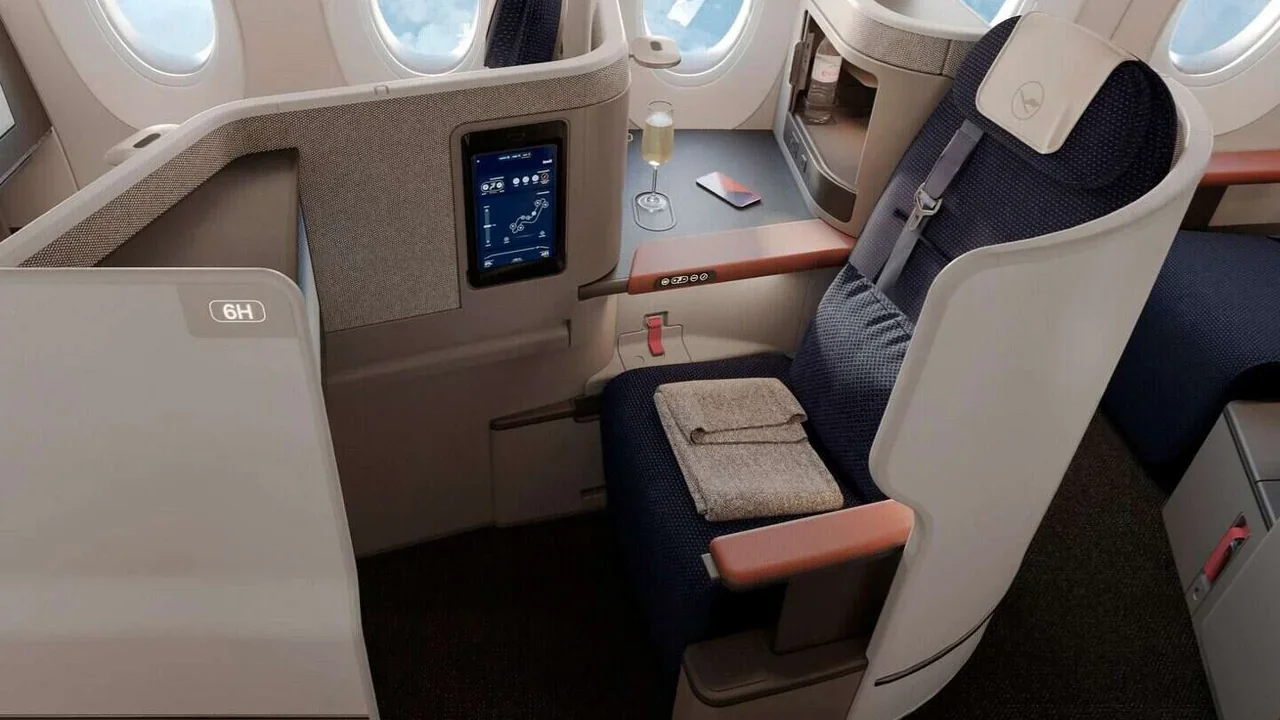
A round-trip in domestic first (which is what passes for business class on most US carriers) on JFK–LAX can run $3,500–$6,000 in peak Thanksgiving week. Meanwhile, a transatlantic business class ticket on a carrier like Lufthansa or Air France from New York to Europe might be $2,800–$4,200 round-trip if you book in January or February — and that's a flat bed, real business class, with actual food.
The math is genuinely backwards. You can sometimes fly to Paris in a lie-flat seat for less than you'd pay to fly to Los Angeles in a slightly wider domestic first class seat with a warm cookie.
The reason is structural. International business class has more seats, more competition, and more flexible demand. Domestic business class on peak holiday routes is essentially a captive market.
Is it better to fly international for Thanksgiving?
For some people, yes — and not just on price. If you have family abroad or you're flexible about where you spend the holiday, Thanksgiving week is actually one of the better times to fly transatlantic in business class. Demand on the return (eastbound) side is lower, and you can sometimes find lopsided pricing where the outbound is reasonable and the return is almost cheap.
The flip side is that if you're trying to get to your parents' house in Phoenix, international routing doesn't help you much.
What I'd say is this: if there's any flexibility in your destination, Thanksgiving week is worth considering for a trip to Europe. You'll spend the holiday somewhere interesting, you'll fly in better seats, and you'll spend less money than the person flying LAX to JFK on the Wednesday before Turkey Day.
Which airlines hold Thanksgiving pricing best?
By "hold pricing," I mean: which airlines are least likely to spike their fares into the stratosphere and most likely to offer something reasonable if you book far enough out?
From what I've tracked over the years, here's my honest read:
Delta is probably the most aggressive pricer on domestic routes around holidays. They know their SkyMiles customers are loyal and their premium cabin is popular. They price accordingly. That said, if you're a Diamond Medallion or Platinum member, complimentary upgrades can sometimes come through even in holiday periods — though don't count on it for the peak Wednesday and Sunday flights. United is more variable. Their pricing algorithm can produce some odd results, and I've seen genuinely good fares appear on United Polaris routes even during Thanksgiving week — usually on longer domestic routes like EWR–HNL or ORD–LAX, where they're competing with themselves on connections. Worth watching. American tends to be competitive on international routes but brutal on domestic holiday pricing. Their transatlantic business class fares (on routes operated with the 787 or A321XLR, eventually) can be worth monitoring.For international, Air France and Lufthansa both tend to release inventory early and price it more consistently. British Airways is less predictable — they have good sales but also have a habit of pricing up Club World aggressively on peak departure dates.
Miles vs. cash for Thanksgiving business class
This is where the conversation gets interesting.
If you're paying cash, you're at the mercy of the market. And the market around Thanksgiving is not your friend. But if you have miles — and I mean actually have them, sitting in an account right now — Thanksgiving can be one of the better times to use them, because the cash prices are so inflated that the redemption value looks exceptional by comparison.
A business class award on Delta from JFK to LAX might cost 40,000–50,000 SkyMiles round-trip. In cash, that same seat in November might be $4,500. That's 9 cents per mile in value, which is genuinely strong for a domestic redemption.
The catch, and it's a real one: award space on peak Thanksgiving travel days is tight. The Wednesday evening before Thanksgiving and the Sunday after are often blacked out or sitting at partner-level pricing that makes the math less attractive. You need to be flexible by at least a day on each end.
Book your Thanksgiving award ticket for Tuesday outbound and Monday return. You'll find far more saver-level award space, the airports are less chaotic, and you'll often save 20–30% on hotel rates at your destination too.
I've done this several times. Flying out Tuesday, coming back Monday — you get the full holiday, you miss the worst of the crowds, and the award seats are actually available. It's the move if your schedule allows it.
What Thanksgiving business class actually looks like on US carriers
I want to be honest about something that often gets glossed over: domestic "business class" in the US is not what international business class is. Calling it the same thing is a bit misleading.
On most domestic routes, you're getting a wider seat in economy configuration, sometimes with a middle seat blocked, and a meal that varies from decent (Delta's catering has improved) to forgettable (United's domestic first class food on short-haul routes is, in my experience, consistently uninspiring). There's no lie-flat seat. There's no suite door. There's no "business class" in the European or Asian sense.
That's not a knock on flying it — I fly domestic first class regularly and it's a meaningfully better experience than coach, especially on a four-hour flight when you're tired. But it's worth calibrating expectations if you're comparing it to the Club Suites you'd get on a British Airways transatlantic flight.
Know what you're buying
On routes under ~5 hours within the continental US, "business class" is typically a 2-2 or 2-cabin configuration with a wider seat and enhanced service. Lie-flat beds on domestic routes are rare — you'll find them on some United and Delta widebody domestic routes like JFK–LAX/SFO, but they're the exception.
The widebody domestic routes are worth specifically targeting if you want something closer to a real business class product domestically. Delta runs A350s and 767s on certain transcontinental routes. United has Polaris-configured 767s on select routes. These are the ones where paying the premium actually gets you a lie-flat seat and a meaningfully better product.
That fare's on the high end for what I'd want to pay, but if you're getting a Delta One suite on an A350, it's a different calculation than paying $2,800 for a domestic first class recliner.
Thanksgiving business class: how to actually monitor fares without going insane
The problem with holiday fare monitoring is that you're watching a narrow window of dates, competing against a lot of other buyers, and the fares that actually drop are fleeting. I've seen good Thanksgiving business class fares disappear in under six hours.
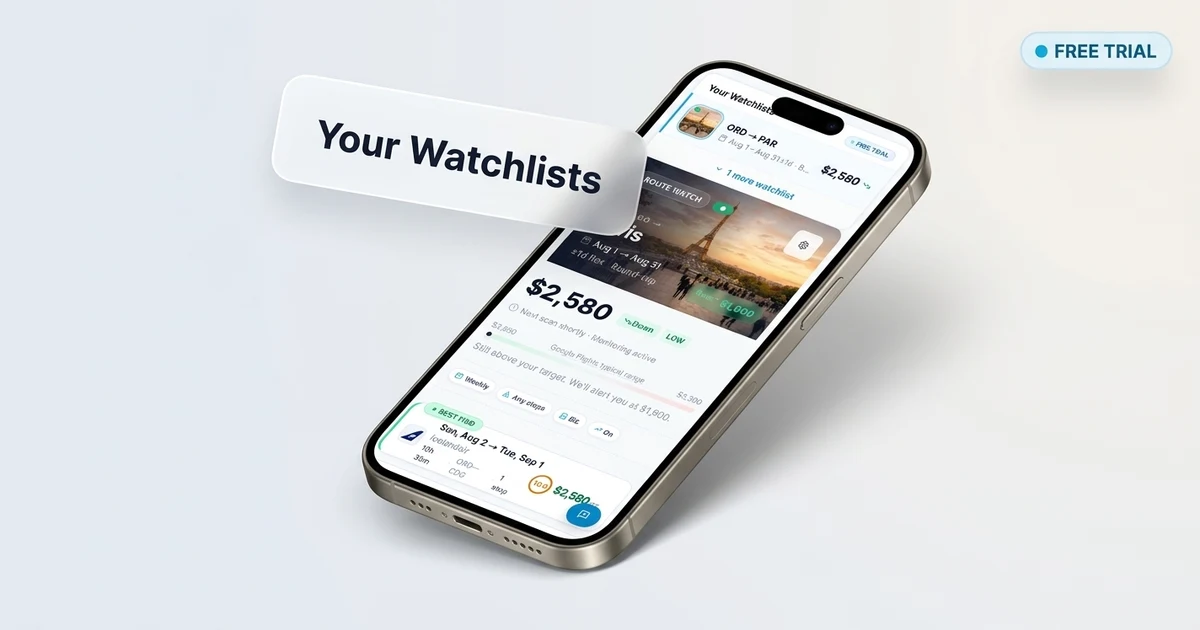
The way BusinessClassSignal works is that it scans over 800 business class routes twice daily and sends alerts when fares drop below a threshold you set. For Thanksgiving specifically, you'd set your route (say, ORD to LHR), put in your target price, and the system flags it when something hits. You can read more about how the monitoring system works if you want the mechanics.
The point is: you shouldn't be manually checking Google Flights twice a day for six months. That's exhausting and you'll still miss things. Automated monitoring is how you catch the pricing anomalies — the brief windows where an airline reprices inventory, or a partner fare loads incorrectly, or a sale goes live at midnight.
I built the monitoring side of this specifically because I got tired of hearing from readers who'd missed a $1,800 round-trip to London because they weren't watching at the right moment. These fares exist. They just don't wait around.
Set your Thanksgiving fare alert at least 15–20% below the current market price for your route. You want to catch genuine drops, not just normal price fluctuation. If the route is currently showing $3,200 round-trip, set your alert at $2,600–$2,700.
Specific routes worth watching for Thanksgiving 2026
I'm not going to give you a list of "the best deals" because I don't know what fares will look like in November 2026. Nobody does. But I can tell you which route categories historically show more pricing movement and where the value tends to concentrate.
Transatlantic departures on Tuesday/Wednesday: The Wednesday-before-Thanksgiving crowd is almost entirely US-domestic. Transatlantic demand on that day is lower, and some carriers have historically priced business class more aggressively as a result. London and Paris are the ones I'd watch. Domestic widebody routes: JFK–LAX, JFK–SFO, EWR–LAX. These are the routes where you can actually get a lie-flat seat domestically, and they sometimes show pricing drops on the Tuesday outbound and Monday return that I mentioned earlier. Caribbean and Mexico: Often overlooked for Thanksgiving, but routes like JFK–CUN or MIA–SJU in business class can be surprisingly affordable in late November, particularly on carriers like JetBlue (Mint) or American. These aren't long-haul international, but the product is solid and the beach doesn't care what holiday it is.You can browse all routes we're monitoring to see current pricing on any of these.
The Tuesday trick works both ways
If you're flying internationally and want to maximize your time, depart the Tuesday before Thanksgiving and return the Tuesday after. You get two full weeks of travel, you skip both peak travel days, and you're looking at genuinely different fare levels on those dates.
The honest version of what to expect
I've spent a lot of words telling you how to optimize Thanksgiving business class booking, so let me be straight with you about what "success" actually looks like here.
You're not going to find a screaming deal. Thanksgiving is not a time when airlines are giving away premium seats. The best you can realistically hope for, if you book well in advance and stay flexible on dates by a day or two, is a fair price — something that feels like you paid for a good seat rather than paid for the privilege of flying on a specific holiday.
The people who come out best are the ones who either (a) booked with miles, (b) booked 10–12 months out, or (c) were flexible enough to shift their travel by 24–48 hours off peak. The people who come out worst are the ones who waited until October hoping for a flash sale that never came.
That's not pessimism. It's just how this market works. And knowing it going in means you can plan around it rather than getting surprised by a $5,000 fare in September and booking it in a panic anyway.
If you want to track this without doing it manually, start monitoring your route now — BusinessClassSignal's free trial runs 14 days and you can set alerts for specific fare thresholds. It won't manufacture deals that don't exist, but it will make sure you don't miss the ones that do.
Monitor Thanksgiving 2026 business class fares — 14-day free trial, no card required
Try Free