
Quick summary
The business class points vs cash decision isn't a simple one-size answer — it depends on the cash fare, the redemption value, and which program you're redeeming through. This article walks through the math, the exceptions, and the situations where paying cash is actually the smarter call.
The question everyone gets slightly wrong
Most points-and-miles content on the internet will tell you to always use points for business class. Burn those miles, they say, because that's where you get the "best value." And they're not entirely wrong. But they're also not entirely right, and the gap between those two things has cost me — and plenty of readers — some genuinely bad decisions over the years.
The real answer to the business class points vs cash question is: it depends. Which I know sounds like a cop-out, but stick with me, because the math here is actually pretty simple once you have the right framework. And once you internalize it, you'll stop agonizing over the decision every time a deal pops up.
I've been flying business class for twelve years now, and I've paid with points, paid with cash, and done the split where you use points and pay the fees. I've had redemptions that felt like stealing and cash purchases that turned out to be better value than any award ticket I could have found. The pattern isn't random — there are rules, and they're learnable.
What "cents per point" actually means — and why it matters
Before we get into when to pay cash vs points, you need one number in your head: cents per point (CPP). It's the single most useful metric in this whole conversation.
The calculation is straightforward. Take the cash price of the ticket, divide by the number of points required, and multiply by 100. That gives you how many cents each point is "worth" in that specific redemption.
So if a round-trip business class seat to London is going for $3,400 cash, and an award redemption costs 120,000 miles, your CPP is ($3,400 / 120,000) × 100 = 2.83 cents per point. Whether that's good or not depends on your program.
Here's a rough baseline to work from:
- American AAdvantage: anything above 1.5¢ CPP is solid; 2¢+ is good
- United MileagePlus: aim for 1.5¢ or better; dynamic pricing makes this variable
- Delta SkyMiles: 1.2¢ is genuinely good because Delta's redemptions are so inconsistent
- Chase Ultimate Rewards (transferred to partners): 1.8¢ is the floor worth chasing
- Amex Membership Rewards: similar to Chase; 1.8–2¢ is where it starts making sense for business class
These aren't gospel. Your CPP floor should reflect how you'd otherwise use those points — if you're sitting on 800,000 Chase points and you're never going to use them for anything else, a 1.5¢ redemption might be fine. But if you're choosing between burning points on this trip or saving them for a better redemption later, the threshold matters a lot.
The 'shadow price' trick
Before booking any award, look up the cash price of the exact same itinerary. Not a comparable flight — that exact flight. Award calculators will tell you what a redemption is "worth" in theory. The cash price tells you what it's worth in practice.
When cash fares are actually the better deal

This is the part that most points content skips, because it's not exciting. But it's real.
There are specific situations where paying cash for business class beats burning points, even at face value. The most common one: when the cash fare is already low.
I've seen transatlantic business class fares drop to $1,800–$2,400 round-trip during off-peak windows — usually January through early March, and again in late October. At $2,200 round-trip, if an award on the same route costs 100,000 Avios plus $600 in carrier surcharges (which BA is notorious for), you're looking at 100,000 points plus $600 out of pocket. Your effective CPP drops to ($2,200 - $600) / 100,000 × 100 = 1.6¢. Fine, but not exceptional. And you've spent 100,000 Avios.
If you value those Avios at 1.8¢ each for a future redemption, you've actually lost value by redeeming now. The cash fare wins.
The second situation: when the award space just isn't there. This sounds obvious, but people burn themselves on it constantly. They hold out for award availability, the cash fare climbs from $2,400 to $4,100, and they end up either paying a much higher cash price or flying economy. Monitoring cash fares in parallel — rather than treating points as your only option — gives you an exit ramp.
That's exactly what how the monitoring system works at BusinessClassSignal: we track the cash price of specific routes alongside award windows, so you can see when a cash fare drops below the effective value of a points redemption. It's not magic, it's just having the right data in front of you when you need it.
What about carrier surcharges?
This is where a lot of award "value" quietly evaporates. British Airways, Lufthansa, Air France, and a handful of others tack on what they call "carrier-imposed surcharges" — which are, in practice, just extra fees layered on top of government taxes. On a BA business class award from JFK to LHR, those surcharges can run $500–$700 per person round-trip.
American Airlines used to waive these when you booked BA metal through AAdvantage. They stopped. Now it depends on the program. Virgin Atlantic Flying Club, interestingly, doesn't pass on BA's surcharges when you book certain partners — which is one reason I keep a Flying Club balance specifically for situations like that.
The rule of thumb I use: if the cash-equivalent surcharges on an award exceed 25% of the cash ticket price, I start seriously questioning whether the redemption makes sense. At that point the math often favors just watching for a good cash fare.
The case for burning points — when it actually holds up
I've been critical, so let me be fair. There are genuinely great points redemptions for business class, and they're worth going after.
The strongest case for using points is on routes where cash prices are consistently high and award availability is decent. Tokyo, Singapore, Hong Kong — routes where business class regularly runs $4,000–$7,000 round-trip and partners like ANA or Singapore Airlines offer reasonable award rates.
An ANA round-trip in business class from LAX to Tokyo is 75,000 Virgin Atlantic Flying Club miles. The cash fare hovers around $4,000–$5,500 depending on season. That's a CPP of roughly 5.3–7.3¢. That's the kind of redemption worth building a points strategy around.
Similarly, Air Canada Aeroplan has some genuinely strong business class sweet spots to Europe, especially on Star Alliance partners. I've booked Lufthansa business class through Aeroplan for 60,000 points one-way, on routes where the cash price was pushing $3,200. That's over 5¢ CPP and no fuel surcharges. That's a real win.
Partner sweet spots beat home-airline redemptions
In my experience, the best CPP values almost always come from booking partner airlines through alliance programs, not booking your home airline on its own metal. ANA through Virgin Atlantic. Lufthansa through Aeroplan. Singapore Airlines through KrisFlyer or United. The airline's own program tends to price its own seats at worse rates.
How do you know if an award redemption is worth it?
Run the CPP calculation. But also ask yourself two follow-up questions before you pull the trigger.
First: what would I realistically do with these points otherwise? If the answer is "probably nothing for the next two years," a 1.6¢ redemption might be perfectly fine. Points sitting idle are depreciating — programs devalue constantly, and a mediocre redemption today often beats a theoretical great redemption you never actually book.
Second: is there a cash fare alert I should be running in parallel? Because if a cash fare drops below the effective value of your award (accounting for surcharges), and you have the cash, it might make more sense to pay and hold the points for something better.
I've set up route monitoring on BusinessClassSignal for my own travel — not just for clients. I track JFK-NRT and LAX-SYD because those are my two most-wanted trips for next year, and I want to know the moment a cash fare drops into what I'd consider competitive range. If it does, I'll run the CPP math on the award options and decide. If the cash fare stays high, I'll probably redeem.
That's the actual workflow. Not "always use points" or "always pay cash" — just: watch both, run the numbers, decide.
The mixed-cabin itinerary situation
A quick note for anyone planning a longer trip where you might fly business class on one leg and economy on another — or where your travel companion is in a different cabin.
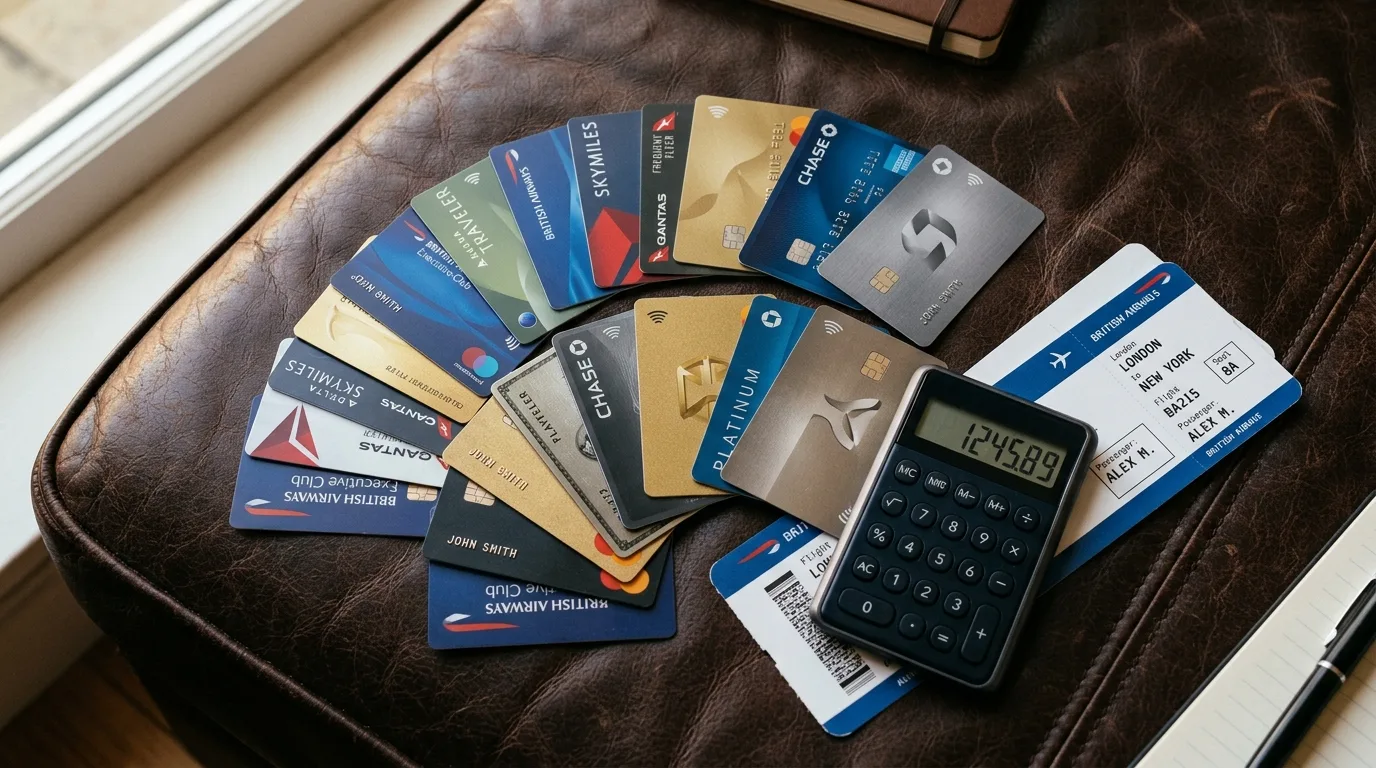
If you're piecing together a trip like that, it's worth splitting the research. For the business class legs, use the CPP framework above. For the economy legs, you're often better off just hunting for low cash fares or using a tool designed for that side of the market.
For economy fare monitoring, FlightKitten does the same kind of price-drop tracking we do at BusinessClassSignal, but focused on economy across 220+ airlines. It's about $4.99/month and handles the grunt work of watching 50 airlines for the same route so you don't have to. If you're planning a mixed itinerary — say, business class outbound and economy on the way back — it's a sensible tool to have running alongside ours.
Points programs with the worst business class redemption value right now
I'll say it plainly: Delta SkyMiles for business class is a mess. Dynamic pricing means the same route can cost 80,000 miles one day and 240,000 miles the next, and the "best" prices are genuinely rare. I've looked at Delta One to London and seen 200,000+ miles for a route where Virgin Atlantic Flying Club would charge 50,000. There's no logic to it. Unless you're sitting on a mountain of SkyMiles with nowhere better to put them, I'd avoid burning them on intercontinental business class in most cases.
United MileagePlus has improved since they moved to dynamic pricing, but "improved" is relative. The sweet spots still exist — mostly on partner carriers like ANA, Singapore, and Lufthansa — but United metal in business class is often priced badly. I booked a United Polaris seat from ORD to FRA last spring and paid 88,000 miles one-way. The cash fare was $2,100. That's 2.4¢ CPP, which is fine but not exciting, especially since Polaris on the 767 is a reasonably good product but not the flattest or the widest seat in that market.
Watch for devaluations before you book
Both Delta and United have devalued their programs multiple times in the last five years, usually with short or no notice. If you're sitting on a large balance and you've identified a redemption you want, book it. Don't wait for a "better time." The better time rarely comes, and the program often gets worse in the meantime.
American AAdvantage is in a complicated place right now. The partner chart is still valuable for specific routes — Cathay Pacific business class from JFK to HKG for 70,000 miles one-way is one of the better deals still available. But AAdvantage has been signaling a shift toward more dynamic pricing, and it's unclear how much of the current chart survives the next 18 months. If you've got AAdvantage miles and a Cathay redemption in mind, I wouldn't wait.
Building a CPP threshold that works for you
Here's how I'd set a personal floor. Think about what you'd realistically do with your points if you didn't spend them on business class. If the answer is:
- Nothing, they'd just sit there: your floor can be low — 1.2–1.5¢ CPP is acceptable
- Economy class redemptions at roughly 1¢: your floor for business class should be at least 1.8¢ to justify the opportunity cost
- Hotel transfers or other travel: this gets complicated, but roughly 1.5–2¢ is a reasonable starting floor
- A specific future aspirational redemption (Cathay first, Singapore Suites, etc.): don't burn them below 2¢ unless the alternative disappears
Calculate your personal CPP floor by looking at the last three things you redeemed points for and averaging the CPP. That's your baseline. Any business class redemption above it is probably worth taking. Any redemption below it deserves more scrutiny.
One thing worth mentioning: if you're booking for two people, the math changes because you're doubling the points required. A 2.5¢ CPP redemption for one person becomes a 1.8¢ effective CPP if the second seat is worse availability (which it often is on partner awards). Always price both seats before committing.
When the fare monitoring approach changes the equation
I want to close on something that doesn't get enough attention in the points world: the value of watching cash fares actively, not just award availability.
Most people treat award booking as a parallel universe — you either have the points or you don't, and if you don't, you pay cash. What I've found, over a lot of bookings, is that the people who get the best outcomes are the ones treating cash fares and award redemptions as genuinely competing options for the same trip. They set alerts on both. They run the CPP math when the cash fare drops. They're not loyal to either method.
BusinessClassSignal monitors over 800 business class routes twice daily and sends alerts when fares drop below your target price. The routes page at browse all routes shows current coverage — there are a lot of transatlantic and transpacific routes on there where the cash price swings $1,500–$2,500 over the course of a few months. Those swings directly affect whether a points redemption makes sense or not.
If you're planning a trip six months out and you're deciding between saving more miles or booking a cash fare when one appears — that's exactly the situation the service is built for. You set your target price, we watch the route, you get an email when the fare hits. The 14-day free trial is genuinely free, no card required, and you can see the how the monitoring system works page if you want to understand what's actually being tracked.
The business class points vs cash decision is one of those things that sounds complicated but really isn't, once you have the right data in front of you. The math is simple. The hard part is watching the right numbers at the right time.
Start monitoring business class fares — 14-day free trial
Try Free