Quick summary
One-way business class pricing follows completely different logic depending on the airline and region. Middle Eastern carriers like Emirates and Qatar often price one-ways at half the round-trip fare, making them the smart choice for flexible itineraries. US carriers almost always punish one-way buyers with inflated fares, so round-trip bookings are the default play. Open-jaw tickets sit in the middle and are frequently the most underused tool in a frequent flyer's kit.
The myth of the simple round-trip
Most people assume business class works like economy: buy a round-trip, save money. And for a lot of routes, that's true. But the moment you start actually watching fares — and I mean really watching them, across carriers and booking windows — you realize the round-trip assumption breaks down faster than a budget airline schedule in August.
I've spent twelve years tracking this stuff, and the single most consistent source of confusion I see from readers is the assumption that one-way business class pricing is always a rip-off. Sometimes it is. But sometimes it's the opposite, and missing that can cost you a lot of money.
The rules vary by carrier, by region, by route, and occasionally by what day of the week the airline's revenue management team decided to run a promotion. There's no single answer here. But there are patterns, and once you know them, you'll stop leaving money on the table.
Why US carriers charge so much for one-ways
Let's start with the most frustrating case, because it's the one most people run into first.
On US airlines — American, United, Delta — one-way business class fares are almost always priced at roughly 65 to 75 percent of the round-trip fare. Not half. Not even close to half. Which means if you're booking two separate one-ways instead of a round-trip, you're often paying 30 to 40 percent more in total.
The logic from the airline's side is pretty transparent: they know that travelers booking one-way international business class are often doing so because they have flexibility they're not willing to give up. Corporate travelers on open-ended assignments. People whose return dates depend on meetings that haven't happened yet. The airline knows you're captive, and they price accordingly.
US carrier one-way trap
On United, Delta, and American, a one-way business class fare to Europe typically costs 65–75% of the round-trip price — not 50%. If you're booking two separate one-ways, do the math before you commit. You might be paying a significant premium for flexibility you don't actually need.
I've seen United charge $3,400 one-way from JFK to London in business, while the round-trip on the same dates was $4,200. Technically the one-way is "cheaper" in isolation, but you're paying $2,600 for the hypothetical return leg that would've cost $800 if you'd just bought the round-trip. That's the trap.
Delta is particularly aggressive on transatlantic routes out of Atlanta. I've monitored ATL-CDG for years and the one-way premium there is almost always significant. The round-trip fare drops during off-peak windows in a way that the one-way fare almost never does.
Does it ever make sense to book one-way on a US carrier?
Yes, but the situations are narrow.
The clearest case is when you're positioning to catch a great deal on the return with a different carrier. Say you find a screaming round-trip deal on Lufthansa from Frankfurt back to the US, and you just need to get to Frankfurt first. Booking a one-way on United to get there and then using the Lufthansa deal for the return can come out ahead, even accounting for the one-way premium on the outbound.
The other case is award travel. If you're mixing cash and miles bookings — paying cash for one direction and using miles for the other — then one-way cash fares are unavoidable. In that scenario, you just have to eat the premium and factor it into whether the miles redemption is actually worth it on the other end.
And occasionally — rarely, but it happens — a US carrier will drop a one-way sale fare that's genuinely competitive. Having alerts set up for those is the only reliable way to catch them. They don't last.
If you must book a one-way on a US carrier, Tuesday and Wednesday departures tend to have slightly lower business class availability at sale prices. Not a guarantee, but worth checking.
Where one-way business class pricing actually works in your favor
Now for the part that surprises most people.
On Middle Eastern carriers — Emirates, Qatar Airways, Etihad — the one-way pricing logic is fundamentally different. These airlines frequently price their one-way business class fares at or very close to exactly half the round-trip price. Which sounds obvious and fair, but it's actually unusual in the industry.
What this means practically: if Qatar Airways is selling a round-trip from JFK to Doha in business class for $5,800, the one-way is often sitting around $2,900. That's not the airline being generous — it's a pricing model built around their hub-and-spoke network. They want to fill seats in both directions through Doha, and they've decided that flexible pricing is how they do it.
I've personally used this to piece together itineraries that would've been far more expensive if I'd tried to book them as a single round-trip on a single carrier. Fly Emirates from LAX to Dubai, spend a few days, then pick up a separate ticket onward to your actual destination. The Emirates one-way fare is clean, fair, and often available in the same sale windows as their round-trip fares.
Gulf carrier one-way strategy
When you find a Gulf carrier round-trip deal, check whether the one-way price is exactly half. If it is, you've got a modular fare — you can mix and match with a return on a different carrier and often come out ahead, especially if you're routing through the Gulf for a stopover anyway.
Singapore Airlines sits in a similar camp, at least on many routes. Their one-way business class fares out of the US to Southeast Asia are often priced more rationally than their US carrier counterparts. Not always 50% of the round-trip, but close enough that the premium for flexibility is minimal.
Emirates specifically has gotten more aggressive on one-way pricing over the last few years, particularly on routes where they're competing with other Gulf carriers. JFK to Dubai is a route worth watching closely if you have any flexibility in your travel dates.Open-jaw tickets: the most underused tool in business class booking
Here's where things get genuinely interesting, and where most casual travelers leave money sitting on the table.
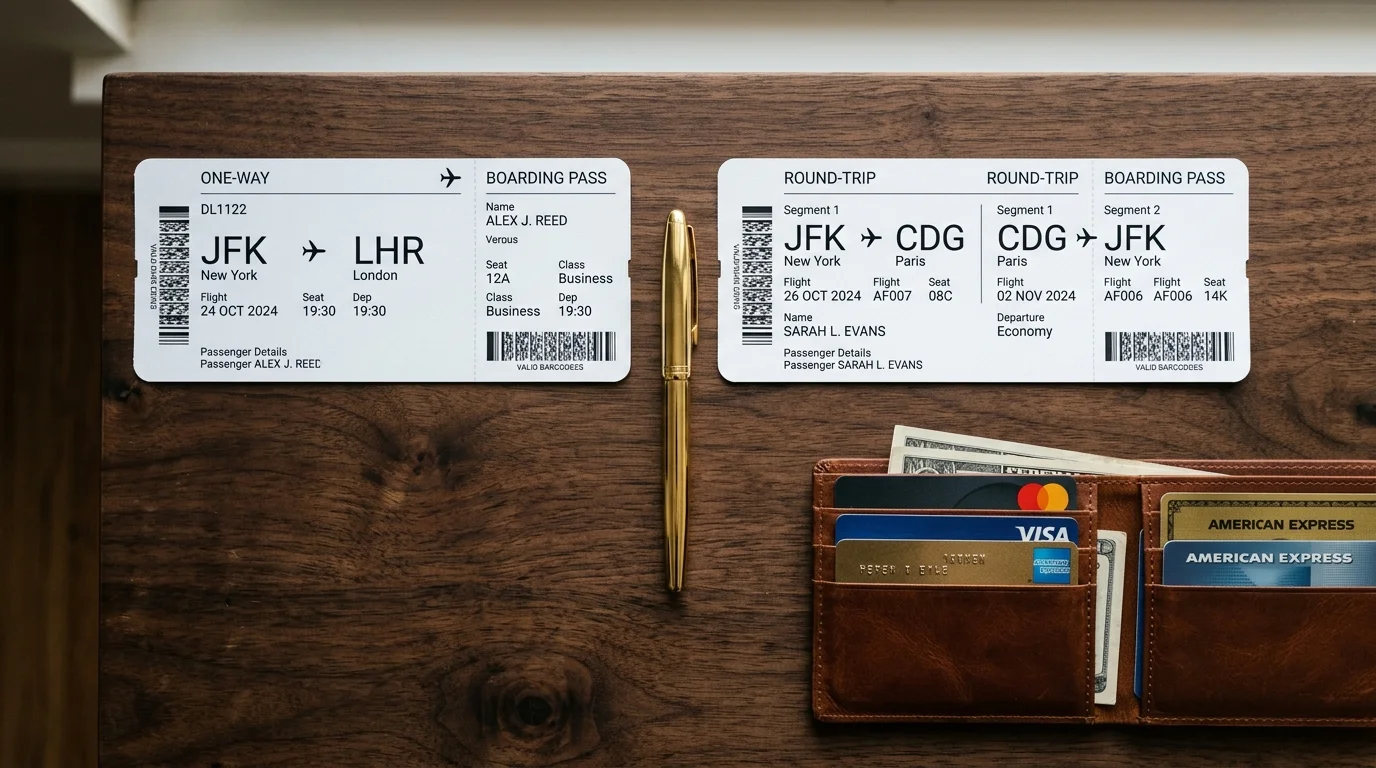
An open-jaw ticket is when you fly into one city and out of a different one. So you fly New York to Paris, and then Rome back to New York. Or New York to Tokyo, and Seoul back to New York. The airline treats it as a round-trip for pricing purposes — which is the key thing — but you get the flexibility of two different cities.
On most carriers, open-jaw tickets are priced at the same level as a standard round-trip, or very close to it. You're not paying the one-way premium. You're getting the round-trip discount. And you've eliminated the need to backtrack.
I find this particularly useful on European itineraries. If I'm spending time in multiple cities, booking a round-trip to one and paying for the internal train or flight to get back is often more expensive than just booking an open-jaw that lets me exit from a different hub. London in, Amsterdam out, for example. The Eurostar cost is real, but it's usually less than what you'd pay for the repositioning.
How do airlines price open-jaw tickets?
The short answer: they average the fares.
The technical version is that most airlines use what's called the "half round-trip" method. They take the round-trip fare for each direction, halve it, and add them together. So if the round-trip NYC-Paris is $4,000 and the round-trip NYC-Amsterdam is $3,600, your open-jaw might be priced at $2,000 + $1,800 = $3,800. Which is cheaper than two separate one-ways, and not much more than the cheapest round-trip.
The catch is that open-jaw pricing isn't perfectly consistent across carriers or booking engines. Some airlines are more generous about it than others, and the pricing can shift based on whether the connecting city is in the same region or across a fare zone boundary.
Double open-jaw
You can sometimes book what's called a "double open-jaw" — flying into one city and out of another on both the outbound and the return. Think: fly New York to London, then Paris back to Los Angeles. Airlines don't advertise this and some booking engines won't surface it easily. Calling the airline directly or using a fare expert often works better than trying to build it online.
For European routes specifically, I've found that Lufthansa and British Airways are both reasonably open-jaw friendly. BA will often let you open-jaw within Europe at little or no premium over a standard round-trip, which is useful if you want to fly into Heathrow and out of Gatwick or into one European city and out of another.
The one frustration with open-jaw on US carriers is that their pricing engines often don't surface the best combinations automatically. You have to know to look for them. And some routes that would theoretically work as an open-jaw get flagged by the system as two separate one-ways, which immediately triggers the pricing penalty.
When building an open-jaw on BA or Lufthansa, try booking via the airline's own site first. Third-party OTAs sometimes mis-price open-jaw itineraries or don't support them at all.
One-way business class pricing and the points angle
This whole conversation changes somewhat when miles and points enter the picture.
Award tickets on most programs are priced per direction. So if you're redeeming miles, a one-way award is almost always exactly half the miles of a round-trip. That makes one-way awards genuinely useful — you're not paying any "one-way premium" in miles. You're just paying proportionally.
Where it gets complicated is when you're mixing cash and miles. Let's say you find a great Qantas points redemption for business class from Sydney to LA, and you want to buy the outbound from LA to Sydney in cash. Now you need a one-way cash fare on the outbound, and if you're looking at US or Australian carriers, the one-way premium reappears.
The cleanest solution I've found is to route the cash leg through a carrier where one-way pricing is fair — usually a Gulf carrier — and save the points redemption for the direction where cash fares are punishingly expensive. That might mean flying Qatar to Asia on cash (where their one-way pricing is sensible) and using miles to come back on a carrier where the cash fare would be brutal.
It requires actually knowing the one-way pricing structure of multiple carriers at once. Which is, admittedly, a lot to keep in your head. It's part of why the monitoring system I built tracks one-way fares separately from round-trips — they behave differently and you need to see them separately to make good decisions.
When to actually book one-way vs round-trip: a practical breakdown
I've given you a lot of variables. Let me try to make this more concrete.
Book round-trip when you're flying on a US carrier and you know your return dates. The pricing almost always favors it, sometimes dramatically. Even if your plans feel uncertain, if there's any chance you'll use the return, the round-trip is usually the right call. Book one-way when you're on a Gulf carrier and your return will be with a different airline or on a separate booking. Emirates, Qatar, and Etihad price one-ways fairly enough that the flexibility is essentially free. Use it. Consider open-jaw whenever you're visiting multiple cities in the same region. Europe especially. Don't pay for a round-trip to Paris if you're going to spend half the trip in Rome — fly into one and out of the other and let the airline treat it as a round-trip for pricing. Mix strategies when you've got a points redemption on one end and a cash fare on the other. Accept the one-way cash fare, but route it through a carrier where the one-way premium is low.The booking window matters too
One-way fares and round-trip fares don't always move together. A round-trip fare might drop during a sale window while the one-way stays flat — or vice versa. If you're monitoring a route, track both. They can diverge by hundreds of dollars and the best structure for your trip can change based on which one moves.
Checking one-way business class pricing without losing your mind
The honest problem with all of this is that it takes time. Checking one-way fares, round-trip fares, and open-jaw combinations across multiple carriers, on multiple date combinations, is genuinely tedious. Most people don't do it because they don't have the time, not because they don't care.
What I'd recommend as a starting point: pick your route and your approximate dates, then check the round-trip fare on the primary carrier for that route. Then check the one-way fare on the same carrier. Calculate what two one-ways would cost versus the round-trip. If the one-way is more than 55% of the round-trip, the round-trip wins — go with it or look at alternate carriers.
Then, separately, check whether a Gulf carrier serves the route. If they do, pull their one-way fare and see how it compares. On a lot of transatlantic and transpacific routes, there's a Gulf carrier option that's priced much more transparently, even if the routing adds a connection.
The frustrating truth is that this comparison doesn't happen automatically on any booking platform I've found. Google Flights will show you one-ways and round-trips, but it won't compare them intelligently or flag when the one-way pricing is unusually fair or unfair. That's a gap I built BusinessClassSignal to help fill — the system monitors both one-way and round-trip fares on your routes and alerts you when either drops below your target. It won't make the decision for you, but it means you're not manually refreshing flight search pages every other day hoping to catch a drop.
BusinessClassSignal scans over 800 business class routes twice daily, tracking one-way pricing separately from round-trip fares. If you're the kind of person who actually cares about this stuff, the 14-day free trial is worth running while you're planning a trip — at minimum you'll learn what the fare patterns on your route actually look like.
Monitor one-way and round-trip business class fares on your route — 14-day free trial, no credit card required
Try FreeOne last thing about flexibility and what it actually costs
There's a real cost to flexibility in business class booking, and it varies wildly depending on who you're flying with.
On US carriers, that cost is high. You're paying a meaningful premium for the ability to leave your return date open, and a lot of travelers pay it without realizing they're paying it at all.
On Gulf carriers, the cost of flexibility is close to zero. Which is one of the reasons those carriers have built such a loyal following among frequent international travelers — it's not just the product, it's that the pricing treats you like an adult.
Open-jaw sits somewhere in the middle: you get geographic flexibility essentially for free, but temporal flexibility (leaving the return date open) still costs you on most carriers.
Knowing which type of flexibility you actually need — and matching it to the carrier whose pricing model rewards that — is where the real savings are. Not in obsessively hunting for the lowest headline fare, but in understanding the structure well enough to know which booking format fits your trip.
That's the stuff that doesn't show up in a fare comparison chart. But once you've internalized it, you start seeing it everywhere.