Quick summary
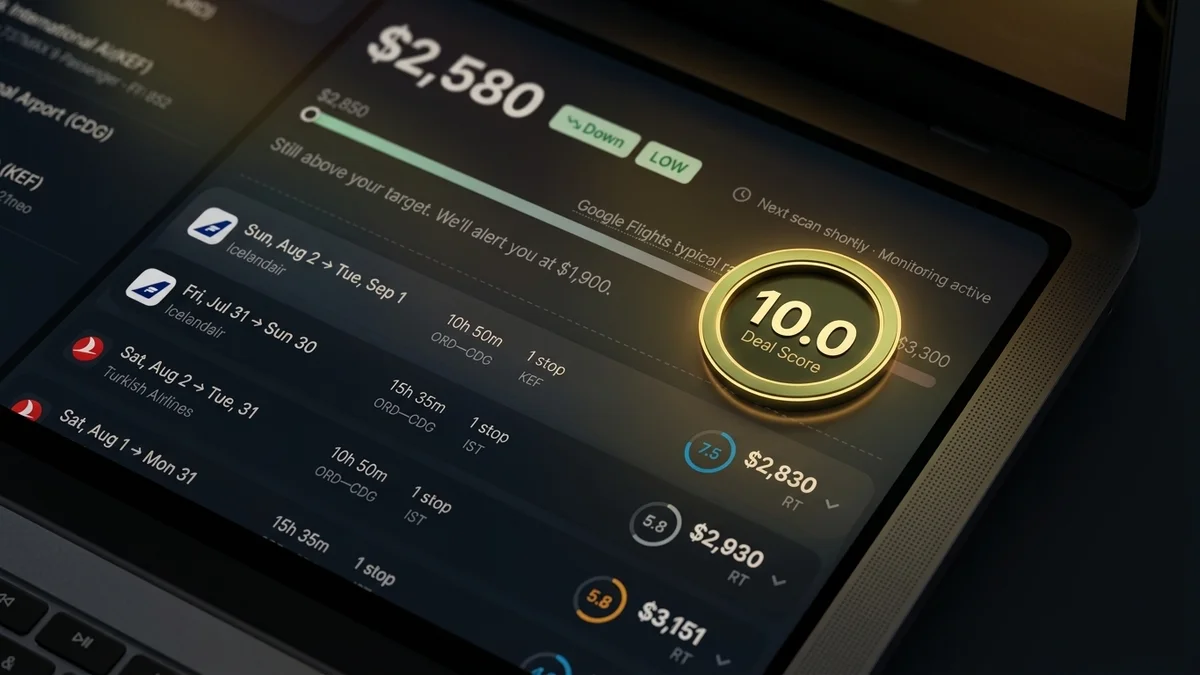
Business class fares drop unpredictably — sometimes by $1,500 or more — and they rarely stay low for more than a few hours. Automated fare monitoring watches your target routes around the clock and alerts you the moment a price crosses your threshold, so you're not the person who missed a $1,800 JFK–LHR round-trip because you checked on the wrong Tuesday. BusinessClassSignal scans 800+ business class routes twice daily and sends alerts when prices drop below whatever number you set.
The math on manual checking doesn't work
Here's how it usually goes. You've got a trip in mind — say, New York to London in March. You check Google Flights on a Monday morning, see $4,200 round-trip in business, wince, and close the tab. You check again Thursday. Still $4,100. You check Sunday night after dinner, it's $3,800, which feels better but you're not sure if it'll drop more, so you wait.
Then your colleague mentions she got it for $2,100 last week.
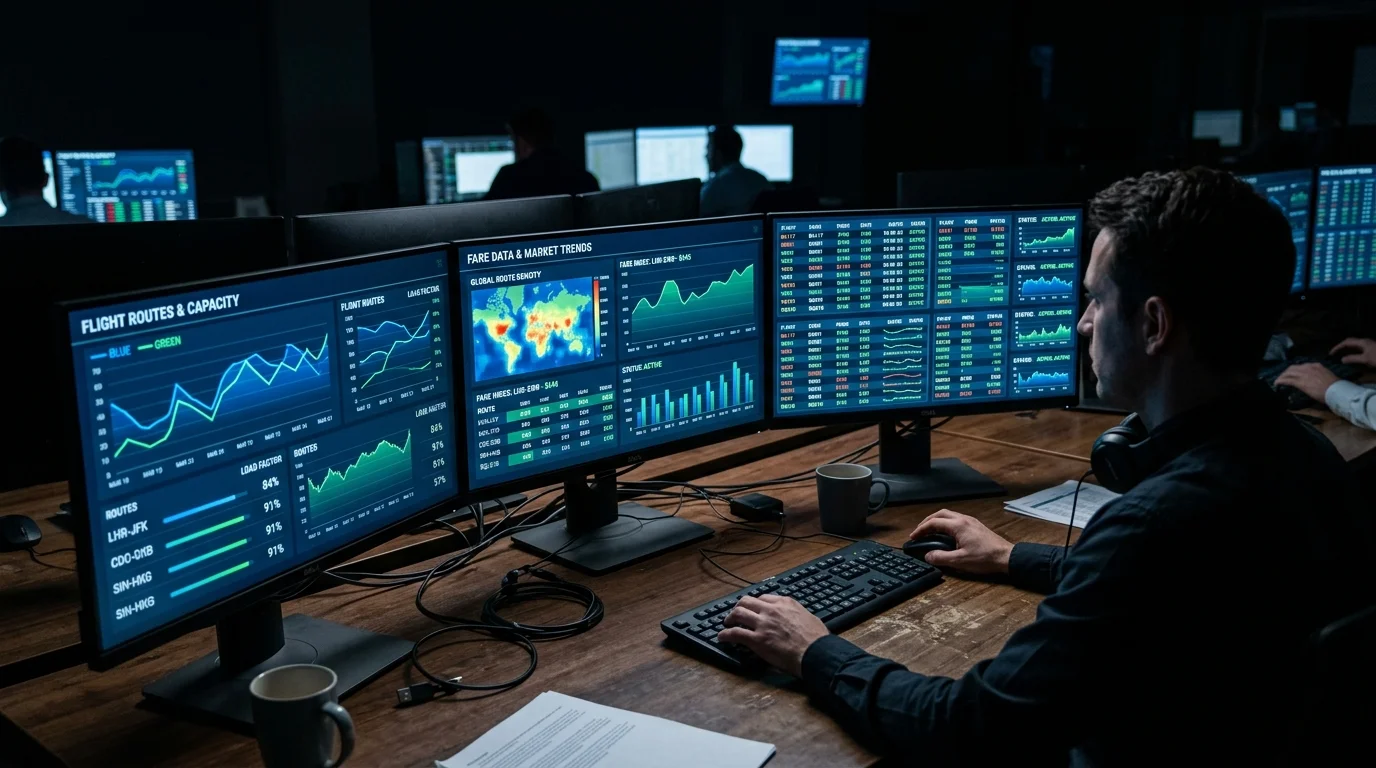
That's not bad luck. That's the structure of how airline pricing works. Revenue management systems are constantly repricing inventory based on load factors, competitive pressure, and a dozen other variables you don't have visibility into. Fares can drop for six hours on a Wednesday afternoon and then bounce back up before you've even opened your laptop. If you're checking manually — even obsessively — you're playing a game where the house controls the clock.
I've been watching business class pricing since 2012. I've personally flown 200-plus business class segments and I've tracked fares on probably twice that many routes. The single most consistent pattern I've seen: the people who get the genuinely good prices are almost never the ones who checked more diligently. They're the ones who had a system that was watching when they weren't.
What automated fare monitoring actually is
Automated fare monitoring is exactly what it sounds like: software that checks flight prices on a defined schedule, compares them against a threshold you've set, and contacts you when the price drops below that number. No browser tabs. No calendar reminders. No checking at 11pm just in case.
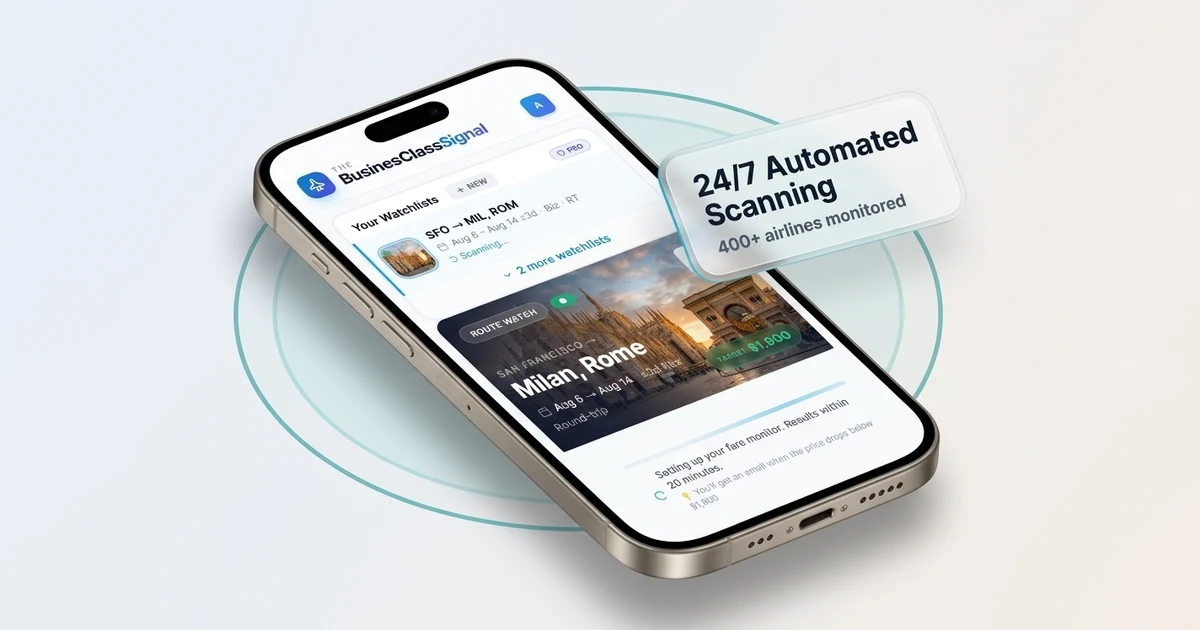
BusinessClassSignal is a fare monitoring service built specifically for business and first class routes. It scans 800+ routes twice daily — more frequently on routes that show higher price volatility — and sends email alerts when fares drop below your target price. You tell it the route, the rough travel window, and the price that would make you book. It does the rest.
What it doesn't do is book for you, or make promises about how low a fare will go. I want to be honest about that. It's a monitoring tool, not a magic wand. But having accurate, timely information is most of the battle.
How often do business class fares actually drop significantly?
More often than most people think, and less predictably than anyone would like.
On high-volume transatlantic routes — JFK–LHR, EWR–CDG, IAD–FRA — I've seen business class fares drop $800 to $1,500 below standard retail at least once a month on average. Sometimes more. The drops tend to cluster around specific conditions: an airline is sitting on unsold premium inventory inside 60 days, a competitor just dropped their fare and triggered an automated match, or a corporate travel season is winding down and leisure demand hasn't filled the gap yet.
The Pacific routes are a bit different. LAX–NRT, SFO–HKG, SEA–ICN — these tend to have fewer but larger drops. When a good fare appears on a long-haul Pacific business class route, it's often genuinely exceptional. I've seen SFO–SYD in business class drop to $2,400 round-trip for a few hours. That kind of thing doesn't repeat itself if you blink.
Domestic premium routes — think JFK–LAX, ORD–SFO — drop more frequently but with smaller absolute savings. Still worth monitoring if you're flying them regularly.
The cost of checking manually (and I mean the real cost)
There's the obvious cost: you miss deals. But there's a less obvious one, and it's the one that actually grinds people down.
Checking fares manually is genuinely time-consuming if you're doing it right. You're not just hitting one website — you're cross-referencing the airline direct site, Google Flights, maybe a couple of OTAs to see if there's a gap. You're doing this across multiple dates because the cheapest business class fare on a given route might be Tuesday departure, not Friday. You're bookmarking things, opening old tabs, trying to remember what the price was three days ago.
I've talked to readers who were spending 45 minutes a day checking fares for an upcoming trip. That's over five hours a week. For weeks. And they still missed the drop.
That's not a character flaw. That's just the limits of human attention versus an algorithm that doesn't sleep or get distracted.
The window is shorter than you think
Most significant business class price drops last between 4 and 24 hours before the fare reverts or sells out. If you're checking once a day — or less — you're statistically likely to miss most of them entirely.
Is automated fare monitoring worth it for occasional travelers?
The honest answer is: it depends on your price sensitivity and how far in advance you plan.
If you're flying business class twice a year and you're booking with points anyway, monitoring cash fares matters less. But if you're paying cash — or if you're using a mix of cash and miles — and you've got some flexibility in your travel dates, the math gets interesting fast.
Let's say you're planning a trip to Tokyo from Los Angeles in the fall. Standard business class round-trip on a major carrier hovers around $4,500 to $5,500 depending on the month. A monitored fare alert catches a drop to $2,900 on the dates that work for you. That's a saving of $1,600 to $2,600 on a single booking. BusinessClassSignal's annual plan costs $99. The arithmetic isn't complicated.
For frequent business travelers — people doing six or more international premium trips a year — automated fare monitoring isn't a nice-to-have. It's a basic tool, like a VPN or a good carry-on. You'd be surprised how many people in that category are still checking fares by hand out of habit.
What it actually feels like to catch a drop
I want to make this concrete rather than abstract, because I think "fare alert" sounds more passive than it actually is in practice.
Picture this: it's a Tuesday morning. You're at your desk. An email lands — subject line something like "LAX → NRT dropped to $2,780 round-trip (your target: $3,000)." You click through, confirm the dates work, and you're on the airline's site booking within three minutes. Total active time on your part: maybe eight minutes, including the booking flow.
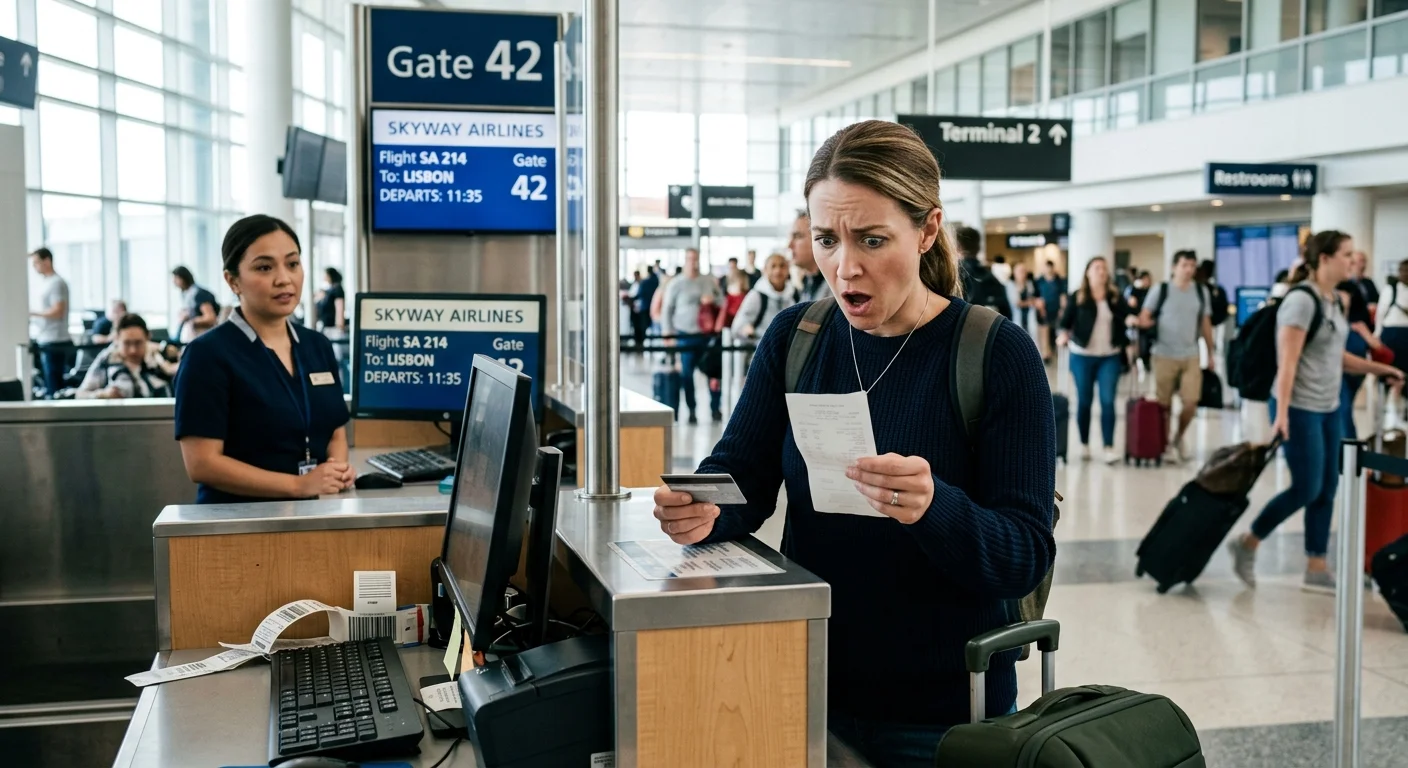
Compare that to a reader I heard from last year — a consultant who travels to Europe six times annually. He'd been manually checking London fares for a trip in October, watching BA and Virgin Atlantic on alternate days. He was targeting around $2,500. He missed a drop to $2,100 on a Friday afternoon because he was in back-to-back meetings. By the time he checked Saturday morning, it was back to $3,400. He ended up booking at $2,950 a week later, figuring that was close enough.
He signed up for BusinessClassSignal before his next trip. Caught a drop to $2,200 on a Frankfurt routing he hadn't even considered. Saved over $700 compared to what he'd been planning to spend.
That's not a dramatic story. It's just what happens when you stop relying on yourself to be in the right place at the right time and let a system handle the watching.
Set your target price 10–15% below what you'd consider a "good" fare on your route. You want the alert to fire when it's genuinely worth acting on, not every time there's a minor fluctuation.
How to set up monitoring that actually works
The setup side of this is worth being specific about, because I've seen people configure fare alerts in ways that make them nearly useless.
The most common mistake: setting your target price too close to current retail. If business class on your route is sitting at $3,800 and you set an alert for $3,600, you'll either get a lot of noise from minor fluctuations or you'll catch drops that aren't actually good enough to act on. You want your threshold to represent a fare that genuinely moves the needle for you.
Second mistake: monitoring too narrow a date window. Business class fare drops don't always fall on the exact dates you originally had in mind. If you've got a three-day window of flexibility — even just being able to depart Thursday versus Friday, or return a day earlier — you significantly increase the probability of catching something useful. The monitoring system at BusinessClassSignal lets you set a date range rather than a single departure date, which is how most serious users run it.
Third thing people get wrong: monitoring only the obvious direct routes. If you're flying New York to Rome, the direct flight is the convenient option, but the fares with a connection through another European hub — Heathrow, Amsterdam, Zurich — often drop independently and can be substantially cheaper. Worth having alerts on both.
Route tip for transatlantic monitoring
On New York–Rome specifically, watch the LHR connection on British Airways and the AMS connection on KLM/Air France. These two routing options frequently drop at different times from the direct Alitalia/ITA and Delta nonstops, and the connection time at Heathrow T5 or Schiphol in business class is genuinely comfortable.
One more thing worth knowing: the full list of monitored routes at BusinessClassSignal is broader than most people expect. It's not just the major transatlantic corridors. There are South American routes, Southeast Asian routes, routes to East Africa that most fare-monitoring services don't bother with. If you're flying a less-traveled business class route, it's worth checking whether it's covered before assuming it isn't.
Why 2026 specifically makes automated fare monitoring more relevant
Airline pricing has always been chaotic. But there are a few things converging right now that make manual checking even less effective than it used to be.
Revenue management software has gotten substantially more sophisticated over the past few years. Airlines are repricing inventory more frequently, in smaller increments, in response to real-time demand signals. The days of a fare sitting at a given price for 48 hours are increasingly rare on competitive routes. Prices can move multiple times in a single day.
At the same time, the number of people monitoring business class fares has gone up. More travelers have figured out that good prices exist and are worth hunting for. That means the window between a fare dropping and inventory at that price selling out has gotten shorter. Being 12 hours late used to be survivable. Now it often isn't.
There's also the proliferation of routes. More airlines are flying more international routes than five years ago, which is genuinely good for competition and pricing — but it also means more combinations to watch. You can't manually track all the carriers that now serve a given city pair.
None of this means the deals have disappeared. They haven't. But the mechanism for catching them has shifted. Human attention can't keep pace with algorithmic pricing. The only sensible response is to fight algorithms with algorithms — or at least, with a monitoring service that runs on a schedule and doesn't have better things to do.
The limits of automated fare monitoring (being honest about this)
I've been running BusinessClassSignal for several years now, and I'd rather be straight with you about what automated fare monitoring can and can't do than oversell it.
It won't guarantee you the lowest possible price. There's no tool that can do that, because no one has full visibility into every fare across every channel simultaneously. What it does is give you a significant edge over checking manually, and it removes the luck element from the timing.
It also won't help you much if you have zero date flexibility. If you absolutely must fly on a specific date — a wedding, a conference with a hard start — monitoring is still worth doing, but the odds of a drop on that exact date are lower than if you can shift by a few days. That's just the reality.
And alerts require action. I've had readers tell me they got an alert, meant to book, got distracted, and came back two hours later to find the fare gone. That's not a failure of the monitoring — that's the nature of limited inventory at sale prices. When you get an alert on a fare you want, you have to move. Have your payment details ready. Know which dates work. Don't sit on it.
A note on award space
BusinessClassSignal monitors cash fares, not award availability. If you're primarily a miles-and-points traveler, the service is less directly relevant — though the cash prices we track can still be useful as a reference point for whether your redemption is actually getting you good value.
Using automated fare monitoring as part of a broader booking strategy
The people who get the best results from fare monitoring tend to use it as one layer of a broader approach rather than a silver bullet.
They book early when prices are genuinely good, rather than waiting indefinitely for something better. They use monitoring to catch drops after they've booked, in cases where the airline allows free changes (which is increasingly common in business class). They set alerts on a few different routing options for the same trip, not just their first choice.
Some of them also use the monitoring data to get a better read on what "normal" pricing looks like on a route before they book. If you've been watching JFK–LHR for six weeks and the lowest you've seen is $2,400, that tells you something. If you've seen it hit $1,900 twice, that tells you something different.
I've also found — and this is something I've written about more in the piece on timing business class bookings — that monitoring a route for four to six weeks before you need to book gives you a much better calibrated sense of what to expect. You stop second-guessing yourself when a good fare appears because you've seen the range.
British Airways business class on transatlantic routes, for example, tends to have more frequent price drops than Lufthansa but the drops are shallower. Knowing that in advance shapes how you set your alert threshold.The goal isn't to optimize forever. It's to book with confidence when the price is genuinely good, rather than booking anxiously at full retail or spending weeks in a state of perpetual tab-checking. That's what a well-configured monitoring setup actually gives you: not just savings, but a cleaner decision-making process.
After you book, keep your alert active. If the fare drops further and you're on a ticket that allows free changes, you can rebook at the lower price. This works more often than people realize, especially on flexible business class fares.
If you haven't tried it yet, BusinessClassSignal offers a 14-day free trial — no credit card required at signup. You pick your routes, set your thresholds, and see whether the alerts fire on prices you'd actually book. It either works for you or it doesn't. But I'd rather you find out with two weeks of free monitoring than spend another month checking tabs.
Start monitoring business class fares — 14-day free trial, no credit card required
Try Free